
American Barbell Dumbbells & Kettlebell Budget Guide
Compare the value of American Barbell dumbbells against cast iron and competition kettlebells. A detailed budget breakdown for your home gym free weights.

The Free Weight Budget Dilemma: Dumbbells vs. Kettlebells
Building a comprehensive home gym in 2026 requires strategic capital allocation, especially when navigating the premium free weights market. When buyers research top-tier equipment, American Barbell dumbbells frequently set the gold standard for durability, precise weight calibration, and ergonomic knurling. However, as training methodologies evolve to include more ballistic movements, unilateral offsets, and metabolic conditioning, lifters inevitably face a critical crossroad: should you continue investing in traditional dumbbells, or pivot your budget toward kettlebells?
If you are leaning toward kettlebells, a second dilemma emerges. Do you purchase standard cast iron kettlebells, or do you pay the premium for uniform competition-grade steel bells? This guide provides a deep-dive budget breakdown and value analysis, comparing the cost-per-pound and long-term utility of American Barbell dumbbells against both cast iron and competition kettlebells to help you maximize your equipment ROI.
The Baseline: Pricing American Barbell Dumbbells
To understand the value proposition of kettlebells, we must first establish a baseline using premium dumbbells. American Barbell is renowned for its commercial-grade urethane and chrome dumbbells. As of 2026, purchasing American Barbell urethane dumbbells directly or through authorized commercial dealers typically costs between $2.80 and $3.50 per pound.
- Pros: Exceptional knurl patterns, neutral grip for joint health, independent hemispheres allowing for natural rotational movement during presses and rows.
- Cons: High cost per pound; bulky storage requirements for a full 5-to-100 lb set; unsuitable for high-velocity ballistic swings due to the grip geometry.
While American Barbell dumbbells remain an unparalleled staple for isolation work and traditional hypertrophy, they cannot safely or effectively replicate the offset center of mass required for kettlebell swings, snatches, and Turkish get-ups. This necessitates a dedicated kettlebell budget.
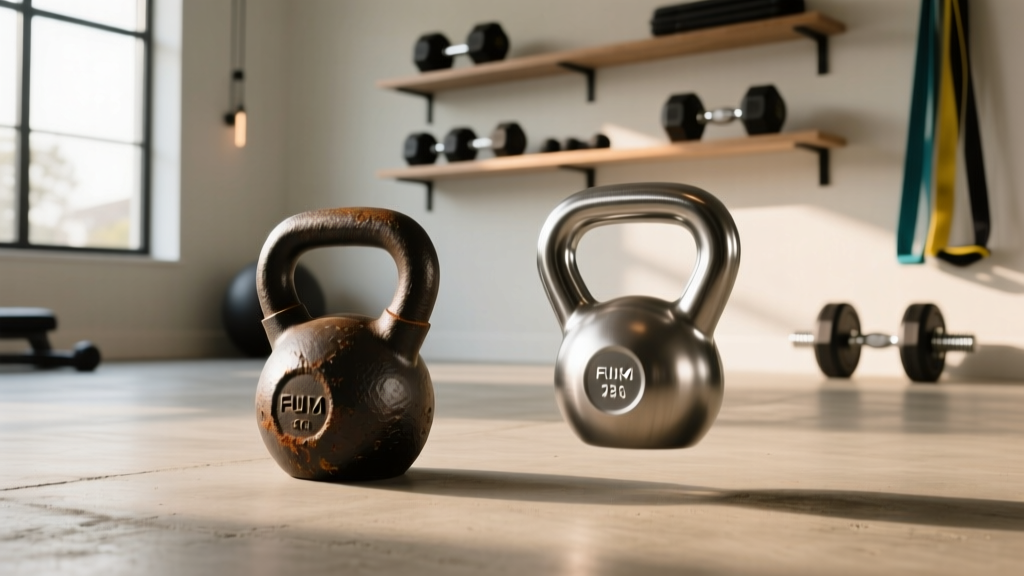
Cast Iron Kettlebells: The Budget-Friendly Workhorse
Cast iron kettlebells are the most common entry point for home gym owners. Brands like Rogue Fitness, Kettlebell Kings, and Rep Fitness dominate this space. The manufacturing process involves pouring molten iron into a mold, resulting in a solid, single-piece bell.
Cost and Specifications
Cast iron bells generally range from $1.50 to $2.50 per pound. A high-quality 24kg (53 lb) cast iron kettlebell will cost roughly $90 to $110. When evaluating cast iron, the finish is the primary differentiator in value:
- Powder Coat (High Value): Brands like Rogue use a matte powder coating that grips chalk exceptionally well and resists rust. This is the gold standard for cast iron.
- Enamel or Paint (Low Value): Cheaper imports often use glossy enamel. This finish chips easily upon impact with other weights or concrete, leading to rust and a degraded grip.
Expert Insight: According to Garage Gym Reviews, the handle diameter on cast iron bells scales with weight. A 12kg bell might have a 32mm handle, while a 32kg beast can exceed 35mm. Furthermore, the 'horns' (the sides of the handle) flare outward on heavier cast iron bells to accommodate the larger mold, which can crowd your forearms during double-kettlebell front squats or cleans.
Competition Kettlebells: The Premium Standard
Competition kettlebells are engineered for the sport of Kettlebell Lifting (Girevoy Sport) and high-volume technical work. Regardless of whether the bell weighs 8kg or 48kg, the physical dimensions remain exactly the same: 228mm in height and 210mm in width. The handle diameter is strictly locked at 33mm.
Why the Price Premium?
Competition bells typically cost between $4.50 and $6.50+ per pound. A 24kg competition bell will easily set you back $220 to $260. The high cost is driven by the manufacturing complexity. Because the shell size is uniform, lighter bells are hollow and must be filled with dense materials (like steel shot or specialized composites) to reach the target weight without rattling, while heavier bells are solid steel.
- Motor Patterning: Because the dimensions never change, your central nervous system maps the exact same spatial geometry for a 16kg snatch as it does for a 24kg snatch. You only adapt to the load, not the equipment.
- Horn Geometry: The horns are narrower and more rectangular than cast iron bells, providing a perfect 'rack' position on the forearm without bruising the wrist.
Competition bells are made of smooth steel. Unlike powder-coated cast iron, bare steel becomes incredibly slick when exposed to sweat. If you are programming high-rep snatches or swings with competition bells, you must budget for high-quality lifting chalk and anticipate the learning curve of managing a slick handle. Cast iron's porous powder coat is vastly superior for chalkless, high-friction grip.
Head-to-Head Budget Breakdown (2026 Pricing Matrix)
To visualize the financial commitment, let us compare the cost of building a foundational 3-bell setup (16kg, 24kg, 32kg) across the three equipment categories. Data reflects average direct-to-consumer pricing before freight shipping.
| Equipment Type | 16kg (35 lb) | 24kg (53 lb) | 32kg (70 lb) | Avg $/lb |
|---|---|---|---|---|
| Cast Iron Kettlebells | $65 | $95 | $125 | $1.80 |
| Competition Kettlebells | $160 | $240 | $310 | $4.95 |
| American Barbell Dumbbells (Pairs) | $195 (Pair) | $295 (Pair) | $385 (Pair) | $2.90 |
Note: Dumbbell prices reflect the cost of a matched pair, which is the standard usage for hypertrophy, whereas kettlebells are often purchased as singles for unilateral ballistic work.
Real-World Failure Modes & Edge Cases
When analyzing value, you must account for how equipment degrades over time. As highlighted in BarBend's extensive kettlebell testing, not all bells age gracefully.
1. The Flat-Spot Hazard (Cast Iron)
Cheaper cast iron kettlebells often have a rounded base edge rather than a machined flat spot. Over time, or if dropped on uneven garage flooring, these bells can develop a 'roll'. A rolling 32kg kettlebell during a missed snatch is a severe safety hazard. Premium cast iron bells feature CNC-machined flat bases to prevent this.
2. Filler Rattle (Competition)
Low-tier competition bells use sand or cheap epoxy fillers to achieve target weights in lighter bells. Within 6 months of hard drops, the filler settles or cracks, resulting in an annoying rattle and a shifted center of mass. Always verify that a competition brand uses steel shot or solid steel construction for their lighter weights.
3. Handle Slickness vs. Knurl Bite
American Barbell dumbbells feature a moderate, grippy knurl that bites into the skin securely without tearing calluses. Cast iron relies on texture and chalk. Competition steel is entirely smooth. If you train in a humid environment or sweat heavily, competition bells will require constant maintenance and chalk application, which some home gym owners find messy and inconvenient.
Final Verdict: Where Should Your Budget Go?
Your budget allocation should be dictated by your primary training stimulus:
- Choose American Barbell Dumbbells if: Your primary goal is muscle hypertrophy, bodybuilding, and controlled tempo work. The independent movement and secure knurling justify the $3.00/lb investment.
- Choose Cast Iron Kettlebells if: You are focused on general physical preparedness (GPP), CrossFit-style conditioning, and heavy two-handed swings. The powder-coated grip and lower price point ($1.80/lb) offer the highest ROI for the average home gym owner.
- Choose Competition Kettlebells if: You are practicing Girevoy Sport, performing high-rep unilateral snatches/jerks, or have sensitive wrists that require the precise, uniform rack position of a 33mm steel handle. You are paying a 150% premium for dimensional consistency.
Frequently Asked Questions
Can I use dumbbells instead of kettlebells for swings?
While you can perform dumbbell swings by holding the head of a single dumbbell, the grip geometry limits the hip hinge depth and places unnatural shear stress on the wrist at the top of the arc. A kettlebell's offset center of mass is biomechanically superior for ballistic hinging.
Do competition kettlebells rust?
High-quality competition bells are made of steel and are often painted or powder-coated on the main body, but the handle is usually left as bare, polished steel to prevent chipping. The bare steel handle will develop surface oxidation (rust) if not wiped down and occasionally oiled, especially in humid garages.
What is the best starter weight for kettlebells?
For men with a baseline of strength training, a 16kg (35 lb) bell is the universal starting point for learning the swing and the Turkish get-up. For women, a 12kg (26 lb) bell is generally recommended to learn the mechanics before scaling up to 16kg.
More gear to consider
All reviews
Leg Exercises with Dumbbells and Barbells: Barbell Knurl Setup Guide
Cast Iron vs Competition Kettlebells: No Dumbbell Bicep Workout

Barbell Collar and Clamp Types Comparison: Moving Past 'Dumbbell Squats Work Which Muscles'

Upgrade Your 45 Minute Upper Body Dumbbell Workout: Barbell Knurl Guide

Bumper vs Iron Plates & Best Glute Exercise with Dumbbells
