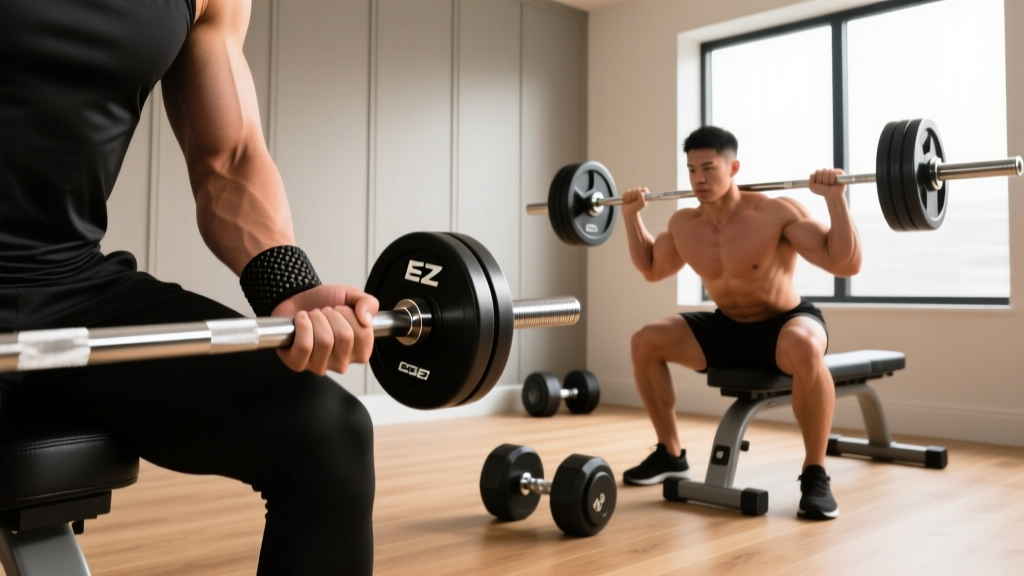
EZ Curl Bar vs Straight Bar: Trends & Dumbbell Chest Flys Data
Explore the 2026 EZ curl bar vs straight bar market trends, sales data, and biomechanics, plus how this shift impacts dumbbell chest flys routines.

The 2026 Upper-Body Isolation Market Shift
The free weights market in 2026 is defined by hyper-specialization and joint-longevity engineering. Gone are the days when a single straight Olympic barbell sufficed for an entire upper-body regimen. While foundational hypertrophy movements like dumbbell chest flys continue to dominate the adjustable dumbbell and pec-deck sectors—driven by consumers seeking optimal pectoral stretch without cable-system limitations—the arm and shoulder isolation market is undergoing a massive hardware evolution. Home gym owners and commercial facility managers are increasingly pivoting toward specialized barbells to mitigate repetitive strain injuries.
This trend report analyzes the technical, biomechanical, and market-driven differences between the EZ curl bar and the standard straight bar, providing a data-backed purchasing framework for serious lifters and gym operators.
Biomechanics & Joint Torque: A Technical Comparison
The primary divergence between a straight bar and an EZ curl bar lies in wrist supination and the resulting valgus/varus stress placed on the elbow joint. According to biomechanical analyses from ExRx on bicep curl mechanics, a fully supinated grip (180 degrees) maximizes short-head bicep activation but forces the radius and ulna into an unnatural parallel alignment under heavy loads.
| Metric | Olympic Straight Bar | Olympic EZ Curl Bar |
|---|---|---|
| Shaft Diameter | 28.5mm - 29.0mm | 25.0mm - 28.0mm |
| Grip Angle | 180° (Fully Supinated/Pronated) | 120° - 140° (Semi-Supinated) |
| Wrist Torque | High (Requires extreme mobility) | Low (Aligns with natural carry angle) |
| Primary Failure Mode | Wrist impingement / Ulnar deviation | Reduced short-head bicep peak contraction |
| Average Weight (Unloaded) | 44 lbs (20 kg) | 25 lbs - 35 lbs (11.3 - 15.8 kg) |
The Edge Case: Heavy Skull Crushers and Tendinopathy
When programming heavy tricep extensions (skull crushers) in the 80lb to 135lb range, using a straight bar frequently leads to medial epicondylitis (golfer's elbow). The forced pronation required to hold a straight bar overhead places immense sheer force on the common flexor tendon. The EZ curl bar's 120-degree angled grips allow for a semi-neutral hand position, distributing the load across the brachioradialis and tricep lateral head, effectively bypassing the elbow's weakest structural link.
Metallurgy, Knurling, and 2026 Manufacturing Standards
Market leaders have drastically improved the metallurgy of specialty bars over the last three years. In 2026, the baseline tensile strength for a high-quality straight bar is 190,000 PSI, with powerlifting variants pushing 205,000 PSI. However, manufacturing an EZ curl bar introduces 'stress risers'—microscopic weak points where the steel is bent into angled grips.
🔬 2026 Material Science Insight: To counteract bending stress, premium manufacturers now utilize proprietary heat-treating processes for EZ bars, maintaining a 190,000 PSI tensile strength without making the shaft brittle. Cheaper import models (often found under $99) skip this tempering, leading to permanent shaft deformation when loaded beyond 150 lbs.Knurl Depth and Coating Technologies
The tactile experience of the bar is dictated by knurling depth and surface coating. Straight bars designed for heavy compound lifts (like the Rogue Ohio Bar) typically feature a 1.5mm deep knurl with aggressive 'volcano' patterns to prevent grip slip during heavy deadlifts and bench presses. Conversely, EZ curl bars prioritize comfort for high-rep isolation work, utilizing a shallower 1.0mm to 1.2mm knurl.
- Hard Chrome: The gold standard for straight bars. Offers superior corrosion resistance (surviving 1,000+ hour salt spray tests) and preserves knurl sharpness.
- Black Zinc: Common on mid-tier EZ bars. Provides a sleek aesthetic but degrades within 12-18 months of heavy use, leaving the underlying steel vulnerable to oxidation.
- Cerakote / E-Coat: The dominant 2026 trend for specialty bars. Offers military-grade corrosion resistance and allows for color-coded gym racks, though it can slightly dull aggressive knurling if applied too thickly.
Market Leaders & Pricing Analysis
The price gap between straight bars and EZ curl bars has narrowed as supply chains have stabilized. Below is a snapshot of the premium commercial-grade market in 2026.
| Brand & Model | Type | Tensile Strength | Coating | 2026 MSRP |
|---|---|---|---|---|
| Rogue Ohio Bar | Straight (Multi-Purpose) | 190k PSI | Hard Chrome / Black Zinc | $295.00 |
| Rogue EZ Curl Bar | Specialty (Angled) | 190k PSI | Hard Chrome / E-Coat | $245.00 |
| Eleiko Olympic Bar | Straight (Weightlifting) | 215k PSI | Hard Chrome | $895.00 |
| REP Fitness EZ Bar | Specialty (Angled) | Unspecified (Est. 160k) | Black Zinc | $129.99 |
For commercial gym owners, the Rogue EZ Curl Bar remains the highest ROI asset in the specialty category, balancing elite metallurgy with a price point that allows for purchasing multiple units to prevent member bottlenecks during peak arm-day hours.
The Displacement Effect: How Specialty Bars Change Gym Routines
An intriguing trend in 2026 fitness data is the 'displacement effect' in upper-body programming. Lifters who previously relied entirely on adjustable dumbbells for both chest and arm isolation are diversifying. While adjustable dumbbells (like the Nuobell or PowerBlock Pro series) remain unmatched for movements requiring a deep, unilateral stretch—such as dumbbell chest flys—they fall short in micro-loadability and bilateral stability for heavy arm work.
Dumbbells maxing out at 50 to 90 lbs force advanced lifters to make massive 10-lb or 15-lb jumps, which is detrimental to elbow tendons during isolation exercises. The EZ curl bar, paired with fractional plates (0.5 lb to 2.5 lb), allows for precise progressive overload. Consequently, modern hypertrophy programs now frequently pair dumbbell chest flys for pec development with EZ curl bar extensions for tricep mass, leveraging the unique mechanical advantages of both tools.
The Buyer’s Decision Matrix
Choosing between a straight bar and an EZ curl bar should not be an 'either/or' decision for a fully equipped 2026 home gym, but budget and space constraints often force a choice. Use this framework to guide your investment:
Buy the Straight Bar If:
- Your programming centers around the 'Big Three' powerlifts (Squat, Bench, Deadlift).
- You require a 28.5mm or 29mm shaft diameter to train grip strength for strongman or Olympic weightlifting.
- You need dual knurl marks (IPF and IWF spacing) for precise hand placement on bench presses.
Buy the EZ Curl Bar If:
- You have a history of wrist impingement, TFCC tears, or medial epicondylitis.
- Your primary goal is upper-body hypertrophy (biceps, triceps, and front deltoids) rather than maximal strength.
- You frequently program skull crushers, upright rows, or reverse curls, where a pronated/semi-neutral grip is mandatory for safety.
Final Market Verdict
The 2026 free weights market has definitively proven that specialization yields better long-term physical outcomes. While the straight bar remains the undisputed king of systemic, full-body loading, the EZ curl bar has captured the lion's share of the upper-body isolation market. By understanding the exact biomechanical loads, metallurgy standards, and pricing structures outlined above, lifters and gym owners can build smarter, more joint-friendly arsenals that complement foundational movements and maximize hypertrophic gains.
More gear to consider
All reviews
Home Barbell Gym Maintenance: EZ Curl Bar vs Straight Bar Care

EZ Bar vs Straight Bar: Gold's Gym Dumbbell Value Comparison

Best 50 Pound Dumbbells Set of 2: 2026 Setup & Comparison Guide

Neoprene Weights Guide: Tricep Pushdown with Dumbbells at Home

Beginner Guide: Dumbbell Shoulder Press with Neoprene Weights
