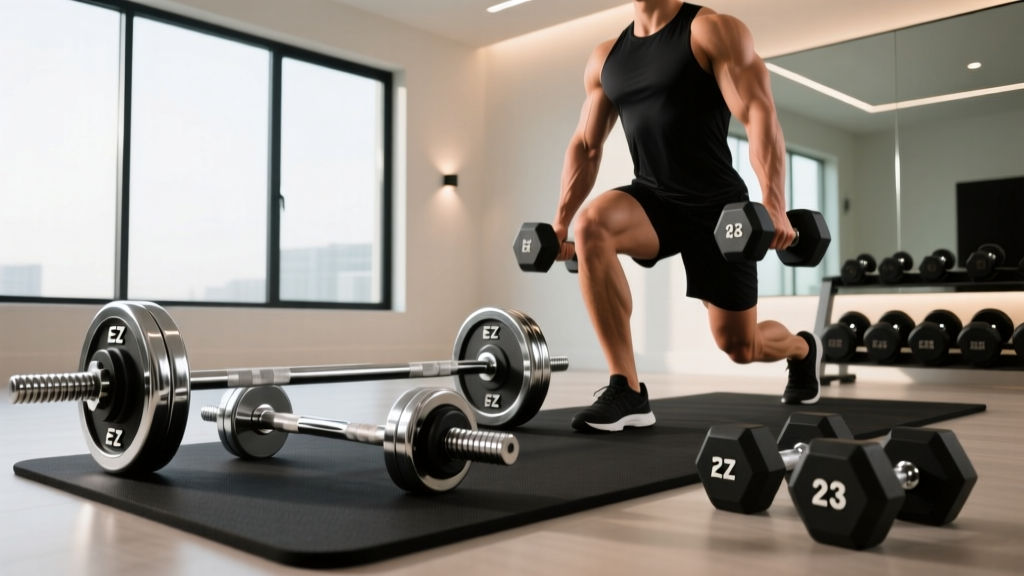
EZ Curl Bar vs Straight Bar Care & Dumbbell Walking Lunges Tips
Compare EZ curl bar vs straight bar maintenance, plus expert tips on equipment care and joint longevity for dumbbell walking lunges in your home gym.

The Home Gym Longevity Blueprint: Upper Body Bars & Lower Body Dumbbells
When building a home gym designed to last a lifetime, the intersection of equipment maintenance and exercise biomechanics is frequently overlooked. Lifters often invest thousands in premium gear, only to degrade it through improper cleaning routines or poor movement mechanics. Whether you are analyzing an EZ curl bar vs straight bar for your upper body isolation days, or programming heavy dumbbell walking lunges for lower body hypertrophy, the physical toll on both your joints and your gear is immense.
In this comprehensive 2026 maintenance guide, we break down the exact care protocols required to maximize the lifespan of your barbells and dumbbells, while simultaneously optimizing your joint longevity during high-impact unilateral movements.
The Barbell Dilemma: EZ Curl Bar vs. Straight Bar Maintenance
The debate between an EZ curl bar and a straight barbell usually centers on wrist ergonomics and bicep activation. However, from a maintenance and longevity perspective, these two tools present entirely different challenges. The geometry of the bar dictates how sweat, chalk, and oxidization accumulate over time.
Knurling, Crevices, and Chalk Removal
Straight barbells, such as the standard 20kg Olympic power bars, feature a continuous, uniform knurl pattern. Cleaning them is straightforward: a stiff nylon brush and a 50/50 white vinegar-to-water solution will dislodge magnesium carbonate (chalk) from the knurl valleys.
EZ curl bars, conversely, introduce multiple 120-degree angled bends. These crevices act as moisture traps. When sweat pools in the inner bends of an EZ bar, it accelerates oxidation, particularly on bars with black oxide or bare steel finishes. To maintain an EZ curl bar, you must use a soft-bristled brush to reach into the angled grips after every session, followed by a microfiber wipe-down with a light coat of mineral oil. Never use a wire brush on ceramic-coated (Cerakote) or zinc-finished EZ bars, as this will strip the protective layer and expose the underlying steel to rapid rusting.
Sleeve Bushings vs. Needle Bearings
The rotational mechanism of your barbell dictates its lifespan under load. Most standard straight bars and economy EZ bars utilize bronze bushings, while high-end Olympic straight bars use needle bearings.
- Bronze Bushings: Require monthly lubrication. Apply 3-5 drops of 3-in-One oil or a specialized barbell sleeve oil directly into the seam where the sleeve meets the shaft. Spin the sleeve to distribute the oil.
- Needle Bearings: Require less frequent maintenance but are highly sensitive to dust. Use a synthetic white lithium grease applied via a needle-nose oiler.
- The WD-40 Warning: Never use standard WD-40 on barbell sleeves. It is a solvent, not a long-term lubricant. It will strip the factory grease, attract chalk dust, and eventually cause the sleeve to seize or grind.
⚠️ Critical Maintenance Callout: Barbell Endplay
Check your barbell's 'endplay' (the lateral movement of the sleeve) every six months. Grip the shaft and pull the sleeve horizontally. If there is more than 1mm of lateral clunking, your snap rings or thrust washers are degraded. Ignoring this will cause the sleeve to wobble during heavy straight-bar squats, accelerating bushing wear and compromising bar integrity.
Equipment Wear & Biomechanics: Dumbbell Walking Lunges
Transitioning from the squat rack to the open floor, we must address one of the most punishing exercises for both the human body and gym flooring: dumbbell walking lunges. According to biomechanical data from ExRx, the walking lunge requires immense stabilization, targeting the quadriceps, gluteus maximus, and adductor magnus while demanding high core engagement.
However, the true test of equipment longevity occurs at the end of the set. Fatigued lifters rarely lower dumbbells gently after a grueling 20-meter lunge track; they drop them. This repetitive impact force is the primary cause of dumbbell failure in commercial and home gyms.
Surviving the 'Lunge Drop': Urethane vs. Rubber
When programming dumbbell walking lunges, the material of your dumbbells dictates their lifespan. Standard cast-iron hex dumbbells coated in cheap recycled rubber (typically rated at 70A-80A on the Shore durometer scale) will crack, split, and expose the iron core to rust within six months of daily drops onto rubber matting. The rigid iron core transfers the shockwave directly to the brittle rubber shell.
For serious lunge work, you must invest in urethane dumbbells. Premium urethane (rated 85A-90A durometer) possesses high tensile strength and tear resistance. It absorbs the kinetic energy of a drop from shoulder height without splitting. While urethane dumbbells command a premium price in the 2026 market—often ranging from $2.50 to $3.50 per pound compared to $1.50 for rubber—their lifespan is easily 5 to 10 times longer, making them the superior choice for high-drop exercises.
Equipment & Finish Longevity Matrix
Use the following matrix to understand the expected lifespan and maintenance requirements of your free weights based on material and finish.
| Equipment Type | Material / Finish | Maintenance Frequency | Est. Lifespan (Heavy Use) |
|---|---|---|---|
| Straight Barbell | Black Oxide | Weekly (Oil & Brush) | 3-5 Years (Humid Climates) |
| Straight Barbell | Cerakote / Hard Chrome | Monthly (Wipe & Brush) | 15+ Years |
| EZ Curl Bar | Zinc Plated | Bi-Weekly (Crevice Clean) | 7-10 Years |
| Hex Dumbbells | Recycled Rubber (75A) | N/A (Replace when cracked) | 1-2 Years (If dropped) |
| Hex Dumbbells | Virgin Urethane (90A) | Monthly (UV Protectant) | 10+ Years |
Joint Longevity: Protecting Wrists and Knees
Equipment longevity is meaningless if your joints fail first. The mechanical stresses of curling and lunging require strict attention to biomechanical alignment.
Wrist Valgus and the EZ Bar
The primary argument for the EZ curl bar is wrist comfort. A straight bar forces the forearms into full supination, which can impinge the radioulnar joint in lifters with limited mobility. The angled grips of an EZ bar allow for a semi-supinated grip, reducing wrist valgus stress. However, lifters must ensure they grip the outermost or innermost bends symmetrically; uneven grip placement on an EZ bar creates torque imbalances that can lead to lateral epicondylitis (tennis elbow) over time.
Knee Shear Forces During Walking Lunges
When executing dumbbell walking lunges, stride length dictates joint loading. A short stride places the knee in deep flexion past the toes, maximizing quadriceps activation but drastically increasing patellofemoral shear forces. Over hundreds of reps, this accelerates patellar tendon wear.
Conversely, a longer stride shifts the load to the gluteus maximus and hamstrings, keeping the tibia more vertical and reducing knee shear. For long-term joint longevity, especially when holding heavy urethane dumbbells, prioritize a longer, heel-driven stride. As noted by strength and conditioning guidelines from Rogue Fitness and broader biomechanical consensus, controlling the eccentric descent and avoiding 'knee valgus' (the knee caving inward) is critical to preserving the medial collateral ligament (MCL) during unilateral loading.
'The gym floor is a laboratory of physics. Every dropped dumbbell and every unracked barbell is a transfer of kinetic energy. Your equipment's lifespan is simply a measure of how well it absorbs that energy over time.'
Frequently Asked Questions (FAQ)
Can I use an EZ curl bar for walking lunges?
While physically possible to hold an EZ curl bar at your sides or on your back, it is highly discouraged. The angled grips are not designed for the heavy, uneven loading of lower body movements, and the shorter shaft length (usually 47 to 52 inches) compromises balance. Stick to dumbbells or a standard 7-foot Olympic straight bar for lunges.
How do I remove rust from the knurling of my straight bar?
For surface rust, create a paste using baking soda and water, apply it to the knurling, let it sit for 15 minutes, and scrub vigorously with a brass wire brush. Follow up with a white vinegar wipe to neutralize the baking soda, then immediately coat with 3-in-One oil to prevent flash rusting.
Why do my urethane dumbbells smell?
Low-grade urethane and rubber dumbbells off-gas volatile organic compounds (VOCs) when exposed to heat and UV light. Store your dumbbells in a climate-controlled, shaded area. Wiping them down with a mild dish soap solution and leaving them in a well-ventilated room for 48 hours will neutralize most factory odors.
More gear to consider
All reviews
Dumbbell Swings Exercise: Rubber Hex vs Urethane Care

Bumper vs Iron: Space for Strength Training Exercises with Dumbbells

Squat Stand vs Rack: Base for a Dumbbell Tricep Workout Routine

Cast Iron vs Competition Kettlebells: Women's Beginner Dumbbell Workout

Best Neoprene Dumbbells for Home Use & Dumbbell Flys GIF Guide
