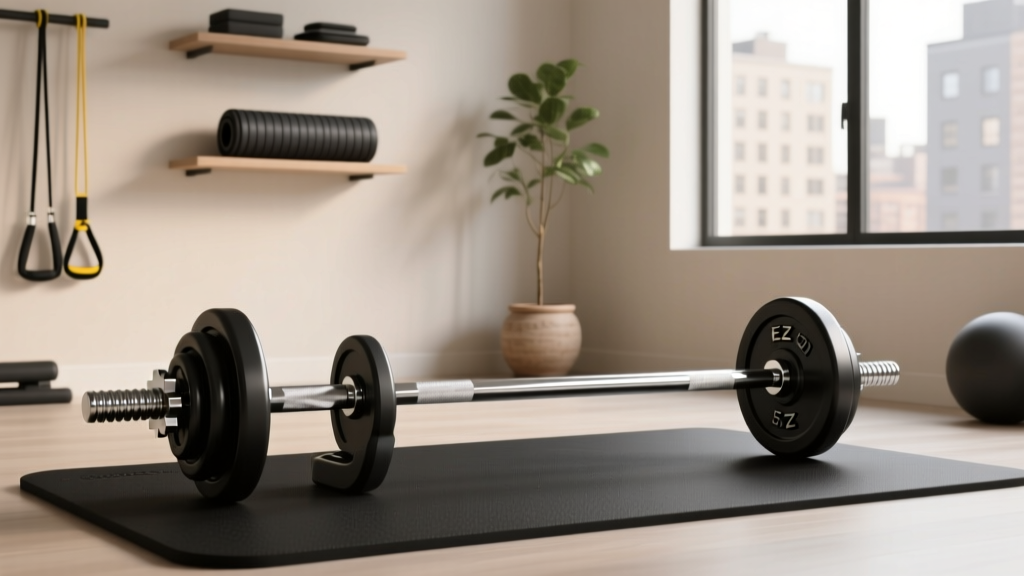
Best Romanian Deadlift Dumbbell Alternative: EZ Curl vs Straight Bar
Compare the EZ curl bar and 5ft straight bar as a space-saving Romanian deadlift dumbbell alternative. Expert layout, biomechanics, and storage tips.

The Micro-Gym Dilemma: Rethinking the Dumbbell Rack
When designing a high-density home gym or apartment workout space, finding a viable romanian deadlift dumbbell alternative is often the linchpin of your layout strategy. A standard 5-to-50-pound rubber hex dumbbell set, complete with a vertical A-frame rack, consumes roughly 14 square feet of floor space. In a compact 50-square-foot bedroom gym, that single station devours nearly 30% of your total footprint.
To reclaim this space, many lifters pivot to compact barbell options. But if your space is so tight that a standard 7-foot Olympic barbell is out of the question, you are likely choosing between a 5-foot straight bar and a 47-inch EZ curl bar. While the EZ curl bar is a staple for upper-body isolation, some space-starved athletes attempt to use it as a multi-purpose tool for lower-body hinges. In this guide, we break down the biomechanics, spatial logistics, and hardware realities of using an EZ curl bar versus a short straight bar for Romanian Deadlifts (RDLs).
Contenders for the Ultimate Space-Saving RDL Tool
To evaluate these tools accurately, we must look at specific, widely available models that fit the micro-gym profile. We are comparing the Troy Barbell 5ft Olympic Bar (OB-59) against the Yes4All 47-inch Olympic EZ Curl Bar. Both feature 2-inch Olympic sleeves, allowing you to use standard bumper plates—a non-negotiable requirement for safe RDL clearance.
Hardware Comparison Matrix
| Specification | Troy Barbell 5ft Straight (OB-59) | Yes4All 47in EZ Curl Bar |
|---|---|---|
| Total Length | 60 inches | 47 inches |
| Bar Weight | 35 lbs | 18 lbs |
| Sleeve Length | 12.5 inches | 7.25 inches |
| Max Bumper Capacity | ~360 lbs (4 per side) | ~160 lbs (2 per side) |
| Tensile Strength | 130,000 PSI | Not Rated (Standard Steel) |
| Average 2026 Price | $115 - $130 | $45 - $55 |
| RDL Suitability | Excellent | Poor to Moderate |
Biomechanics of the RDL: Why Bar Shape Matters
The Romanian Deadlift is a hip-hinge movement that demands strict bar path tracking and optimal latissimus dorsi engagement to protect the lumbar spine. According to kinematic analyses published by the National Strength and Conditioning Association (NSCA), keeping the barbell in direct contact with the thighs and shins minimizes shear force on the lower back. The shape of your bar directly dictates your ability to maintain this contact.
The Pronation Problem with EZ Bars
The defining feature of an EZ curl bar is its angled, zig-zag shaft. These angles are designed to place the wrists in a semi-supinated position, reducing strain on the radioulnar joint during bicep curls. However, this geometry is highly detrimental to the RDL.
- Elbow Flare: Gripping the angled portions of an EZ bar forces your elbows to point slightly outward rather than locking them back against your lats. This breaks the 'lat shelf' required to keep the bar glued to your legs.
- Grip Width Limitations: The knurled sections on a 47-inch EZ bar are narrow. For lifters with broader shoulders, this forces an artificially narrow grip, causing the bar to drift forward during the eccentric (lowering) phase.
- Wrist Torque: If you attempt to use the straight, un-angled center portion of the EZ bar to achieve a pronated (overhand) grip, the short 5-to-6-inch center knurling is often too narrow for a comfortable hip-width deadlift stance.
Expert Insight: While EXRX.net's biomechanical breakdown of the dumbbell RDL highlights the benefit of a neutral grip for shoulder health, translating a neutral grip to an EZ curl bar during a heavy hip hinge alters the center of mass and compromises spinal neutrality. Stick to a straight bar for heavy hinges.
Sleeve Length and Bumper Plate Clearance
When using a barbell as a dumbbell alternative for RDLs, you must use full-diameter 45-pound bumper plates (17.7 inches in diameter) to ensure the bar rests at the correct mid-shin height at the bottom of the movement. Standard iron plates drop the bar too close to the floor, forcing excessive lumbar flexion.
The 7.25-inch sleeve on the Yes4All EZ curl bar can only accommodate two 45lb bumper plates per side. This caps your working weight at roughly 160 lbs (plus the 18lb bar). For intermediate and advanced lifters, this is a severe bottleneck. The 12.5-inch sleeve on the Troy 5-foot straight bar easily fits four bumpers per side, supporting over 360 lbs and allowing for long-term progressive overload without requiring a larger bar.
Layout & Storage: Fitting the Bar into a 4x6 Footprint
Space optimization is not just about the workout; it is about how the equipment lives in the room when not in use. Both bars offer distinct advantages depending on your storage infrastructure.
⚠ Vertical Storage Warning
If you are storing your barbell vertically in a corner sleeve or wall-mounted holder to save floor space, never store an EZ curl bar vertically by its sleeve. The asymmetrical weight distribution and the bent shaft can cause the bar to wedge or slip out of standard PVC or steel vertical holders. Always store EZ bars horizontally on wall hooks or under a bench. A 5-foot straight bar, however, stores perfectly in a 6-inch vertical floor sleeve, taking up less than 0.2 square feet of floor space.
Under-Bench vs. Corner Integration
If your layout features a low-profile adjustable bench (like the Rogue AB-2 or Rep Fitness AB-3100), the 47-inch EZ curl bar can be slid completely underneath the bench frame when the bench is folded flat. This makes it virtually invisible in a studio apartment. The 60-inch straight bar will protrude by about 6-8 inches, which can become a tripping hazard in high-traffic walkways.
The Verdict: Which is the Ultimate Space-Saving Alternative?
If your primary goal is to find a true romanian deadlift dumbbell alternative that allows for proper biomechanics, progressive overload, and safe plate clearance, the 5-foot straight barbell is the undisputed winner. The Troy OB-59 provides the necessary sleeve length for bumper plates and the straight shaft required for proper lat engagement and bar path tracking.
The EZ curl bar should remain strictly in the upper-body arsenal. Attempting to use it as a multi-purpose lower-body hinge tool is a compromise that will ultimately limit your strength gains and increase your risk of lumbar strain. Ditch the bulky dumbbell rack, invest in a 5-foot straight bar and a set of bumpers, and reclaim your gym space without sacrificing your posterior chain development.
Frequently Asked Questions
Can I use standard iron plates instead of bumpers for RDLs on a short bar?
You can, but it is not recommended. Standard 45lb iron plates have a diameter of roughly 14.5 inches. When performing an RDL, the bar should stop at mid-shin. With iron plates, the bar will travel closer to the floor, forcing you to either round your lower back to reach the bottom position or artificially stop the movement early, reducing the stretch on the hamstrings. Bumpers (17.7 inches) solve this geometry problem.
Are 5-foot barbells prone to 'whip' or bending during heavy RDLs?
Because 5-foot bars have a shorter shaft between the sleeves, they actually exhibit less whip (flex) than a standard 7-foot Olympic barbell. A high-quality 5-foot bar with a tensile strength of 130,000 PSI or higher will remain completely rigid during RDLs up to 300 lbs, providing a stable, predictable pull.
What is the best wall-mount storage for a 5-foot straight bar?
For micro-gyms, heavy-duty J-cups mounted to a wall stud or a dedicated vertical barbell holder (like the Rogue Vertical Barbell Holder) are ideal. Ensure the holder has a UHMW plastic liner to protect the bar's knurling and zinc finish from scratching during storage.
More gear to consider
All reviews
Standard vs Olympic Plates for Standing Dumbbell Chest Exercises
EZ Curl Bar vs Straight Bar Cost & Dumbbell Step Up Workout Value
2026 Loadable Dumbbell Trends: Dumbbell Exercises for Quads

Cast Iron vs Competition Kettlebells & Butterfly Dumbbell Workout

Olympic vs Standard Plates: Head-to-Head (Beyond Dumbbell Curls GIF)
