
Power Rack vs Squat Rack vs Stand: 20 lb Dumbbell Workout Rigs
Compare power racks, squat racks, and stands for your home gym. Find the perfect rig for heavy barbell lifts and your 20 lb dumbbell workout routines.

The Home Gym Rig Dilemma in 2026
Building a home gym in 2026 requires more than just throwing a barbell in the garage. It demands strategic space planning, safety engineering, and versatile equipment flow. Whether you are testing your one-rep max on the back squat or transitioning into a high-volume, metabolic 20 lb dumbbell workout for accessory conditioning, your primary lifting rig dictates the functionality of your entire space.
The terminology in the fitness equipment industry is often conflated, leading to costly purchasing mistakes. A power rack, a squat rack (half rack), and a squat stand serve fundamentally different purposes, possess distinct safety profiles, and occupy varying amounts of floor space. According to testing standards highlighted by Garage Gym Reviews, the structural integrity, steel gauge, and attachment ecosystem of your rig will determine its lifespan and versatility. Below, we break down the exact specifications, pricing, and spatial requirements of each rig type to help you make an informed, expert-level decision.
Power Racks: The Ultimate Four-Post Fortress
A true power rack (or full rack) features four main uprights connected by top and bottom crossmembers, creating an enclosed cage. This design provides unparalleled safety for solo lifters, as the barbell is contained within the structure.
Key Specifications & Engineering
- Steel Gauge: Premium models in 2026 utilize 11-gauge steel (approximately 0.120 inches thick), offering massive rigidity. Budget options may use 14-gauge or 16-gauge steel, which can flex under loads exceeding 400 lbs.
- Upright Dimensions: The industry standard for high-end racks is 3x3-inch square tubing with 5/8-inch or 1-inch hardware holes. This matches the 'Monster Lite' or 'Infinity' ecosystems, allowing for cross-brand attachment compatibility.
- Hole Spacing: Look for 'Westside' hole spacing—1-inch spacing in the bench press and squat zones for micro-adjustments on safeties, and 2-inch spacing higher up for pull-up bars and band pegs.
Top Contender: The REP Fitness PR-4000 (starting around $799) and the Rogue R-3 (approx. $1,050). Both offer 1000+ lb weight capacities and extensive modularity.
Pro Tip for Accessory Flow: Power racks offer the best attachment ecosystem. By adding rack-mounted dumbbell shelves to the rear or sides, you can store your gear vertically. This keeps the floor clear, allowing you to step out of the cage and immediately begin a dynamic 20 lb dumbbell workout without tripping over scattered weights.Squat Racks (Half Racks): The Open-Front Hybrid
Often incorrectly called 'squat stands' by big-box retailers, a true squat rack or 'half rack' features two front uprights and two rear stabilizing legs. The barbell rests on the outside of the front uprights, and spotter arms extend forward to catch missed lifts.
Pros and Cons of the Half Rack
The primary advantage of a half rack is the open front. This is critical for Olympic weightlifters who need to bail forward on a missed clean or snatch without hitting the safety bars. Furthermore, the open footprint makes it slightly easier to move in and out of the rig for supersetting barbell movements with free-weight accessories.
However, the forward-extending spotter arms create a tipping hazard if the rack is not bolted to the floor or heavily loaded with weight storage pegs on the rear crossmember. The BarBend equipment testing team consistently notes that half racks require strict adherence to weight-loading protocols on the rear storage pegs to maintain a safe center of gravity.
Top Contender: The Rogue S-2 Squat Rack 2.0 ($795). It features a 49x46-inch footprint, 11-gauge steel, and includes a pair of safety spotter arms and a pull-up bar.
Squat Stands: The Minimalist Approach
Squat stands consist of just two independent uprights (or two uprights connected by a single, narrow stabilizer bar). They are designed strictly to hold a barbell at shoulder height for squats and presses.
The Physics of Tipping and Safety
Because they lack a full enclosure or heavy rear base, squat stands are inherently the least safe option for heavy, unassisted lifting. If a lifter racks the bar off-center, or if they fail a rep and dump the bar forward, the stands can tip over. The National Strength and Conditioning Association (NSCA) emphasizes that when lifting outside of a fully enclosed rack, the use of human spotters or specialized safety straps is non-negotiable for heavy loads.
Top Contender: Rogue SML-1 Monster Lite Squat Stands ($495). These feature 3x3-inch 11-gauge steel uprights and a UHMW plastic protective strip to prevent barbell knurling damage. They must be bolted to a concrete slab for any serious use.
Head-to-Head Comparison Matrix
| Feature | Power Rack (Full) | Squat Rack (Half) | Squat Stands |
|---|---|---|---|
| Avg. Price Range (2026) | $699 - $1,200+ | $599 - $850 | $350 - $550 |
| Footprint (L x W) | 47" x 47" to 49" x 49" | 49" x 46" (plus arm reach) | 49" x 48" (with stabilizer) |
| Safety for Solo Lifts | Excellent (Enclosed) | Good (Spotter Arms) | Poor (Tipping Risk) |
| Storage Integration | High (Shelves, Horns) | Medium (Rear Pegs) | Low (Base Horns only) |
| Floor Space for DB Work | Requires stepping away | Moderate clearance | Maximum open floor |
Space Planning: Integrating Your 20 lb Dumbbell Workout
When designing a home gym, lifters often focus solely on the barbell. However, a well-rounded program includes high-rep accessory work, mobility drills, and metabolic conditioning. This is where spatial planning becomes critical.
Consider a standard garage bay measuring 10 feet by 20 feet. If you install a 49x49-inch power rack, you consume nearly 17 square feet of prime real estate. When you transition from heavy squats to a superset involving a 20 lb dumbbell workout—such as walking lunges, goblet squats, or dumbbell snatches—you need a clear, unobstructed runway.
'The biggest mistake home gym owners make is treating the rack as an island. You must map out the 'blast radius' of your accessory movements. A 20 lb dumbbell complex requires lateral and forward movement space that a cluttered half-rack footprint simply doesn't allow.' — FitGearPulse Spatial Ergonomics Report, 2025
The Solution: If you opt for a power rack, mount your dumbbell storage vertically on the rear uprights. If you choose squat stands, push them against a wall when not in use, reclaiming the entire floor space for your dumbbell conditioning circuits.
Installation & Anchoring: Don't Skip This Step
Regardless of whether you choose a half rack or squat stands, anchoring is a matter of life and death. Follow this step-by-step protocol for concrete floors:
- Locate the Joists (if on wood subfloor): Never bolt heavy rig uprights solely into plywood or OSB. You must hit the structural joists or pour dedicated concrete footings.
- Use Wedge Anchors: For concrete slabs, use 3/8-inch or 1/2-inch steel wedge anchors. Drill the hole to the exact depth specified by the anchor manufacturer, usually 1/2 inch deeper than the embedment.
- Torque to Spec: Use a torque wrench to tighten the anchors. Over-tightening can snap the bolt; under-tightening will allow the rack to wobble during kipping pull-ups or heavy re-racking.
- Shim for Level: Garage floors are rarely perfectly level. Use steel shims under the base plates before tightening to ensure the uprights are perfectly plumb, preventing binding on your safety spotter arms.
Frequently Asked Questions (FAQ)
Can I use a squat stand for bench pressing?
Yes, but it is highly discouraged for heavy loads without a dedicated spotter. Squat stands lack the lateral stability of a power rack. If you catch the bar unevenly on the bench press, the lateral force can tip the stand. For benching, a power rack with safety straps or pin-pipe safeties is the only recommended solo option.
Do I need a full power rack if I only lift up to 300 lbs?
Not necessarily. If your max lifts are well within the 300 lb range, a high-quality half rack or even heavy-duty squat stands (bolted down) will suffice. However, the primary reason to buy a power rack isn't just weight capacity; it's the attachment ecosystem. If you plan to add lat pulldowns, cable crossovers, or vertical dumbbell storage to streamline your 20 lb dumbbell workout transitions, a full rack is the superior long-term investment.
What is the difference between 5/8-inch and 1-inch hole spacing?
The hole size dictates which attachments you can buy. Rogue's 'Monster' line uses 1-inch hardware, while 'Monster Lite' and most competitors (like REP and Titan) use 5/8-inch hardware. Always verify the hole size before purchasing J-cups, safety arms, or pulley systems, as they are not cross-compatible.
More gear to consider
All reviews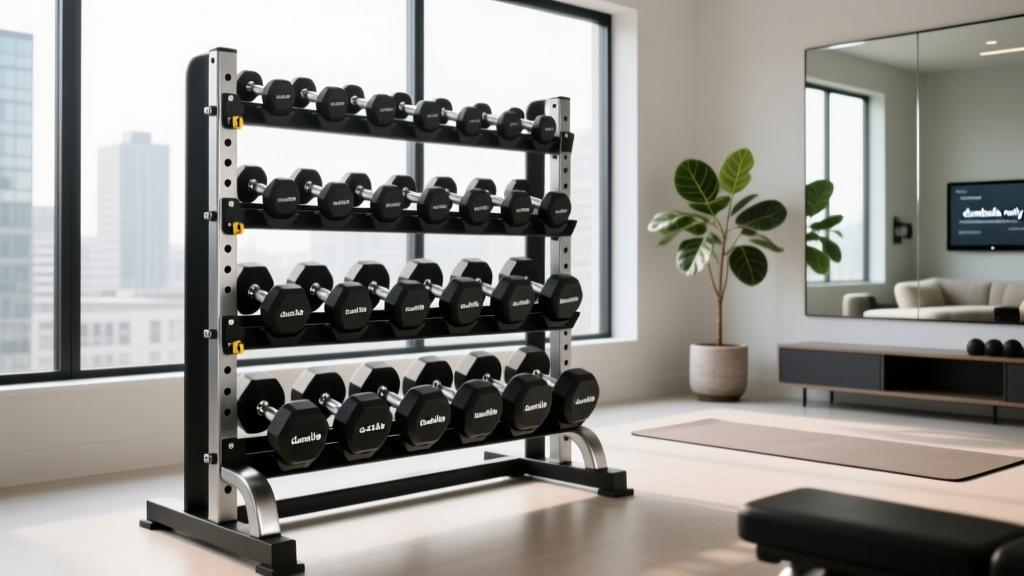
Dumbbell Rack Trends 2026: Fueling the Dumbbells Only Workout Boom

Home Gym Setup: Training Upper Body With Dumbbells (2026)

Top Adjustable Sets for a Women's Workout With Dumbbells (2026)

2026 Olympic Barbell Buying Guide: Weight, Knurling, and the Supinated Dumbbell Row

Bumper vs Iron Plates: Layouts & Dumbbell Exercises for Lower Pecs
