
Space-Saving Gym Layout: Kettlebells & Dumbbell Chest and Arm Workout
Optimize your home gym layout by comparing cast iron vs. competition kettlebells, featuring a space-efficient dumbbell chest and arm workout.

The Spatial Dilemma: Designing a High-Density Home Gym
When engineering a compact home gym in 2026, space optimization extends far beyond purchasing foldable squat racks or wall-mounted storage. True spatial efficiency requires a granular understanding of the dimensional geometry of your free weights. The physical profiles of your equipment dictate your floor plan, your shelving depth, and your operational clearances. This is especially critical when balancing a diverse equipment roster—such as integrating a kettlebell collection while preserving the central floor space required to execute a comprehensive dumbbell chest and arm workout. In this guide, we break down the exact measurements, storage matrices, and layout blueprints needed to maximize a standard 10x10 training zone.
The Geometry of Iron: Cast Iron vs. Competition Kettlebells
The decision between cast iron and competition kettlebells is often framed around grip feel or sport specificity. However, from a layout and space optimization perspective, the choice fundamentally alters your storage footprint. Cast iron kettlebells scale in physical size as the weight increases. An 8kg cast iron bell might feature a compact 4.5-inch base, while a 32kg beast can span over 7.5 inches in diameter. This variable geometry makes designing a flush, space-saving storage rack incredibly difficult, as heavier bells require deeper shelves or staggered floor placement.
Conversely, competition kettlebells are manufactured to strict, uniform dimensional standards. Whether you are holding an 8kg or a 32kg competition bell, the dimensions remain locked at 280mm in height, 210mm in width, and an 80mm base diameter. According to StrongFirst Kettlebell Standards, this uniformity is designed for sport consistency, but for the home gym architect, it is a spatial superpower. Uniform dimensions allow you to build exact, minimalist shelving units that hug the wall, eliminating wasted cubic volume.
Dimensional Data & Storage Footprint Matrix
To visualize how bell profiles dictate rack layout, review the comparative data below based on standard Rogue Fitness kettlebell specifications and competition guidelines:
| Feature | Cast Iron Kettlebells (Variable) | Competition Kettlebells (Uniform) | Spatial & Layout Impact |
|---|---|---|---|
| Base Diameter (8kg vs 32kg) | 4.5" to 7.5" | 3.15" (80mm) across all weights | Competition bells allow for narrow, 4-inch deep wall shelves; cast iron requires 8-inch+ deep floor racks. |
| Height Profile | 7.5" to 11.5" | 11.0" (280mm) across all weights | Uniform height allows for exact vertical shelf spacing (12 inches), maximizing vertical air rights. |
| Handle Horn Width | Scales with bell size | Fixed 210mm width | Fixed width ensures predictable lateral spacing on single-tier floor racks without handle clashing. |
| Optimal Storage Solution | Heavy-duty tiered floor rack | Wall-mounted vertical shelving | Wall-mounting competition bells reclaims up to 6 square feet of prime floor matting. |
Designing the "Strike Zone" for Your Dumbbell Chest and Arm Workout
While kettlebells dictate your perimeter storage, your adjustable bench and dumbbells command the central "strike zone" of your gym. To safely and effectively perform a high-volume dumbbell chest and arm workout, you must calculate your lateral wingspan clearance. Failing to account for this results in drywall damage, restricted range of motion, and compromised joint mechanics.
According to ExRx's kinesiology anthropometric data, the average adult male wingspan is roughly equivalent to their height (e.g., 70 inches). When holding a standard 14-inch hex dumbbell in each hand, your total operational width expands to approximately 98 inches (over 8 feet). Therefore, if you are using a standard 48-inch adjustable bench, you need a minimum of 25 inches of clear floor space on both the left and right sides just to accommodate the dumbbells at the bottom of a chest flye or triceps extension.
Pro-Tip for Compact Spaces: If your room width is under 10 feet, swap traditional flat-bench dumbbell flyes for floor presses or neutral-grip dumbbell pullovers. The floor naturally limits your elbow travel, protecting your shoulders while eliminating the need for a bench and saving roughly 12 square feet of central layout space.
The Space-Optimized Dumbbell Chest and Arm Routine
This specific dumbbell chest and arm workout is engineered for a 10x10 room layout. It utilizes an adjustable bench set to a 30-degree incline, minimizing the lateral footprint while maximizing upper-chest and triceps activation. Keep your dumbbells stored on a low-profile, 3-tier hex rack positioned exactly 24 inches from the head of the bench to minimize transition time and floor clutter.
- Incline Dumbbell Press: 4 sets of 8-10 reps. (Requires 8-foot lateral clearance. Focus on a deep stretch without hitting the floor).
- Neutral-Grip Dumbbell Flye: 3 sets of 12 reps. (Keeps the elbows slightly bent and the dumbbells closer to the body's midline, reducing lateral spatial demand by 15%).
- Seated Overhead Triceps Extension: 3 sets of 10 reps per arm. (Utilizes a single heavy dumbbell. Requires strict vertical clearance—ensure your ceiling is at least 96 inches high).
- Cross-Body Dumbbell Skull Crushers: 3 sets of 12 reps. (Performed lying on the bench, bringing the dumbbells toward the opposite shoulder, keeping the movement entirely within the bench's vertical footprint).
Floor Plan Blueprint: The 10x10 Multi-Use Zone
To bring this all together, here is a precise layout blueprint for a standard 10x10 foot spare room, utilizing 3/8-inch vulcanized rubber flooring to dampen sound and protect the subfloor.
Zone 1: The Perimeter (Storage & Kettlebells)
Allocate the back-left corner for a wall-mounted competition kettlebell rack. Because competition bells share a uniform 80mm base, you can install heavy-duty steel shelving brackets directly into the wall studs, spaced exactly 12 inches apart vertically. This creates a flush storage unit that protrudes only 10 inches from the wall, leaving the rest of the room open. Store your cast iron dumbbells on a low-profile, 3-tier horizontal rack against the adjacent wall, ensuring the heaviest pairs (e.g., 50lb-70lb) are on the bottom tier to maintain a low center of gravity and prevent tipping in a compact space.
Zone 2: The Central Strike Zone
Position your adjustable bench in the center of the room, but offset it 18 inches toward the right wall. This asymmetrical placement creates a massive 6-foot open lane on the left side of the room. This open lane is critical for dynamic movements, kettlebell swings, or carrying equipment from the perimeter racks to the bench. When executing your dumbbell chest and arm workout, the offset bench ensures your dumbbell heads never strike the side walls during the eccentric phase of your presses.
Expert Clearance Metrics & Safety Margins
When optimizing for space, vertical clearance is just as critical as lateral footprint. Standard US residential ceilings are 96 inches (8 feet) high. If you are 70 inches tall, your seated torso height is roughly 36 inches. Add 30 inches for your extended arm and 12 inches for the dumbbell, and you are operating at 78 inches. This leaves only an 18-inch safety margin for overhead triceps extensions or seated shoulder presses. Always measure your specific room's ceiling height—including HVAC vents and light fixtures—before committing to an overhead dumbbell routine. For rooms with 8-foot ceilings or lower, substitute overhead movements with lying triceps extensions to maintain high intensity without compromising safety or drywall integrity.
Ultimately, a highly optimized home gym is not defined by how much equipment you can cram into a room, but by how intelligently the equipment's geometry interacts with your architecture. By leveraging the uniform dimensions of competition kettlebells for vertical storage and calculating exact wingspan clearances for your dumbbell chest and arm workout, you can transform a cramped spare room into a world-class, high-density training facility.
More gear to consider
All reviews
Standard vs Olympic Plates for Beginner Dumbbell Workouts
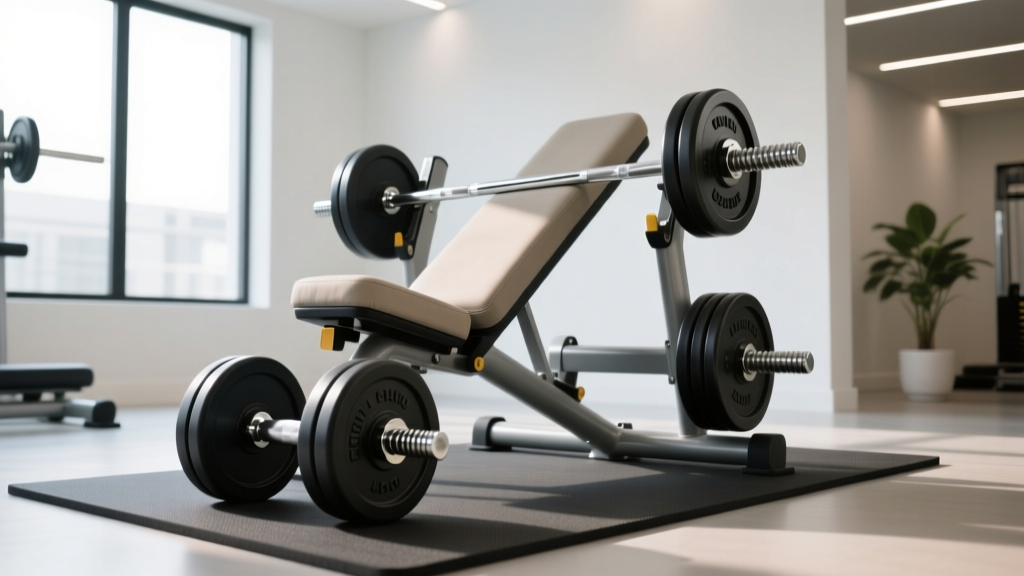
Reverse Fly Dumbbell Bench Setup: Olympic vs Standard Plates

Olympic vs Standard Plates: Setup for Benching 100 lb Dumbbells

Cast Iron vs Competition Kettlebell Care & Biceps Workout with Dumbbells for Beginners

Dumbbell Snatch CrossFit Trends: 2026 Rack & Storage Analysis
