EZ Curl vs Straight Bar: Space Layout & Dumbbell Image
Compare EZ curl bar vs straight bar dimensions, storage layouts, and spatial footprints to optimize your compact home gym design.

The Spatial Illusion: Deconstructing the Dumbbell Image
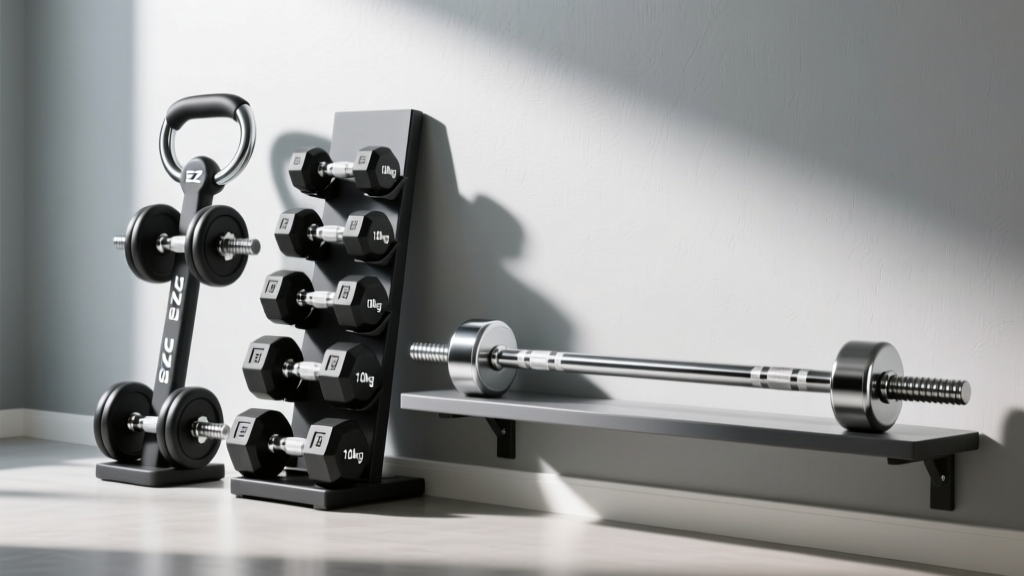
When planning a compact home gym, lifters frequently fall victim to what spatial designers call the 'dumbbell image' illusion. If you search online for a classic home gym layout or a traditional dumbbell image, you are almost always presented with a sprawling, multi-tiered rubber hex rack dominating 15 to 20 square feet of floor space. While visually impressive, this footprint is entirely impractical for the modern 2026 garage gym, where average usable square footage hovers between 100 and 150 square feet.
To reclaim this space without sacrificing arm and back development, smart home gym owners are pivoting toward specialty barbells. The debate between the EZ curl bar vs straight bar is usually framed around wrist biomechanics and muscle isolation. However, from a space optimization and layout design perspective, this comparison is actually about spatial geometry, loading clearances, and vertical storage potential. In this guide, we break down the exact measurements, operational footprints, and storage frameworks required to integrate these bars into tight spaces.
Space Optimization Callout: The 20-Square-Foot Rule
A standard 5-to-50 lb rubber dumbbell set requires a 4-foot wide, 2-tier A-frame rack. Factoring in the 3-foot clearance needed to pick up and maneuver the weights, the total operational footprint is roughly 20 square feet. By replacing this setup with an Olympic EZ curl bar, a standard straight bar, and a vertical plate tree, you can achieve 90% of the same exercise variations in under 4 square feet of floor space.
Straight Bar Geometry: The 7-Foot vs. 5-Foot Dilemma
The standard Olympic straight bar is the backbone of any free weight zone, but its length dictates the minimum width of your room. According to equipment specifications from Rogue Fitness, a standard 7-foot Olympic barbell measures exactly 86 inches in total length, with a shaft length of 51.5 inches and sleeve lengths of 16.3 inches per side.
The Hidden Cost of Plate Loading Clearance
When designing your gym layout, the physical length of the bar is only half the equation. You must calculate loading clearance. A standard 45-pound bumper plate has a diameter of 17.7 inches. To slide a plate onto a barbell, you need a minimum of 20 inches of lateral clearance from the wall to the end of the sleeve.
- 86-inch Barbell: Requires a minimum operational room width of 126 inches (10.5 feet) to allow for wall clearance and plate loading on both sides.
- 60-inch (5-foot) Barbell: Requires a minimum operational room width of 100 inches (8.3 feet), making it the superior choice for narrow hallways or single-car garage conversions.
If your room width is under 10 feet, a 7-foot straight bar will force you to angle the bar diagonally during floor presses or drag plates across your drywall during loading. In these scenarios, a 5-foot straight bar or an EZ curl bar becomes a structural necessity, not just a preference.
EZ Curl Bar Spatial Profile: The Compact Advantage
The Olympic EZ curl bar is the ultimate spatial hack for arm-focused training. Most high-quality Olympic EZ bars, such as those reviewed by the testing team at Garage Gym Reviews, measure between 47 and 52 inches in total length and weigh between 15 and 22 pounds.
Fitting Inside the Power Rack
One of the most significant spatial advantages of the EZ curl bar is its compatibility with standard power rack dimensions. The interior width between uprights on a standard squat rack is typically 43 inches (for short racks) or 49 inches (for standard racks). A 47-inch EZ curl bar fits perfectly inside the rack, allowing you to perform rack pulls, close-grip bench presses, and suspended curls without the bar sleeves scraping the J-cups or safety straps. A standard 7-foot straight bar, by contrast, requires 86 inches of clearance, meaning it must extend well beyond the rack's footprint, requiring open lateral space that many small gyms lack.
Head-to-Head Space & Layout Comparison Matrix
Below is a precise spatial and economic comparison to help you decide which bar configuration fits your floor plan and budget.
| Feature | 7ft Straight Bar | Olympic EZ Curl Bar | 10-Pair Dumbbell Set |
|---|---|---|---|
| Total Length | 86 inches | 47 - 52 inches | N/A (Rack is 48" wide) |
| Min. Room Width Required | 10.5 feet | 7.5 feet | 8 feet (with clearance) |
| Storage Footprint | 2 sq ft (Wall Mount) | 0.5 sq ft (Vertical Hook) | 8 to 12 sq ft (A-Frame) |
| Avg. Cost (2026 Market) | $150 - $295 | $80 - $225 | $400 - $750+ |
Biomechanics Meets Spatial Constraints
Beyond physical dimensions, the choice between an EZ bar and a straight bar impacts the spatial flow of your workout. According to guidelines published by the National Strength and Conditioning Association (NSCA), grip width and wrist supination significantly alter joint stress during flexion movements.
A straight bar forces full supination (palms facing directly up). While excellent for peak bicep contraction, it requires a wider grip to avoid shoulder impingement, which in turn demands more lateral clearance from walls or mirrors. The EZ curl bar features angled grips (usually 30 to 45 degrees) that allow for a semi-supinated grip. This not only reduces ulnar collateral ligament strain but also allows the lifter to keep their elbows tucked closer to their torso. In a cramped home gym where you might be standing just two feet from a wall or a loaded plate tree, the tucked-elbow profile of the EZ curl bar prevents accidental drywall strikes during heavy hammer curls or tricep extensions.
'In sub-150-square-foot training environments, equipment selection must be viewed through a dual lens: biomechanical efficacy and spatial non-interference. The EZ curl bar excels in the latter by minimizing the lateral sweep of the lifter's elbows.'
Actionable Layout Frameworks for Compact Gyms
To maximize your layout, abandon the traditional horizontal barbell racks. Implement these specific spatial frameworks based on your room's geometry:
- The Vertical Drop Zone (For EZ Bars): Install a heavy-duty single-bar wall hook at 14 inches from the floor. Store your Olympic EZ curl bar vertically. Because the sleeves are only 50mm in diameter and the bar weighs under 25 lbs, a vertical mount takes up exactly 6 inches of horizontal wall space. Pro Tip: Mount this on the side panel of your power rack rather than drywall to eliminate stud-finding and reinforce structural integrity.
- The Overhead Horizontal Glide (For Straight Bars): If you must store a 7-foot straight bar on a wall, do not use standard J-hooks at waist height, which creates a tripping hazard and blocks floor space. Instead, install wall-mounted horizontal bar holders at 72 inches high. This keeps the 86-inch bar completely out of the walking path and utilizes 'dead air' space above head height.
- The Sleeve-Loading Corner: If your gym is in a corner, position your plate tree exactly 22 inches from the adjacent wall. This specific measurement allows you to slide a 45lb bumper plate off the tree and directly onto a barbell sleeve without having to rotate the plate or maneuver around the rack.
Final Verdict: Designing Your Free Weight Zone
Escaping the traditional dumbbell image is the first step toward engineering a highly functional, space-optimized home gym. If your training space is wider than 11 feet, a standard 7-foot straight bar (like the Titan Fitness 7ft Olympic Bar) remains the most versatile tool for compound lifts, provided you utilize high-wall horizontal storage. However, if you are operating in a narrow corridor, a single-car bay, or an apartment spare room, the 47-inch Olympic EZ curl bar is a non-negotiable spatial asset. It fits inside standard rack uprights, stores vertically in the footprint of a shoebox, and provides the necessary grip variations to replace an entire rack of bulky hex dumbbells. By prioritizing spatial geometry over traditional equipment hoarding, you can build a complete, joint-friendly arm and back arsenal in less than 5 square feet of floor space.
More gear to consider
All reviews
Power Rack vs Squat Stand: Triceps Workout Dumbbell Mistakes
EZ Bar vs Straight Bar: Arms After Great Back Exercises with Dumbbells
EZ Bar vs Straight Bar & Exercise Routines with Dumbbells: 2026 Data

Best Neoprene Dumbbells for the Incline Dumbbell Y-Raise

Best Loadable Dumbbells for Standing Dumbbell Twists
