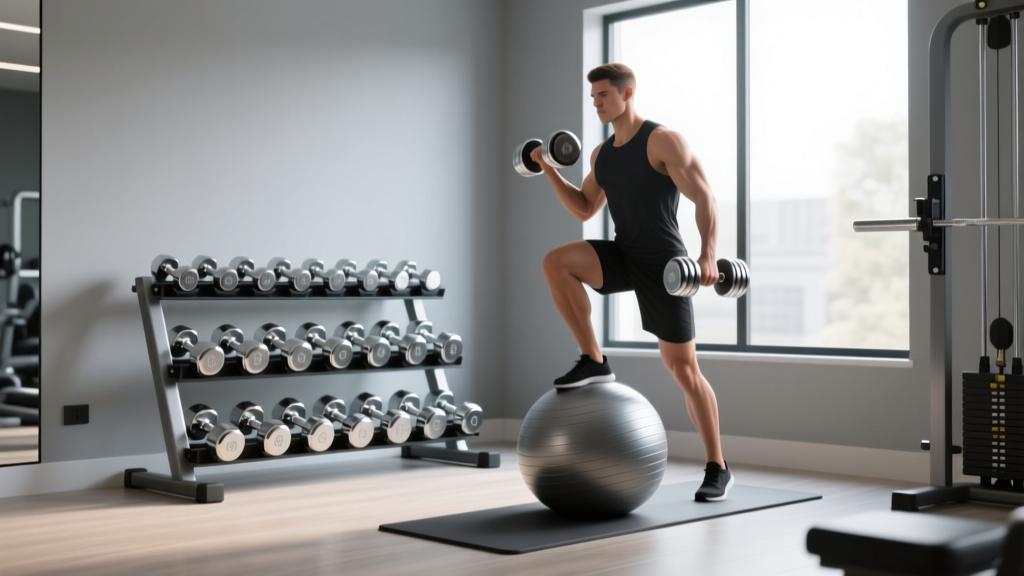
Space-Saving Dumbbell Racks for a Dumbbell Stability Ball Workout
Maximize your home gym footprint. Discover space-saving dumbbell racks and layout tips to seamlessly integrate your dumbbell stability ball workout.

The Spatial Challenge: Merging Storage with Functional Movement
Designing a high-performance home gym in a limited footprint requires more than just buying compact equipment; it demands a rigorous understanding of spatial geometry and human biomechanics. This is especially true when your primary training modality is a dumbbell stability ball workout. Unlike traditional flat bench pressing, exercising on a Swiss ball introduces a massive, dynamic variable to your floor plan. A standard 65cm stability ball requires a wide base of support, and when you add the wingspan of a loaded dumbbell chest fly or shoulder press, your spatial requirements expand exponentially.
Traditional 3-tier A-frame dumbbell racks, which often span 48 inches in length and protrude 24 inches from the wall, are notorious space-hogs. They create physical barriers that disrupt the fluid transition between grabbing your weights and positioning your ball. To optimize your layout, you must shift your perspective from mere 'storage' to 'workflow integration.' By selecting ultra-low-footprint dumbbell racks and mapping out precise clearance zones, you can transform a cramped spare room into a highly efficient functional training studio.
Clearance Mapping: Designing the Stability Ball Strike Zone
Before purchasing any storage solution, you must calculate the 'Strike Zone'—the minimum unobstructed floor area required to perform your movements safely. According to biomechanical guidelines emphasized by the National Strength and Conditioning Association (NSCA), maintaining proper spinal alignment and core engagement on an unstable surface requires unrestricted limb movement. If your knuckles or dumbbell heads strike a metal rack during the eccentric phase of a movement, you risk severe joint injury and equipment damage.
⚠️ The 360-Degree Rule: Never place a vertical or tiered dumbbell rack within 36 inches of the center point of your stability ball training zone. This accounts for the radius of the ball (approx. 26 inches for a 65cm model), plus the length of a standard rubber hex dumbbell (approx. 14 inches), plus a safety buffer for lateral roll-off.Exercise-Specific Clearance Matrix
Use the table below to map out your floor plan based on the specific exercises in your dumbbell stability ball workout repertoire.
| Exercise | Ball Size | Min. Width | Min. Length | Rack Placement Strategy |
|---|---|---|---|---|
| Dumbbell Chest Fly | 65cm | 78 inches | 48 inches | Wall-mounted or far corner |
| Seated Shoulder Press | 65cm | 54 inches | 36 inches | Adjacent to vertical rack |
| Hamstring Curl / Bridge | 55cm | 36 inches | 84 inches | Clear longitudinal axis |
| Renegade Row (on ball) | 65cm | 60 inches | 72 inches | Dead center clearance |
Top Space-Saving Dumbbell Racks for Compact Gyms
To preserve the clearance zones outlined above, you must abandon the traditional 4-foot A-frame. Here are three elite storage solutions engineered for high-density home gyms, evaluated on footprint, material durability, and workflow efficiency.
1. Rogue Fitness Vertical Dumbbell Rack
The Rogue Vertical Dumbbell Rack is the gold standard for minimizing floor space without sacrificing heavy-duty capacity. Constructed from 11-gauge steel and finished with a black powder coat, it features UHMW plastic saddles that protect your dumbbell handles from tearing and abrasion.
Footprint: A mere 13 x 17 inches (less than 1.6 square feet).
Capacity: Holds up to 10 pairs of dumbbells (up to 52 lbs per pair on the standard model, or heavier on the pro model).
Price Range: $295 - $345.
Layout Advantage: Because it grows vertically rather than horizontally, you can tuck it into a tight corner or place it directly behind your stability ball zone, provided you leave a 24-inch buffer for the ball's rearward roll during crunches.
2. Rep Fitness Wall-Mounted Dumbbell Shelves
If your floor space is entirely consumed by your stability ball workout area, the only direction left to build is up. The Rep Fitness Wall-Mounted shelves bolt directly into your wall studs, completely eliminating the floor footprint. The heavy-duty steel brackets are lined with thick rubber padding to dampen noise when racking heavy hex dumbbells.
Footprint: 0 square feet (Floor).
Capacity: 3-tier system, typically holding 6 to 9 pairs depending on the width of the dumbbell heads.
Price Range: $169 - $189.
Layout Advantage: Mount these at chest and waist height on a side wall. This creates a 'grab-and-roll' workflow where you pick up the weights, take one step back, and drop into your stability ball position without navigating around metal legs.
3. Bells of Steel 3-Tier Low-Profile Rack
For those who cannot mount hardware to their walls (such as renters or those with masonry walls) but still need a compact solution, the Bells of Steel 3-Tier rack offers a brilliantly low-profile, angled design. The incline allows for easy reading of weight increments and ergonomic lifting.
Footprint: 26 x 22 inches.
Capacity: Holds up to 15 pairs of standard hex or rubber dumbbells.
Price Range: $249 - $279.
Layout Advantage: Its low height (under 30 inches) means it won't obstruct your line of sight or interfere with the arc of a stability ball back extension if placed slightly behind your training zone.
Integrating Stability Ball Storage into Your Layout
A dumbbell stability ball workout isn't just about the dumbbells; the ball itself is a massive spatial disruptor. When not in use, a 65cm or 75cm ball acts like a rogue boulder in a small room. Core stability and physical therapy research highlighted by the Mayo Clinic's fitness guidelines stresses the importance of keeping your training environment free of trip hazards to maintain focus on neuromuscular control.
The Solution: Wall-Mounted Ball Cradles.
Instead of letting the ball sit in the corner, invest in a wire or heavy-duty nylon wall-mounted ball cradle (typically $25 to $45). Mount it in the 'dead space' between your wall-mounted dumbbell shelves or high up in a corner near the ceiling. This keeps the ball accessible but entirely out of your clearance zone, ensuring your floor remains a dedicated, unobstructed platform for your workout.
Expert Design Tip: 'The most efficient home gyms operate on a circular workflow. Your storage should form the perimeter, while the center remains a sacred, empty void dedicated entirely to movement. Never place a rack in the center of the room, even if it fits.'
Workflow Optimization: The 10x10 Room Blueprint
To visualize how these elements come together, let us map out a highly optimized 10-foot by 10-foot room dedicated to functional training. According to the American Council on Exercise (ACE), functional training requires seamless transitions between exercises to maintain heart rate and muscle engagement.
- The Perimeter (Walls A & B): Install Rep Fitness Wall-Mounted Dumbbell Shelves on Wall A, spaced at waist and chest height. Mount the stability ball cradle in the upper corner where Wall A and Wall B meet.
- The Anchor (Wall C): Place a Rogue Vertical Dumbbell Rack in the corner of Wall C to hold your heavier, oversized dumbbells that might not fit on the wall shelves.
- The Strike Zone (Center): The entire 8x8 foot center of the room is left completely empty, covered in 3/8-inch thick rubber horse stall mats for grip and impact absorption.
- The Transition Flow: When performing a dumbbell stability ball workout, you step to Wall A, grab your 25 lb hex dumbbells, pivot, kick the ball down from its high cradle, and immediately sit in the center zone. When the set is over, the weights go back to the wall, and the ball is rolled to the perimeter. The center remains clear for the next movement.
Final Thoughts on Spatial Efficiency
Optimizing your home gym for a dumbbell stability ball workout is an exercise in spatial discipline. By abandoning bulky, outdated A-frame racks in favor of vertical and wall-mounted storage solutions, you reclaim the square footage necessary for safe, unrestricted, and highly effective functional training. Measure your clearance zones, invest in 11-gauge steel storage, and respect the geometry of your movement. Your home gym will not only look larger, but it will perform like a professional athletic facility.
More gear to consider
All reviews
Barbell Collar & Clamp Types: Ivanko Dumbbells Set & Bar Safety

Best Neoprene Dumbbells for Home Use: Single RDLs with Dumbbells
EZ Curl Bar vs Straight Bar: Gym Layouts for Dumbbell Deadbugs

Bumper vs Iron Plate Maintenance & Dumbbells for Chest Press Care
Cast Iron vs Competition Kettlebells + Adding Resistance Bands to Dumbbells
