EZ Curl Bar vs Straight Bar: Arm Strength for the Dumbbell Get Up
We compare the EZ curl bar vs straight bar for bicep growth, wrist health, and building the grip stability needed for a heavy dumbbell get up.

The Biomechanical Divide: Wrist Angles and Muscle Activation
When building a resilient, high-performance physique, arm training is often relegated to vanity work. However, for strength athletes and functional fitness enthusiasts, the forearms, biceps, and brachialis act as critical stabilizers for complex, full-body movements. The debate between the EZ curl bar vs straight bar is not just about bicep peaks; it is about joint longevity, tendon health, and structural integrity. To understand which tool belongs in your gym, we must first look at the biomechanics of the elbow and wrist during flexion.
The traditional straight bar forces your hands into full supination (palms facing directly up). According to kinesiology data from ExRx.net, this fully supinated position maximizes the activation of the short and long heads of the biceps brachii. However, it also places significant valgus stress on the wrists and elbows, particularly for lifters with a naturally high carrying angle (cubitus valgus).
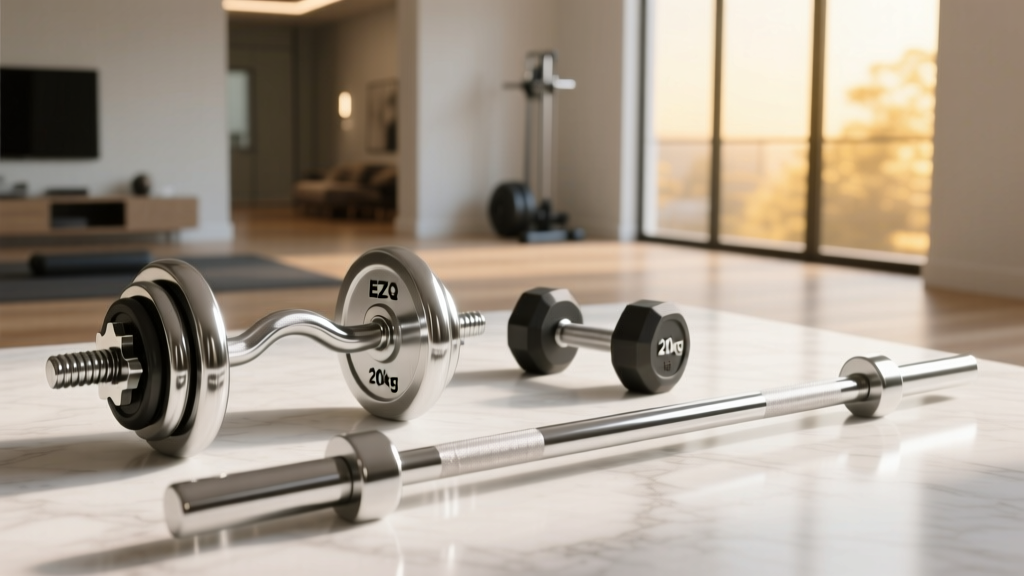
Conversely, the EZ curl bar features angled grips that place the hands in a semi-supinated position. This slight shift in grip angle reduces wrist torque and shifts a greater percentage of the mechanical tension onto the brachialis and the brachioradialis. While you may sacrifice a marginal amount of peak biceps contraction, the reduction in joint strain allows for higher training volumes and heavier loads without the connective tissue burnout associated with straight bars.
Why Arm and Grip Strength Matter for the Dumbbell Get Up
You might be wondering why a review of curl bars is intersecting with the dumbbell get up (often referred to as the Turkish Get-Up when performed with a kettlebell). The connection lies in the overhead lockout and the sweep-to-lunge transition. When you execute a heavy dumbbell get up, your wrist must remain perfectly stacked over your elbow and shoulder. If your forearm flexors, brachioradialis, and biceps tendons are fatigued, weak, or inflamed, the wrist will inevitably buckle under the load, leading to a failed lift or a severe shoulder impingement.
Expert Insight: The Lockout Chain
The StrongFirst methodology emphasizes that the get-up is a series of stacked joints. The grip is the first point of contact. A straight bar builds the raw, unyielding forearm and bicep tendon resilience needed to maintain a neutral wrist under a 70lb+ dumbbell. Meanwhile, the EZ bar allows you to accumulate the necessary arm volume to build that tissue tolerance without frying your wrists before your next get-up practice session.
Hands-On Review: 2026 Top Picks for Your Armory
To determine the best equipment for building get-up-ready arms, we tested the most popular bars on the market in early 2026, evaluating knurl depth, sleeve spin, tensile strength, and grip ergonomics.
1. Rogue Fitness Curl Bar (The Premium Standard)
Price: $135.00 | Grip Diameter: 35mm | Tensile Strength: 190,000 PSI
The Rogue Curl Bar remains the gold standard for commercial and serious home gyms. The 35mm grip diameter is noticeably thicker than standard cheap curl bars, which forces your forearms to work harder during every rep. This thicker grip directly translates to the grip endurance required during the floor-press and sweep phases of the dumbbell get up. The composite bushings provide a smooth, consistent spin, preventing wrist bind when you are grinding out heavy eccentric reps. The dual knurl marks are aggressive enough to secure a chalky grip but won't tear your calluses.
2. Titan Fitness 47" Straight Curl Bar (The Budget Workhorse)
Price: $69.99 | Grip Diameter: 25mm | Finish: Chrome
If your goal is strictly to overload the biceps brachii with a fully supinated grip, the Titan 47-inch straight bar is an exceptional value. At 25mm, the grip is relatively thin, allowing for a tight, secure lock around the bar. This is ideal for lifters with smaller hands who struggle to maintain a false grip on thicker Olympic bars. However, the chrome finish can become slick with sweat, so chalk is mandatory for heavy sets. We recommend using this bar for low-rep, high-intensity strength work rather than high-volume pump work, to spare your wrists.
3. Eleiko Olympic EZ Curl Bar (The Elite Choice)
Price: $285.00 | Grip Diameter: 30mm | Bearings: Precision Needle
For the uncompromising lifter, the Eleiko EZ Curl Bar is a masterpiece of engineering. The 30mm grip hits the perfect sweet spot between the thick Rogue and the thin Titan. The proprietary knurling pattern is arguably the best in the industry—it grips the skin securely without feeling like a cheese grater. The needle bearings in the sleeves ensure that the bar rotates independently of your wrists, completely eliminating rotational torque during strict curls. If your dumbbell get up is limited by wrist pain from heavy arm accessories, this bar is the ultimate rehabilitation and hypertrophy tool.
Head-to-Head Comparison Matrix
| Feature | Straight Bar | EZ Curl Bar |
|---|---|---|
| Grip Angle | Full Supination (Palms Up) | Semi-Supinated (Valgus Angle) |
| Primary Muscle Focus | Biceps Brachii (Short & Long Heads) | Brachialis & Brachioradialis |
| Wrist Strain | High (Requires mobile wrists) | Low (Ergonomic alignment) |
| Get-Up Utility | Builds raw lockout tendon strength | Builds volume without wrist fatigue |
| Max Load Capacity | Higher (Better leverage) | Slightly Lower |
Programming Protocol: Pairing Curls with the Dumbbell Get Up
Integrating isolated arm work into a program dominated by complex, full-body movements like the dumbbell get up requires strategic periodization. You cannot perform heavy straight bar curls the day before a heavy get-up session, as the delayed onset muscle soreness (DOMS) and central nervous system (CNS) fatigue in your forearms will compromise your overhead stability. The National Strength and Conditioning Association (NSCA) frequently highlights the importance of managing localized fatigue when programming accessory movements around primary skill work.
Here is a proven weekly split to maximize arm hypertrophy while protecting your get-up performance:
- Monday (Heavy Skill & Raw Strength): Perform heavy dumbbell get ups (3-5 reps per side, 85%+ 1RM). Follow up with Straight Bar Curls (4 sets of 5-8 reps). The heavy straight bar work will build the raw tendon stiffness needed for the lockout.
- Wednesday (Active Recovery & Mobility): Light get-up practice with a shoe or very light dumbbell. No direct arm work. Allow the wrist flexors to recover.
- Friday (Volume & Hypertrophy): Perform moderate dumbbell get ups (8-10 reps per side, 60% 1RM) focusing on speed and technique. Follow up with EZ Curl Bar Curls (4 sets of 10-15 reps). The EZ bar allows you to flush the biceps and brachialis with blood, promoting hypertrophy and tissue healing without aggravating the wrists.
Expert Verdict: Which Should You Buy?
The choice between the EZ curl bar vs straight bar ultimately depends on your wrist anatomy and your primary training goals. If your main objective is to build the raw, unyielding forearm and bicep strength required to stabilize a massive overhead load during a heavy dumbbell get up, the straight bar is a non-negotiable tool in your arsenal. It forces the wrists to adapt to high-torque environments, building the exact type of connective tissue resilience needed for functional strength.
However, if you suffer from medial epicondylitis (golfer's elbow) or general wrist pain, the straight bar will quickly become a liability. In this case, the EZ curl bar is vastly superior. It allows you to continue building the brachialis and forearm musculature necessary for joint support, without the destructive valgus stress. For the most well-rounded home gym in 2026, we recommend investing in a high-quality EZ curl bar (like the Rogue or Eleiko) as your primary arm builder, and utilizing a standard Olympic barbell for occasional heavy, supinated grip work to maintain tendon stiffness.
More gear to consider
All reviews
Put Down the Dumbbell Mug: Beginner Guide to Barbell Collars
Barbell Setup: Weight, Knurling & Do You Clean Dumbbells at the Gym?
Collar Guide for Any Barbell and Dumbbell Leg Workout

Bumper vs Iron Plates: Budget Breakdown & Dumbbell Glute Workout

Dumbbell Rack Layouts: Space for Seated Dumbbell Front Raises