
Olympic vs Standard Plates for the One Arm Dumbbell Shoulder Press
Comparing Olympic vs standard weight plates for loadable dumbbells. Discover which bore size optimizes your one arm dumbbell press shoulder mechanics.

The Biomechanical Link: Plates, Handles, and Shoulder Stability
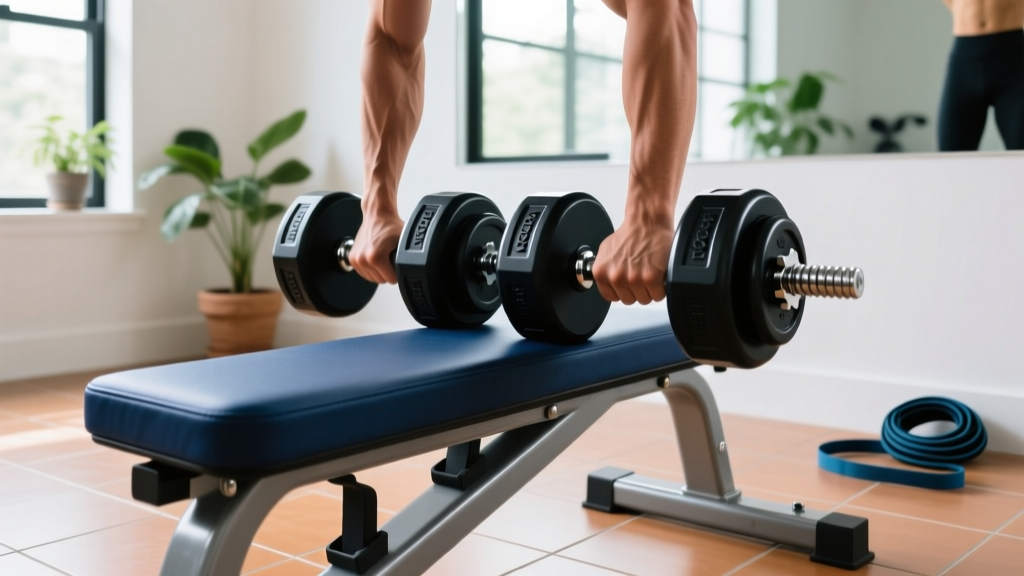
When building a home gym in 2026, the debate between Olympic and standard weight plates usually centers on barbell lifts. However, this decision becomes critically complex when you introduce loadable dumbbells into your routine. If you are targeting the anterior deltoid via a one arm dumbbell press shoulder routine, the rotational mechanics of your wrist, the diameter of your plates, and the locking mechanism of your dumbbell handle all intersect to dictate both performance and safety.
Unlike fixed hex or urethane dumbbells, loadable dumbbell handles require you to slide weight plates onto a sleeve. The bore size of those plates—1-inch for standard, 2-inch for Olympic—fundamentally changes the physics of unilateral pressing. According to ExRx.net's biomechanical breakdown of the dumbbell shoulder press, the natural movement path requires slight internal and external rotation of the humerus, which translates to torque on the wrist and the dumbbell sleeve. Let us break down exactly how standard and Olympic plates handle this torque, and which system is superior for heavy overhead pressing.
Standard (1-Inch) Weight Plates: The Budget Spin-Lock Route
Standard weight plates feature a 1-inch center hole and are paired with 1-inch diameter dumbbell handles. These handles almost universally rely on threaded "spin-lock" or "star-lock" collars to secure the weight.
Real-World Specs and 2026 Pricing
- Average Cost: $1.20 to $1.60 per pound (cast iron).
- Common Models: CAP Barbell Cast Iron Standard Plates, Yes4All Standard Sets.
- Handle Cost: $20 to $35 for a pair of 14-inch threaded handles.
The "Wobble" Failure Mode in Unilateral Pressing
When executing a heavy one arm dumbbell press shoulder movement, your grip naturally shifts from a slightly neutral position at the bottom of the lift to a pronated (palms-forward) position at lockout. On a standard 1-inch handle, the sleeve does not rotate independently of the grip. This means the rotational torque generated by your wrist is transferred directly into the iron plates.
As the plates twist against the threads of the spin-lock collar, they create microscopic vibrations. Over a set of 8 to 10 reps, this friction can literally unscrew the star-lock nut. We have documented numerous instances where lifters performing strict unilateral presses experienced a collar failure at the top of the movement, resulting in a 25-pound iron plate dropping onto their face or clavicle. For heavy overhead work, standard spin-lock handles are a documented safety hazard.
Olympic (2-Inch) Weight Plates: Rotational Freedom
Olympic plates feature a 2-inch bore and require specialized Olympic loadable dumbbell handles. In 2026, high-quality loadable handles (such as the Rogue Loadable Dumbbell Handle or the Titan Fitness Olympic Dumbbell Handle) feature internal bronze bushings or needle bearings.
Sleeve Rotation and Wrist Health
This is where Olympic plates shine for overhead pressing. Because the sleeve rotates independently of the handle grip, the torque generated during the pressing arc is absorbed by the bushings, not the plates. The 2-inch Olympic plates remain completely stationary while the handle rotates in your palm. This eliminates collar-loosening vibrations entirely and drastically reduces shear stress on your wrist joints during the lockout phase.
Expert Insight: If you are pushing loads north of 60 pounds per hand on a loadable dumbbell, the rotational decoupling of an Olympic bushing sleeve is not just a luxury; it is a mandatory requirement for joint longevity and lift safety.
The Head-Clearance Problem (Why Bumpers Fail)
There is a massive caveat to using Olympic plates for shoulder presses: plate diameter. A standard 10-pound Olympic bumper plate has a diameter of 17.7 inches. If you load 10-pound bumpers onto an Olympic dumbbell handle and attempt a shoulder press, the plates will physically collide with your head and neck before your elbow can reach 90 degrees of flexion, completely destroying your range of motion.
To perform a proper one arm dumbbell press shoulder exercise with Olympic gear, you must purchase Olympic Cast Iron or Urethane Grip Plates. As detailed in the Rogue Fitness Deep Dish Iron Plates specifications, a 10-pound Olympic iron plate has a diameter of roughly 9 inches, and a 2.5-pound plate is just 4.5 inches. This compact profile allows the dumbbell to clear your ear and neck at the bottom of the press, mimicking the ergonomics of a fixed hex dumbbell.
Head-to-Head Comparison Matrix
| Feature | Standard (1-Inch Bore) | Olympic (2-Inch Bore) |
|---|---|---|
| Handle Sleeve Mechanics | Fixed (Transfers torque to plates) | Bushing/Bearing (Decouples torque) |
| Collar Security | Spin-Lock (Prone to vibrating loose) | Snap-Ring or Clamp (Highly secure) |
| 10lb Plate Diameter | ~6.5 inches (Excellent clearance) | ~9.0 inches (Iron) / 17.7" (Bumper) |
| Cost per Pound (2026) | $1.20 - $1.60 | $1.80 - $3.50 (Iron/Urethane) |
| Wrist Ergonomics | Poor (Forces rigid wrist tracking) | Excellent (Allows natural rotation) |
| Best For | Light isolation, budget home gyms | Heavy unilateral pressing, longevity |
Grip Length and Sleeve Real Estate
Another non-obvious factor in the Olympic vs. standard debate is the physical footprint of the dumbbell. Standard 1-inch handles are usually 14 inches long, with about 5 inches of loadable sleeve space. Because standard iron plates are relatively thin, you can stack 35 to 40 pounds per hand before running out of sleeve space.
Olympic loadable dumbbell handles are typically 19 to 20 inches long. However, Olympic iron plates are thicker. Furthermore, the grip thickness on an Olympic handle is usually 35mm (compared to the 28mm-30mm grip of a standard handle). For lifters with smaller hands, the 35mm grip of an Olympic handle can make stabilizing a heavy one arm dumbbell press shoulder variation significantly more taxing on grip endurance. If you have small hands, you may need to invest in specialized 30mm-32mm Olympic handles (like those offered by REP Fitness or Eleiko) to maintain proper grip security without premature forearm fatigue.
Final Verdict: Building Your 2026 Home Gym
If your primary goal is heavy, progressive unilateral overhead pressing, the Olympic system is the undisputed winner, provided you buy the correct plate profiles. The bushing-equipped sleeves protect your wrists and prevent catastrophic collar failures, while snap-ring collars ensure the weight stays locked in place.
Warning: Never use Olympic bumper plates for loadable dumbbell shoulder presses. The 17.7-inch diameter will halt your range of motion and force dangerous compensatory arching in your lumbar spine. Always use calibrated iron or urethane grip plates for overhead dumbbell work.However, if you are on a strict budget and only plan to perform lighter isolation movements (lateral raises, light tricep extensions) under 30 pounds per hand, a standard 1-inch spin-lock setup remains a viable, space-saving entry point. Just be vigilant about checking your collars between every single set.
Frequently Asked Questions
Can I use standard plates on an Olympic dumbbell handle?
No. The 1-inch bore of a standard plate will not fit over the 2-inch sleeve of an Olympic handle. While cheap plastic adapters exist to convert standard plates to Olympic bars, using them on dumbbell handles adds dangerous lateral wobble and is highly discouraged for overhead pressing.
Why do my wrists hurt during the one arm dumbbell press shoulder movement?
Wrist pain during unilateral pressing is often caused by using fixed handles or standard spin-lock handles that force your wrist into a rigid, pronated track. Switching to an Olympic loadable handle with rotating sleeves allows the dumbbell to follow your natural biomechanical arc, significantly reducing joint strain.
More gear to consider
All reviews
EZ Curl Bar vs Straight Bar: Pairing & Split Squats with Dumbbells

Loadable Biceps Dumbbell Setups: 2026 Budget & Value Analysis

Best Neoprene Dumbbells for Dumbbell Complex Exercises (2026)

Top Dumbbell Racks & Storage for Quad Focused Dumbbell Exercises
Troubleshooting Neoprene Dumbbell Bench Press Equipment Mistakes
