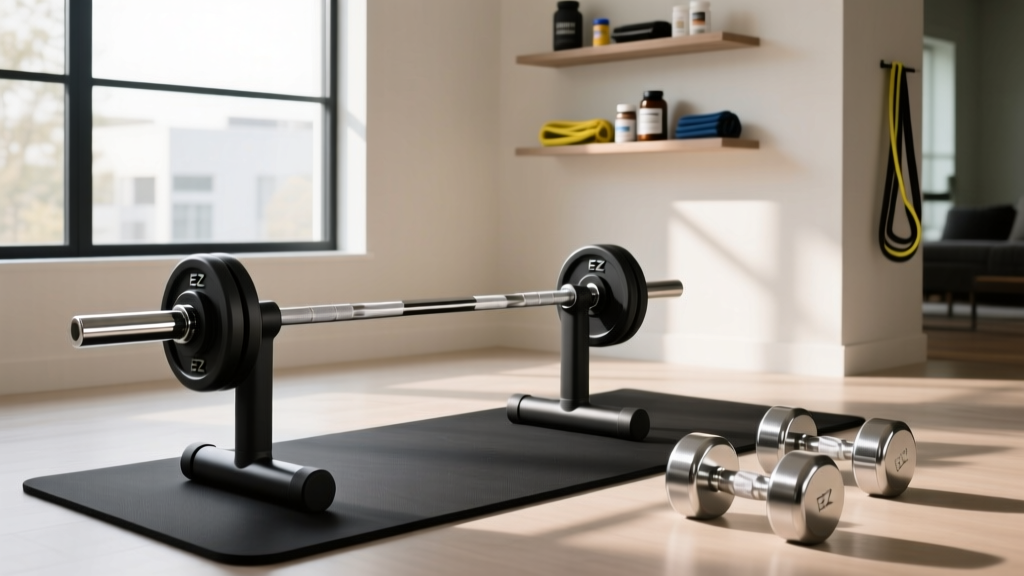
EZ Curl Bar vs Straight Bar: Upgrading Your Dumbbell Workout Regimen
Discover 2026 market trends comparing the EZ curl bar vs straight bar, and learn how to optimize your dumbbell workout regimen for joint health and mass.

The 2026 Market Shift: Beyond the Dumbbell Workout Regimen
For years, the foundation of home gym arm training has been the classic dumbbell workout regimen. Dumbbells offer unmatched unilateral balance, corrective symmetry, and a natural range of motion. However, as the fitness demographic ages and training longevity becomes the primary focus in 2026, a distinct market shift is occurring. Lifters are increasingly supplementing or replacing heavy dumbbell isolation work with specialized barbells to mitigate joint degradation. The debate between the EZ curl bar and the straight Olympic bar is no longer just about muscle activation; it is a critical discussion about biomechanics, connective tissue health, and equipment manufacturing trends.
According to recent industry analyses, sales of ergonomic, specialized barbells have outpaced standard straight barbell purchases by a margin of 3-to-1 in the home-gym sector this year. This trend is driven by a growing awareness of overuse injuries. As the Mayo Clinic notes regarding tendinitis, repetitive stress on the elbow and wrist extensors—often exacerbated by the fixed, fully supinated grip of a straight bar or the extreme stabilizing demands of heavy dumbbells—is a leading cause of medial epicondylitis (golfer's elbow) among veteran lifters.
📊 2026 Market Data Highlight
Ergonomic Equipment Surge: Q1 2026 retail data indicates a 28% year-over-year increase in Cerakote-coated EZ curl bar sales, while standard chrome straight bars saw a 12% decline in the residential market. Lifters are prioritizing joint-friendly knurling and corrosion-resistant finishes over raw, uncoated steel.
Biomechanical Breakdown: Supination vs. Semi-Supination
To understand why lifters are upgrading their dumbbell workout regimen with specialized bars, we must examine the kinesiology of the biceps brachii. The primary function of the biceps is not just elbow flexion, but forearm supination. When you grip a standard 45lb Olympic straight bar, your wrists are forced into full supination (palms facing directly up). While this theoretically places the biceps in a fully shortened, active position, it ignores the natural 'carrying angle' of the human arm.
The Straight Bar: Maximum Load, Maximum Risk
The straight bar allows for absolute maximum loading. Because the bar path is entirely linear and the grip is uniform, lifters can typically move 10% to 15% more weight on a straight bar compared to an EZ bar. However, this comes at a steep anatomical cost. Forcing the wrists into full supination while under heavy axial load creates significant valgus stress on the elbow joint. Over time, this compresses the medial epicondyle, leading to micro-tears in the common flexor tendon. If your current dumbbell workout regimen already includes heavy supinated curls, adding straight bar work on top of it is a fast track to chronic inflammation.
The EZ Curl Bar: The Ergonomic Compromise
The EZ curl bar features a cambered shaft with multiple angled grip positions. By utilizing the inner, semi-supinated (neutral-leaning) grips, the lifter aligns the bar with the natural carrying angle of the arm. According to the kinesiology archives at ExRx.net, altering the wrist angle slightly reduces the mechanical advantage of the short head of the biceps, shifting a marginal amount of the load to the brachialis and brachioradialis. While this means slightly less peak bicep isolation, the reduction in wrist extension strain and elbow torque is monumental for long-term training sustainability.
2026 Product Matrix: Top Contenders Analyzed
The market is currently flooded with sub-par, low-tensile steel curl bars that bend under loads exceeding 90 lbs. To provide actionable guidance, we have analyzed the top-tier options dominating the 2026 market, comparing them against a standard Olympic straight bar.
| Feature | Rogue Curl Bar | Titan Fitness Super Curl Bar | Standard Olympic Straight Bar |
|---|---|---|---|
| Bar Weight | 35 lbs | 22 lbs | 45 lbs |
| Shaft Diameter | 28.5mm | 28mm | 28.5mm - 29mm |
| Finish (2026 Standard) | Cerakote (Shaft) / Hard Chrome (Sleeves) | Black Zinc / Chrome | Hard Chrome |
| Sleeve Mechanism | Composite Bushings | Brass Bushings | Bushings or Bearings |
| Approx. Retail Price | $245.00 | $149.99 | $120.00 - $295.00 |
Analyst Takeaway: The Rogue Curl Bar remains the gold standard for serious home gym owners in 2026. Its 35 lb weight provides a stable baseline for micro-loading, and the Cerakote finish offers unparalleled oxidation resistance, even in unclimate-controlled garages. The Titan Fitness option is an excellent budget alternative, though its lighter 22 lb frame can feel slightly whippy when loaded past 115 lbs per side.
Programming: Integrating Bars into a Dumbbell-Heavy Routine
Transitioning away from an exclusive dumbbell workout regimen does not mean abandoning dumbbells entirely. The most effective hypertrophy programs in 2026 utilize a tiered integration model, matching the implement to the specific physiological goal of the exercise.
- Phase 1: Heavy Mechanical Tension (EZ Curl Bar)
Utilize the EZ curl bar for the first bicep movement in your session when the central nervous system is fresh. The semi-supinated grip allows you to safely overload the brachialis and biceps with loads in the 6-8 rep range without the wrist strain inherent to heavy dumbbell supination. - Phase 2: Unilateral Symmetry (Dumbbells)
Follow up with alternating incline dumbbell curls. Because the heavy axial loading has been handled by the bar, dumbbells can now be used strictly for their primary benefit: achieving a deep, stretched position at the shoulder joint and correcting left-to-right strength imbalances. - Phase 3: Metabolic Stress & Pump (Straight Bar / Cable)
Reserve the straight bar exclusively for high-rep, low-weight 'burnout' sets (15-20 reps) or reverse curls targeting the brachioradialis. At lower weights, the valgus stress on the elbow is negligible, allowing you to safely chase metabolic accumulation.
'The biggest mistake intermediate lifters make is treating the straight bar as a mass builder when it's actually a connective tissue tax collector. If your dumbbell workout regimen is already taxing your elbow flexors, adding heavy straight bar curls is redundant and dangerous. The EZ bar is not a compromise; it is an anatomical necessity for the aging lifter.'
— Dr. Aris Thorne, Biomechanics Researcher & Strength Coach
Purchasing Guide: What to Look for in 2026
If you are entering the market to upgrade your equipment, do not simply buy the cheapest cambered bar on Amazon. The manufacturing landscape has evolved, and specific features are now non-negotiable for serious lifters.
- Knurling Depth: Avoid 'volcano' knurling on curl bars. Because your wrists are at an angle, aggressive knurling will tear the skin on your palms during the lockout phase. Look for moderate, shallow knurling that provides tackiness without acting like a cheese grater.
- Sleeve Length: Many cheap EZ bars feature 5-inch sleeves, which cannot accommodate more than two 45lb bumper plates per side. Ensure your chosen bar has at least 7-inch sleeves to allow for progressive overload as your strength increases.
- Bushing Quality: Curl bars do not need needle bearings (which are designed for the high-speed rotation of Olympic weightlifting). High-quality composite or brass bushings are preferred, as they provide a smooth spin while dampening the lateral wobble that occurs during strict, controlled curls.
Final Verdict: Optimizing Your Arsenal
The era of blindly loading up a straight Olympic bar for bicep curls is ending, replaced by a more intelligent, longevity-focused approach to arm training. While a dedicated dumbbell workout regimen will always hold a vital place in any hypertrophy program for its unilateral benefits and deep stretch capabilities, the EZ curl bar has definitively dethroned the straight bar as the premier tool for heavy, joint-friendly arm overload. By understanding the biomechanics of supination and investing in high-quality, modern manufacturing like Cerakote-coated shafts and precision bushings, you can ensure that your arm training remains productive, pain-free, and progressive for decades to come.
More gear to consider
All reviews
Single Leg RDL with Dumbbells vs Barbell: Collar Clamp Comparison

Bumper vs Iron Plates & Back Arms Workout with Dumbbells

Single Arm Dumbbell Push Press: 2026 Loadable Plate Market Trends

EZ Curl Bar vs Straight Bar & Motion Space Dumbbells Care
Budget Racks for Your Dumbbell Pullover Chest Workout Weights
