Dumbbell Rack Care and Storage for a Safer Dumbbell Push Press
Learn how to maintain your dumbbell rack and optimize storage height to safely load and execute the heavy dumbbell push press without injury.

The Biomechanical Link: Why Rack Setup Dictates Push Press Safety
The dumbbell push press is one of the most explosive, full-body overhead movements in strength training. According to ExRx.net's biomechanical breakdown, the lift relies on a violent dip and drive from the lower body to propel the weights upward, requiring immense shoulder stability and core bracing. However, the success and safety of this lift begin long before the actual press: it starts with how you clean the dumbbells off the rack.
When working with heavy dumbbells—typically 50 to 100+ lbs per hand for an intermediate or advanced push press—the physical act of retrieving and racking the weights places enormous stress on both your body and your storage equipment. A poorly maintained, improperly configured, or structurally compromised dumbbell rack transforms a simple retrieval into a high-risk liability. Warped shelves, degraded saddles, and loose hardware can cause the dumbbell to slip during the clean, leading to severe wrist, bicep, or shoulder injuries. This guide explores the critical intersection of dumbbell rack maintenance, storage ergonomics, and longevity, ensuring your equipment safely supports your heaviest overhead days.
The Clean-to-Press Ergonomics: Rack Height and Tier Selection
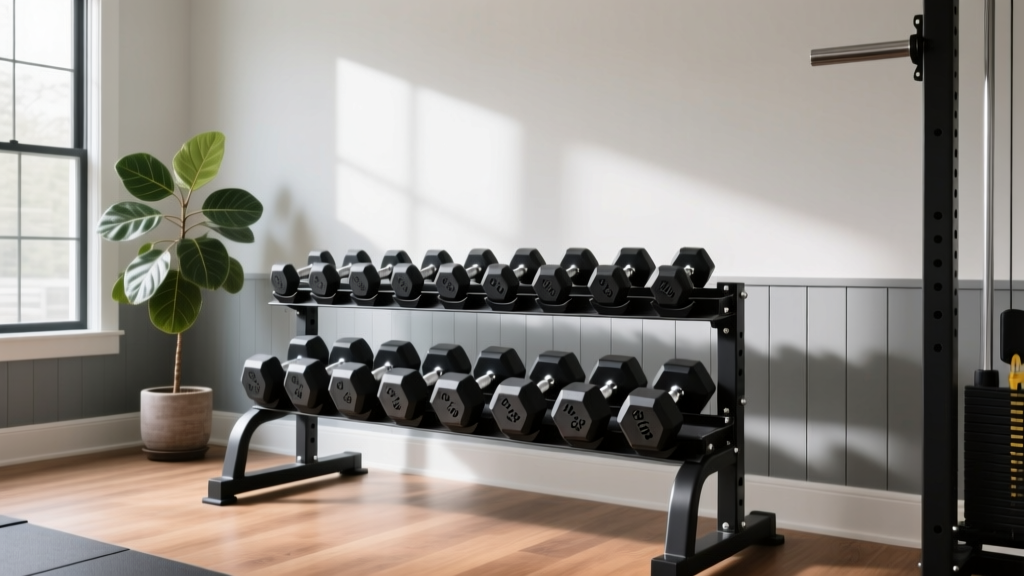
Not all dumbbell racks are created equal, and the tier height of your storage solution directly impacts the biomechanics of your clean into the push press. Most commercial and home gym racks fall into two primary categories: 2-tier and 3-tier horizontal racks, or vertical A-frames.
For the dumbbell push press, the top tier's height is the most critical metric. A standard 3-tier rack (like the popular models found in commercial gyms) often places the top shelf at roughly 38 to 42 inches off the floor. Cleaning an 80 lb dumbbell from a 40-inch shelf requires an awkward, upright rowing motion that places excessive shear force on the lumbar spine and biceps. Conversely, a 2-tier rack with a top shelf height of 30 to 34 inches allows the lifter to hinge at the hips, grip the dumbbell, and use a fluid, deadlift-like clean to bring the weight to the shoulders.
Rack Configuration and Maintenance Matrix
| Rack Type | Top Tier Height | Push Press Clean Ergonomics | Primary Maintenance Vulnerability |
|---|---|---|---|
| 2-Tier Horizontal | 30" - 34" | Excellent. Allows proper hip hinge and safe heavy cleaning. | Upright bending if users drop heavy bells from waist height. |
| 3-Tier Horizontal | 38" - 42" | Poor for heavy sets. Forces an upright, bicep-heavy row to clean. | Top-tier shelf warping; carriage bolt loosening from vibration. |
| A-Frame (Vertical) | Variable (Up to 60") | Dangerous for heavy push press cleans. High risk of lateral tipping. | Base weld fractures; floor anchor bolt pull-out. |
Hardware Integrity: Combating Vibration and Drop-Shock
The most common failure point on any dumbbell rack is the hardware. When a lifter completes a grueling set of heavy push presses, they rarely lower the dumbbells with perfect, controlled eccentrics back to the rack. Instead, the bells are often dropped or forcefully guided onto the shelves. This repeated "drop-shock" sends high-frequency vibrations through the steel frame, systematically backing out nuts and bolts over time.
The 90-Day Torque Protocol
To maintain structural longevity, implement a strict 90-day hardware audit. Most premium racks, such as the Rogue 3-Tier Dumbbell Rack, utilize M10 or M12 carriage bolts and heavy-duty hex nuts.
- Inspect for Micro-Gaps: Look closely at the connection points between the uprights and the horizontal shelf brackets. Any visible gap indicates the bolt has stretched or backed out.
- Apply Threadlocker: If you find bolts that continuously loosen, remove them, clean the threads with a wire brush, and apply a medium-strength threadlocker like Loctite 243. Avoid Loctite 271 (red/high-strength), as it requires extreme heat to remove and makes future maintenance a nightmare.
- Torque Specifications: Use a calibrated torque wrench. For standard M12 Grade 8.8 steel bolts used in fitness equipment, the optimal torque setting is typically between 45 Nm and 55 Nm (approx. 33-40 ft-lbs). Overtorquing can strip the threads or snap the bolt head under lateral stress.
If your facility utilizes A-Frame dumbbell racks, they must be bolted to the floor or a heavy rubber matting system. When a user aggressively racks a heavy dumbbell on one side of an A-frame, the lateral torque can easily exceed the base's center of gravity, causing the entire rack to tip over. Inspect floor anchor wedges quarterly for concrete spalling or pull-out.
Saddle Care and The "Drop-Zone" Wear Pattern
The "saddle" is the protective liner resting on the steel shelves, designed to cradle the dumbbell and protect its knurling and coating. In budget racks, these are made of cheap, recycled rubber. In premium racks, they are crafted from UHMW (Ultra-High Molecular Weight) polyethylene or dense, vulcanized rubber pads.
Because the push press is a high-fatigue exercise, the top tier of the rack becomes the "Drop-Zone." Users consistently dump the heaviest dumbbells onto the exact same two-inch strip of the saddle. Over time, this causes:
- Compression Set: The rubber permanently compresses, losing its shock-absorbing properties and transferring drop-shock directly to the steel shelf welds.
- Friction Tearing: The aggressive knurling of steel or iron dumbbells acts like a file against degraded rubber, eventually tearing the saddle and exposing the bare steel shelf beneath.
Saddle Replacement and Upgrade Strategy
Do not wait for the saddle to tear completely. Once you notice deep grooves or a hard, glossy finish on the rubber (indicating it has dried out and lost its elasticity), replace it. Upgrading from standard rubber to UHMW plastic liners (typically $30 to $60 per shelf tier) drastically reduces friction, allows dumbbells to slide into position smoothly, and boasts a lifespan up to five times longer than vulcanized rubber.
Environmental Longevity: Fighting Rust and Urethane Chalking
The environment surrounding your dumbbell rack dictates the lifespan of both the rack and the dumbbells stored on it. The push press is a highly metabolic, sweat-inducing movement. Lifters standing directly in front of the rack will inevitably drip sweat onto the uprights and shelves.
Coating Maintenance
Most modern racks feature either a powder-coated finish or a zinc plating. Sweat is highly acidic and corrosive. If left to pool in the crevices where the shelf brackets meet the uprights, it will bypass the powder coat and cause sub-surface oxidation (rust that bubbles up from underneath the paint).
- Weekly Wipe-Downs: Use a pH-neutral cleaner or a simple mixture of water and a few drops of mild dish soap. Avoid bleach-based or highly acidic gym wipes, which can degrade powder-coat binders and cause UHMW plastics to become brittle.
- Urethane Dumbbell Care: If you store urethane dumbbells on the rack, keep them out of direct UV sunlight. UV exposure causes urethane to "chalk" (a white, powdery degradation on the surface) and eventually crack. If chalking begins, wiping the dumbbells down with a specialized urethane protectant or a very light coat of mineral oil can restore the surface and halt degradation.
"Facility layout is a critical component of equipment longevity. Placing heavy dumbbell storage in high-humidity zones or direct HVAC draft lines accelerates the oxidation of uncoated steel components and degrades rubber shock-absorbers at an exponential rate." — Principles of Strength and Conditioning Facility Design
Frequently Asked Questions (FAQ)
Can I use a standard barbell squat rack to store dumbbells for my push press?
While you can temporarily rest dumbbells on the J-cups or pin-pipe safeties of a power rack, it is highly discouraged for heavy push press sets. Barbell racks lack the wide, cradling surface area of a dedicated dumbbell rack, creating a severe tipping hazard if the dumbbell is not placed perfectly dead-center. Furthermore, the steel-on-steel or steel-on-UHMW contact can damage the dumbbell's ends.
How do I fix a warped shelf on my 3-tier dumbbell rack?
If a horizontal shelf has bowed downward in the center, it is usually due to overloading the middle span with heavy (100+ lb) dumbbells while the outer brackets remain unsupported. To fix minor bowing, remove all weights, use a hydraulic floor jack with a block of wood to gently push the steel back to a 90-degree level, and then install an aftermarket steel cross-brace underneath the shelf to redistribute the load to the uprights.
What is the best floor matting to place under a dumbbell rack?
Use 3/8-inch or 1/2-inch thick vulcanized rubber horse stall mats. They provide enough density to absorb the acoustic shock of dropped dumbbells without compressing so much that the rack becomes unlevel. Avoid interlocking EVA foam tiles, as they will permanently compress under the concentrated point-load of a heavily loaded dumbbell rack's feet.
More gear to consider
All reviews
Dumbbell Lateral Raise Form Guide & Best Adjustable Dumbbells Reviewed

Home Gym Setup Walkthrough: Integrating a 45 lb Dumbbell Pair
Space-Saving Dumbbell Racks for Your Dumbbell Leg Workout
Are Dumbbells FSA Eligible? Loadable Plates Budget
Barbell Collar Types & Rotating Dumbbell Press Safety