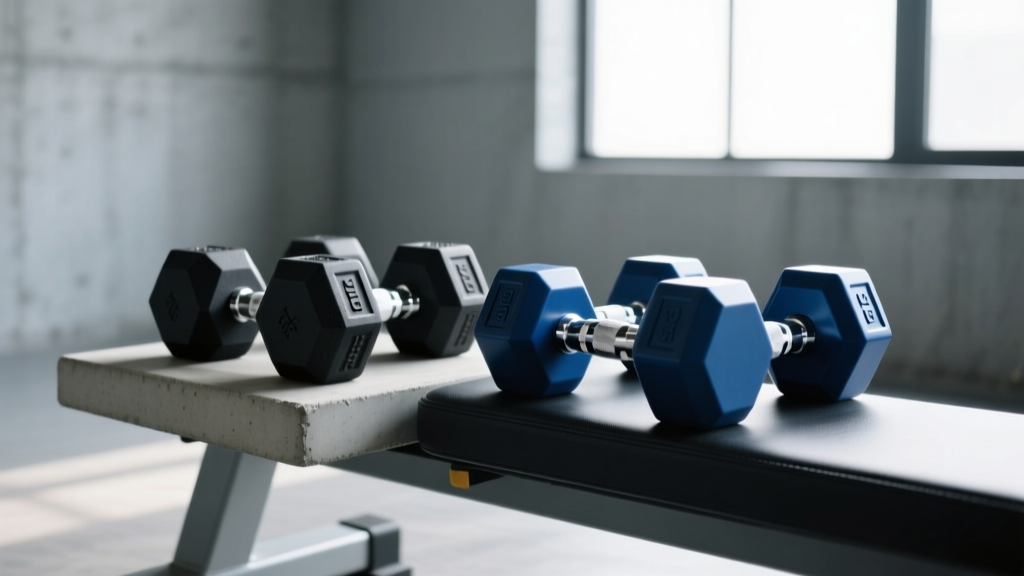
Decline Dumbbell Bench Press: Rubber Hex vs Urethane Value Analysis
Discover the true cost of rubber hex vs urethane dumbbells for the decline dumbbell bench press. We break down 5-year value, safety, and durability.

The Biomechanical and Safety Demands of the Decline Dumbbell Bench Press
When building a comprehensive chest routine, the decline dumbbell bench press is a non-negotiable movement for targeting the lower sternal fibers of the pectoralis major. According to exercise biomechanics databases like ExRx.net, the 15-to-30-degree decline angle alters the force vector, placing unique stress not just on your musculature, but on the equipment itself. Unlike flat or incline variations, the decline angle changes how you kick the weights up, how sweat migrates down your forearms, and most importantly, the trajectory and impact force when you drop the dumbbells at the end of a grueling set.
This brings us to a critical equipment debate for home and commercial gym owners in 2026: rubber hex dumbbells vs. urethane dumbbells. While both feature the hexagonal heads necessary to prevent rolling into the bench's rear leg supports, their material composition dictates their long-term value, safety profile, and total cost of ownership. In this budget breakdown, we strip away the marketing fluff and analyze the real-world financial and functional differences between these two coatings specifically through the lens of the decline dumbbell bench press.
The Sweat Migration Factor
On a decline bench, gravity pulls sweat from your torso and face directly down your arms and into your grip. Urethane offers a slightly more porous, tactile micro-texture on the handle edges compared to the slick, sometimes oily finish of budget rubber hex dumbbells, making grip security paramount when handling heavy loads at a negative angle.
Rubber Hex Dumbbells: The Budget-Friendly Workhorse
Rubber-coated cast iron hex dumbbells (such as the widely available CAP Barbell or Yes4All lines) have been the default choice for budget-conscious lifters for decades. In 2026, you can expect to pay between $1.50 and $2.20 per pound for a standard rubber hex set. For a pair of 70-pound dumbbells, that is an upfront investment of roughly $210 to $308.
Material Science and Failure Modes
The 'rubber' used in these budget options is typically a recycled synthetic blend with a Shore A Durometer (hardness) rating of around 85 to 90. This makes the coating relatively hard. While this hardness protects the floor from superficial scratches, it creates a high-rebound effect. When you finish a set of decline dumbbell bench presses and drop the weights to the floor, the hard rubber absorbs very little kinetic energy. The resulting bounce can cause the dumbbells to ricochet unpredictably, posing a hazard to your shins or the bench frame.
- Edge Chipping: The most common failure mode for rubber hex dumbbells is the tearing of the rubber at the sharp hexagonal corners after repeated drops from the elevated height of a decline bench.
- Handle Separation: Budget rubber dumbbells often use a press-fit or basic weld at the handle insertion point. The high-impact shock from hard rubber bouncing transfers directly to this joint, leading to loosening and eventual 'rattling' within 2 to 3 years of heavy use.
- VOC Off-Gassing: Recycled rubber emits volatile organic compounds (VOCs). In a poorly ventilated home gym, this odor can be overwhelming and degrade the air quality during intense, heavy-breathing sets.
Urethane Dumbbells: The Premium Investment
Urethane is a high-grade synthetic elastomer that has become the gold standard for premium commercial and serious home gyms. Brands like Rogue Fitness and REP Fitness engineer their urethane dumbbells to withstand thousands of drops. The 2026 pricing for urethane reflects this durability, sitting firmly between $3.50 and $5.00 per pound. A pair of 70-pound urethane dumbbells will cost you $490 to $700 upfront.
Why Urethane Excels for Decline Presses
Urethane possesses superior 'elastomeric memory' and abrasion resistance compared to standard rubber. It is typically formulated to a Shore A Durometer of 90, but unlike hard rubber, it has a 'dead-bounce' quality. It absorbs and disperses kinetic energy rather than reflecting it. When you drop a urethane dumbbell after a max-effort decline press, it hits the floor with a dull thud and stays exactly where it lands.
'The true cost of a dumbbell isn't just the purchase price; it's the replacement cost and the risk of injury from equipment failure. Urethane's dead-drop characteristic is a massive safety upgrade for any movement where the lifter's center of gravity is compromised, such as the decline bench press.'
— Industrial Fitness Equipment Testing Standards, 2025 Report
Furthermore, urethane is completely odorless, UV-resistant, and impervious to the sweat and oils that degrade cheaper rubber over time. The handle insertion points on premium urethane dumbbells are usually secured with high-tensile steel retaining bolts or deep-penetration friction welding, completely eliminating the 'rattle' that plagues budget sets.
5-Year Cost of Ownership & Performance Matrix
To truly understand the value, we must look beyond the initial receipt. Below is a comparative breakdown of the 5-year cost and performance metrics for a lifter performing the decline dumbbell bench press twice weekly, utilizing a pair of 70 lb dumbbells.
| Metric | Rubber Hex (Budget) | Urethane (Premium) |
|---|---|---|
| Upfront Cost (Pair of 70s) | $250 ($1.78/lb) | $590 ($4.21/lb) |
| Expected Lifespan | 3 - 4 Years | 10 - 15+ Years |
| 5-Year Replacement Cost | $250 (1 replacement needed) | $0 |
| Total 5-Year Spend | $500 | $590 |
| Bounce Factor (Drop Safety) | High (Hazardous) | Low (Dead-bounce) |
| Odor / Off-Gassing | High (VOCs present) | Zero |
| Edge Durability | Prone to tearing/chipping | Highly abrasion-resistant |
As the matrix illustrates, the financial gap narrows significantly over a half-decade. By year four, the rubber hex set will likely require replacement due to aesthetic degradation, edge tearing, or handle loosening, pushing its total cost of ownership dangerously close to the buy-it-for-life urethane set.
Real-World Value Analysis: Which Should You Buy?
Your decision should be dictated by your training environment, budget liquidity, and safety tolerance.
Choose Rubber Hex If:
- You are outfitting a garage gym on a strict sub-$500 total budget and need to purchase a full rack of dumbbells (e.g., 20 lbs to 50 lbs) rather than just heavy pairs.
- You are willing to mitigate the bounce risk by controlling the eccentric lowering phase and manually placing the dumbbells on the floor rather than dropping them after a set.
- Your gym is in a detached, well-ventilated structure where the initial rubber off-gassing odor will not be a nuisance.
Choose Urethane If:
- You frequently train to failure on the decline dumbbell bench press and require the safety of a dead-drop weight that won't bounce back toward your ankles or the bench frame.
- You are buying heavy dumbbells (60 lbs and above) where the kinetic energy of a drop is substantial enough to easily shatter cheap rubber coatings.
- You view your gym equipment as a 10-year capital investment and want a zero-maintenance, odor-free, commercial-grade aesthetic.
Frequently Asked Questions
Does the handle knurling differ between rubber and urethane dumbbells?
Generally, yes. Budget rubber hex dumbbells often feature shallow, standard knurling that can become slick when exposed to the sweat migration common in decline pressing. Premium urethane dumbbells typically feature deeper, 'volcano' style knurling and a slightly thicker handle diameter (often 35mm to 38mm), providing a much more secure grip when your hands are compromised by sweat at a 30-degree decline angle.
Can I repair chipped rubber hex dumbbells?
While you can use heavy-duty rubber adhesives or Flex Seal to patch cosmetic tears on the hexagonal edges, you cannot repair the internal structural integrity. If the rubber is chipping, it is a sign that the shock absorption has failed, and the cast iron core is taking the brunt of the impact, which will eventually lead to handle separation.
Is the decline dumbbell bench press safer with adjustable dumbbells?
Adjustable dumbbells (like Bowflex or Nuobell) are highly space-efficient, but they are not recommended for heavy, drop-prone movements like the decline dumbbell bench press. The internal dial or pin mechanisms of adjustable dumbbells are highly sensitive to impact. Dropping them from the height of a decline bench will almost certainly void the warranty and risk catastrophic failure mid-set. Stick to fixed-weight rubber hex or urethane for this specific movement.
More gear to consider
All reviews
Olympic Barbell Guide for a Chest Workout Without Dumbbells

Power Rack vs Squat Rack vs Stand: Best Dumbbell Exercise Book Rigs

Decorative Dumbbells Evolve: 2026 Loadable Plate Market Trends

Power Rack vs Squat Stand: How to Get Bigger Shoulders with Dumbbells

Barbell Collars vs Clamps & Collarbone Exercises with Dumbbells
