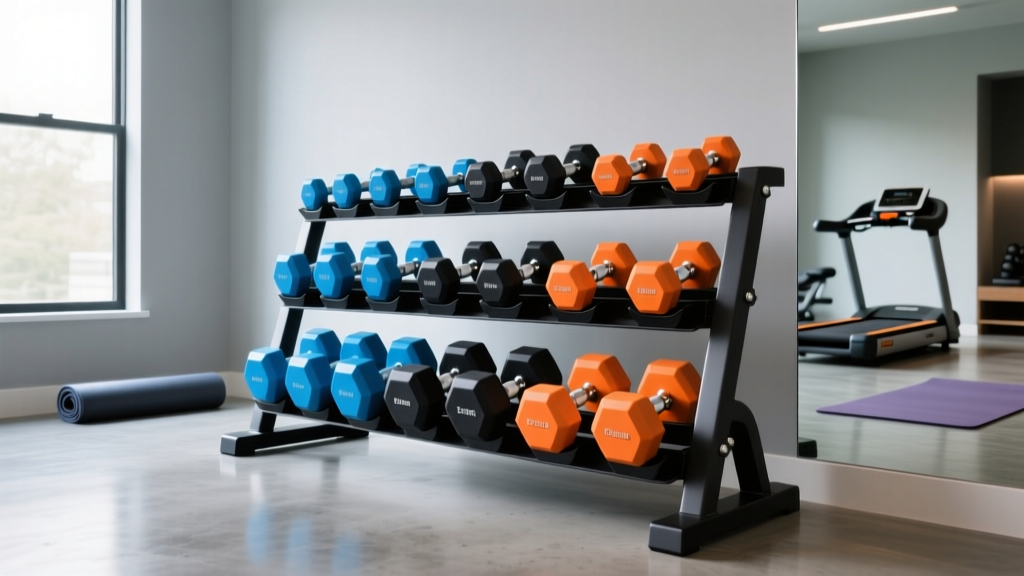
Smart Dumbbell Rack Layouts: Space for Any Dumbbell Fly Alternative
Optimize your home gym layout with space-saving dumbbell racks. Reclaim floor space to perform any dumbbell fly alternative with full wingspan clearance.

The Spatial Cost of Traditional Dumbbell Storage
As we refine home gym layouts in 2026, the shift toward joint-friendly movement patterns has exposed a major flaw in traditional equipment storage. The standard 3-tier dumbbell rack—such as the popular Rogue Fitness 3-Tier model—commands a footprint of roughly 43 inches long by 28 inches wide. That consumes over 8.3 square feet of prime floor space. While this seems negligible in a commercial facility, in a home garage gym or spare bedroom, that 8.3 square feet is often the exact clearance required for wide-stance, wide-arm isolation movements.
When lifters experience anterior shoulder capsule strain from heavy flat-bench dumbbell flyes, they naturally pivot to a dumbbell fly alternative. However, alternatives like cable crossovers, gymnastic ring flyes, or sliding floor flyes demand a massive 'wingspan zone'—an unobstructed lateral clearance of at least 7 to 8 feet. If your bulky dumbbell rack is parked in the corner of this zone, you risk smashing your elbows or knuckles into steel uprights mid-rep. Space optimization isn't just about aesthetics; it is a critical safety and biomechanical requirement.
Biomechanical Insight: The average adult male wingspan is approximately 70 inches. To perform a full range-of-motion chest fly variation safely, you need a minimum of 84 inches (7 feet) of lateral clearance to account for arm extension, hand width, and a safety buffer. According to facility design guidelines from the NSCA, equipment placement must always prioritize the maximum dynamic envelope of the intended exercises over static storage convenience.Reclaiming the Wingspan Zone for Fly Alternatives
By swapping a horizontal 3-tier rack for a vertical or wall-mounted solution, you can reclaim up to 6 square feet of usable floor space. This reclaimed space is exactly what you need to properly execute the three most effective fly alternatives:
- Cable Crossovers: Requires a functional trainer or dual cable stack. You need a clear 8-foot path between the stacks. A vertical dumbbell rack tucked tightly against the wall prevents the rack from encroaching on the cable's line of pull.
- Gymnastic Ring Flyes: Suspended from a pull-up bar or squat rack crossmember. This movement requires a 6-foot lateral clearance and a 4-foot posterior clearance to allow for a slight backward lean. Wall-mounted storage ensures the floor beneath the rings is entirely free of tripping hazards.
- Sliding Floor Flyes (ValSlides/Towels): Performed on a smooth surface from a push-up position. This highly effective chest isolation requires a 4x6 foot unobstructed floor mat area, completely free from the protruding feet of traditional A-frame racks.
Top Space-Optimized Dumbbell Racks for Layout Efficiency
Below is a comparison of the most efficient storage solutions available, graded on how well they preserve your wingspan zone for dynamic movements.
| Storage Model | Floor Footprint | Capacity | Est. Price | Fly-Alt Clearance Score |
|---|---|---|---|---|
| Titan Fitness Wall-Mount Rack | 0 sq ft (Wall) | 200 lbs / shelf | $129 | 10/10 (Maximum) |
| Rep Fitness Vertical Rack | 4 sq ft (24x24) | 5-50 lb pairs | $149 | 8/10 (High) |
| PowerBlock Elite Tray | 0.5 sq ft (12x6) | 1 adjustable pair | $69 (Tray only) | 10/10 (Maximum) |
| Rogue 3-Tier Standard | 8.3 sq ft (43x28) | Up to 150 lb pairs | $295 | 3/10 (Poor) |
Step-by-Step: Designing Your Free Weight Zone
To seamlessly integrate your dumbbell storage while prioritizing space for a dumbbell fly alternative, follow this layout sequence:
- Map the Dynamic Envelope: Stand in the center of your planned workout area with your arms extended laterally. Add 12 inches to each side. Mark this 7-to-8-foot circle with painter's tape. This is your 'No-Storage Zone'.
- Anchor the Vertical/Wall Storage: Place your chosen rack on the periphery of the taped zone. If using a wall-mounted unit like the wall-hanging options from Rogue or Titan, ensure the bottom shelf is at least 24 inches off the ground to allow for sliding flye movements underneath.
- Align the Alternative Equipment: Position your cable stacks or suspension anchor points so that the line of pull intersects directly with the center of your cleared zone. Ensure no dumbbell handles protrude past the rack's vertical plane into your swing path.
- Test the Eccentric Phase: Perform a dry run of your fly alternative with zero weight. Fully extend your arms and simulate the eccentric stretch. If your knuckles graze the stored dumbbells, rotate the rack 90 degrees or switch to a flush-mount wall tray.
Edge Cases and Installation Failure Modes
Space optimization often introduces structural risks if not executed correctly. When reclaiming floor space, you must account for the following failure modes:
Warning: Wall-Mount Drywall PulloutA pair of 50lb dumbbells resting on a wall-mounted shelf generates significant shear force. Never use standard drywall toggle bolts for dumbbell storage. You must drive 3/8-inch or 1/2-inch structural lag screws directly into the center of wooden wall studs (typically spaced 16 inches on center). If your rack's mounting holes do not align with 16-inch stud spacing, you must install a horizontal 2x6 wooden cleat across the studs first, and then mount the rack to the cleat.
Vertical Rack Tipping Hazards:
Vertical racks like the Rep Fitness model have a small 24x24 inch footprint. While this is excellent for saving space for fly alternatives, it creates a high center of gravity. If you pull a heavy 90lb dumbbell from the top tier aggressively, the dynamic force can tip the rack forward. Solution: Always load vertical racks from the bottom up, keeping the heaviest pairs on the lowest tier. For homes in seismic zones or on uneven garage floors, use the included L-brackets to anchor the top of the vertical rack to the wall.
Frequently Asked Questions
Q: Can I just store my dumbbells on the floor to save space?
A: While storing dumbbells on the floor technically frees up vertical space, it creates severe tripping hazards and ruins the smooth floor surface required for sliding floor flyes. Furthermore, bending down to pick up 80lb hex dumbbells from the floor places unnecessary shear stress on the lumbar spine. A compact vertical or wall-mounted rack is a non-negotiable safety requirement.
Q: Are adjustable dumbbells better for small gym layouts?
A: Absolutely. A set of PowerBlock or Nuobell adjustable dumbbells replaces up to 30 pairs of traditional fixed-weight dumbbells. When paired with a compact storage tray, you reduce your storage footprint by over 95%, leaving the entirety of your garage or spare room open for wide-stance cable crossovers and ring flyes.
Q: How far should a dumbbell rack be from a squat rack?
A: Maintain a minimum of 36 inches of clearance between any dumbbell storage and your power rack. This allows you to safely carry heavy dumbbells to a bench without clipping the squat rack's uprights, and ensures you have an escape route if you need to bail on a heavy set.
More gear to consider
All reviews
Space Layouts for Different Exercises with Dumbbells: Hex vs Urethane

Top Adjustable Dumbbells for Beginner Dumbbell Workout Plans in 2026

Troubleshooting Dumbbell Press Variations: Olympic vs Standard Plates
Optimize Your Training Program with Dumbbells: Rubber Hex vs Urethane

Bumper vs Iron Plates: Budget Guide for Standing Dumbbell Users
