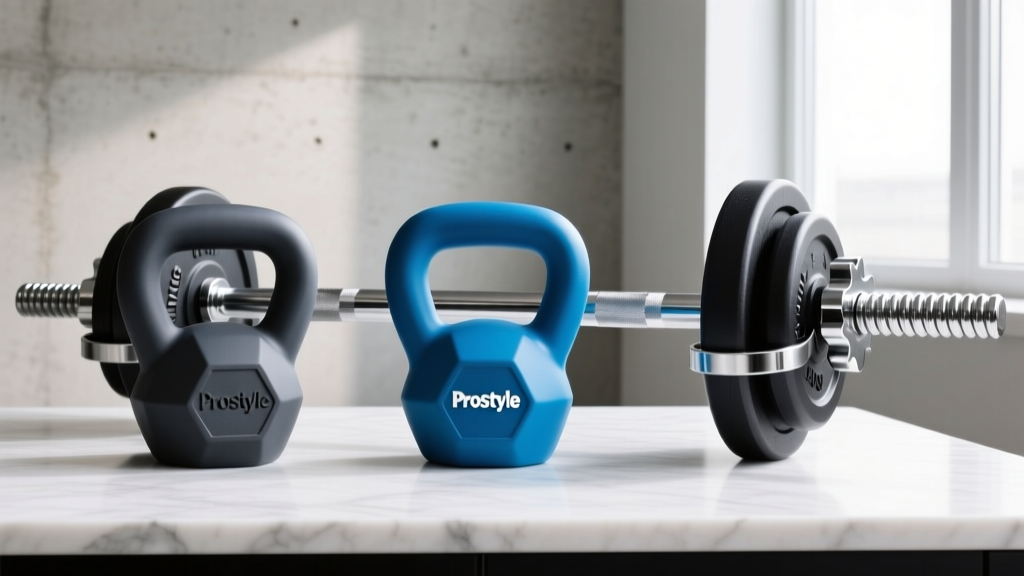
Prostyle Dumbbells & Barbell Collars: Clamp Types Compared
Compare fixed prostyle dumbbells with loadable setups. We test barbell collar and clamp types (spring, lock-jaw, aluminum) for 2026 home gym safety.

The Free Weight Security Dilemma: Fixed Prostyle Dumbbells vs. Loadable Setups
When outfitting a serious home or commercial gym in 2026, lifters inevitably face a critical crossroads regarding dumbbell selection: Do you invest in a full rack of fixed commercial prostyle dumbbells, or do you opt for adjustable loadable dumbbell handles paired with fractional plates? The answer heavily dictates your equipment security strategy and your reliance on barbell collars.
Fixed commercial prostyle dumbbells—characterized by their ergonomic, thick 35mm handles, Shore A 85-90 urethane coatings, and monolithic cast-iron or steel cores—represent the gold standard for safety. Because the weight is permanently encased or welded, there is zero risk of lateral plate shift, collar failure, or catastrophic weight dumping during a heavy incline press. However, the financial barrier is steep. A complete 5-to-50-pound set of premium prostyle dumbbells costs between $2,500 and $4,000, and requires substantial floor space for a multi-tier rack.
Conversely, a pair of premium loadable Olympic dumbbell handles (such as the Rogue Loadable Dumbbell Handles, retailing around $195) combined with a set of bumper or fractional plates offers immense versatility and space savings. Yet, this adjustable route introduces a single point of catastrophic failure: the collar. If your barbell collar or clamp fails during a heavy floor press or Romanian deadlift, the consequences range from damaged flooring to severe joint injury. Below, we conduct a rigorous head-to-head comparison of barbell collar and clamp types to determine which locking mechanism actually keeps your adjustable setups as safe as fixed prostyle dumbbells.
Head-to-Head: Barbell Collar and Clamp Types Comparison
Not all clamps are created equal. The market is flooded with cheap imitations that fail under the high-vibration environment of dropped weights. Based on extensive testing data and BarBend's comprehensive barbell collar reviews, we have categorized the four primary collar types used in modern strength training.
| Collar Type | Material & Build | Clamping Force / Mechanism | Weight per Pair | Best Use Case | Estimated Cost (2026) |
|---|---|---|---|---|---|
| Spring Clips | High-carbon steel wire | Torsion spring tension (~40-60 lbs outward force) | 0.2 lbs | Light accessories, rehab work | $8 - $15 |
| Lock-Jaw Pro (Polymer) | Glass-filled nylon resin | Dual-cam lever lock (mechanical bite) | 0.5 lbs | High-rep Olympic lifts, CrossFit | $30 - $35 |
| Rogue HG 2.0 (Aluminum) | 6061 Aerospace Aluminum | Cam-lever with T-handle tension screw | 1.0 lbs | Heavy powerlifting, max effort dumbbell pressing | $45 - $55 |
| Spinlock / Threaded | Cast iron or steel | Threaded friction (screw-on) | 3.0 - 5.0 lbs | Standard 1-inch bars, slow-paced bodybuilding | $20 - $40 |
1. Spring Clips: The False Economy
Spring clips are the default inclusion with most budget barbell and dumbbell handle purchases. They rely entirely on the torsion tension of the steel wire. While they are lightning-fast to apply and remove, Garage Gym Reviews' clamp durability analysis highlights a critical flaw: metal fatigue. After approximately 500 to 800 repetitions of loading, unloading, and especially dropping, the steel wire loses its tensile memory. The outward clamping force degrades, allowing plates to rattle and shift. For heavy loadable dumbbell work, spring clips are a massive liability and should be relegated strictly to light resistance band attachments or rehab protocols.
2. Polymer Clamp Collars (e.g., Lock-Jaw)
Polymer clamps utilize a mechanical cam-lever system that physically bites down onto the 50mm Olympic sleeve. High-quality models use glass-filled nylon, which resists shattering upon impact if dropped from overhead. They are lightweight and secure for standard barbell work. However, when scaled down to the shorter sleeves of loadable dumbbell handles, the 1.5-inch width of the clamp can consume valuable sleeve real estate, limiting the number of plates you can load. Furthermore, on cheaper, slightly undersized import dumbbell handles (which may measure 49.5mm instead of a true 50mm), polymer clamps can slip laterally during heavy eccentric movements.
3. Aluminum Clamp Collars (e.g., Rogue HG 2.0)
For lifters attempting to replicate the absolute security of fixed prostyle dumbbells using loadable handles, aerospace aluminum clamps are the undisputed champion. The Rogue HG 2.0 utilizes a 2.5-inch wide body and a precision-machined T-handle tension screw. This allows the user to manually dial in the exact clamping pressure against the sleeve, compensating for any microscopic manufacturing tolerances in the dumbbell handle. The aluminum body will not crack under the shear force of a dropped 100-pound loadable dumbbell. The only drawback is the bulk; they are heavy and wide, meaning you will need a longer sleeve handle to accommodate heavy plate loads.
4. Threaded Spinlock Collars
Spinlocks are the traditional screw-on nuts used on 1-inch standard bars, though some specialized Olympic adapters exist. They offer 100% fail-proof lateral security because they are physically threaded onto the bar. The trade-off is time. Changing weights on a pair of loadable dumbbells using spinlocks takes 4 to 5 times longer than using a cam-lever clamp, completely destroying the flow of drop-sets or supersets.
Critical Failure Modes and Edge Cases
Understanding how and why collars fail is essential for preventing injury. Unlike fixed prostyle dumbbells, where the urethane casing absorbs shock and keeps the center of mass permanently fixed, loadable setups are dynamic.
⚠️ WARNING: The 'Sleeve Polish' Edge CaseOver time, the chrome or zinc coating on barbell and dumbbell handles becomes highly polished from repeated plate friction. A polished 50mm sleeve has a significantly lower coefficient of friction. Polymer clamps that grip perfectly on a brand-new, matte-finished handle will suddenly slide off a 3-year-old polished sleeve during a heavy dumbbell row. Always use aluminum cam-lever clamps with adjustable tension screws on older, polished equipment.
Another common failure mode occurs during asymmetrical loading. If you are using loadable handles for unilateral farmer's carries or offset core work, the lateral force placed on the collar is immense. Spring clips will instantly pop off under this asymmetrical shear force. Even standard polymer clamps can hinge open if the cam-lever is not perfectly aligned with the horizontal axis of the sleeve.
Step-by-Step: Securing Loadable Handles for Heavy Pressing
If you are bench pressing or floor pressing with loadable dumbbell handles, you must treat the collar application with the same rigor as rigging a climbing harness. Follow this protocol to achieve near-prostyle dumbbell security:
- Inspect the Sleeve: Wipe down the 50mm sleeve with a microfiber cloth and a touch of chalk or rosin to increase friction. Remove any oil or grease.
- Seat the Plates Tightly: Ensure all bumper or iron plates are flush against the dumbbell head. Tap the handle vertically on a rubber mat to settle the plates.
- Apply the Aluminum Collar: Slide the Rogue HG 2.0 (or equivalent) flush against the outermost plate.
- Engage the Cam-Lever: Pull the lever to 90 degrees.
- Dial the Tension Screw: Use the T-handle to tighten the internal pressure pad against the sleeve until the collar cannot be rotated by hand.
- The 'Shake Test': Grip the dumbbell handle and violently shake it horizontally and vertically. If you hear any metallic clicking or plate rattle, tighten the tension screw another quarter-turn.
Final Verdict for 2026 Home Gyms
The choice between fixed implements and adjustable setups ultimately comes down to budget, space, and risk tolerance. If you have the capital and the square footage, a full rack of commercial prostyle dumbbells remains the safest, most efficient, and most frustration-free option for heavy hypertrophy and strength work. You never have to think about collars, plates shifting, or sleeve tolerances.
However, for the 90% of home gym owners utilizing loadable dumbbell handles and Olympic barbells to save space and money, upgrading your locking mechanism is non-negotiable. Throw away the included spring clips immediately. Invest $45 to $55 in a pair of premium aerospace aluminum cam-lever collars. By manually dialing in the clamping tension, you effectively eliminate the lateral shift risk, bridging the safety gap between adjustable handles and fixed commercial weights.
More gear to consider
All reviews
Olympic vs Standard Setup & Dumbbell Exercises for Female Beginners PDF

Home Gym Setup: Dumbbell and Bench Full Body Workout Guide

HIIT With Dumbbells: Adjustable Dumbbell Head-to-Head Review

Rubber Hex vs Urethane: Dumbbell March Maintenance Tips

How to Work Out Back With Dumbbells: Loadable Budget Guide
