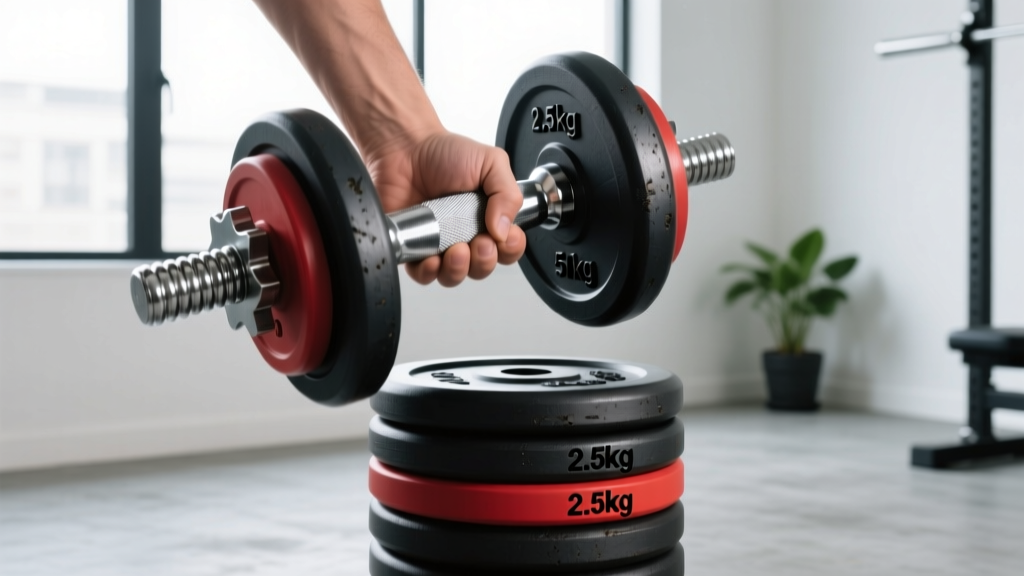
Cast Iron vs Competition Kettlebells & Single Dumbbell Exercises for Arms
Compare cast iron vs competition kettlebell costs and discover how integrating single dumbbell exercises for arms maximizes your minimalist home gym budget.

The Metallurgy of Value: Cast Iron vs. Competition Kettlebells
When building a minimalist home gym in 2026, the kettlebell remains a cornerstone implement for ballistic power, grip strength, and conditioning. However, buyers are immediately confronted with a bifurcated market: traditional cast iron kettlebells and hollow-steel competition kettlebells. Understanding the metallurgical and manufacturing differences is critical for accurate budget breakdown and long-term value analysis.
Cast Iron Kettlebells are gravity-cast from molten iron. Because they are solid, their physical dimensions scale linearly with their weight. A 35-pound cast iron bell is significantly smaller than a 70-pound bell. This creates a shifting center of mass and varying handle clearances as you progress in weight. Brands like CAP Barbell and Rogue (E-Coat series) dominate this space, offering durable, no-frills implements that prioritize cost-efficiency.
Competition Kettlebells, governed by standards outlined by organizations like StrongFirst and the IUKL, are constructed from hollow steel shells filled with an internal ballast (often a mix of steel shot and epoxy). The defining feature is uniformity: whether the bell is 8kg or 32kg, the handle diameter is strictly 35mm, and the bell dimensions remain identical. This ensures that your rack position, clean mechanics, and snatch clearance never change as you increase the load.
2026 Cost-Per-Pound Comparison Matrix
To evaluate the true value, we must look beyond the sticker price and analyze the cost-per-pound metrics, material longevity, and biomechanical utility in the current market.
| Feature | Standard Cast Iron | Competition (Steel) |
|---|---|---|
| Material | Solid Cast Iron | Hollow Steel Shell + Ballast |
| Handle Diameter | 32mm - 35mm (Variable) | 35mm (Strict Uniform) |
| Bell Dimensions | Scales with Weight | Uniform across 8kg-32kg |
| Avg 2026 Price/Lb | $1.40 - $2.50 | $4.50 - $6.00 |
| Primary Failure Mode | Chipped Enamel / Rust | Dented Shell / Paint Wear |
The Biomechanical Gap: Why Kettlebells Struggle with Arm Isolation
While kettlebells are unparalleled for posterior chain development and multi-joint ballistic movements, they present a distinct biomechanical disadvantage for strict arm isolation. According to kinesiology data from ExRx.net, optimal hypertrophy for the biceps brachii and triceps brachii requires a stabilized center of mass and a continuous tension curve.
The thick 35mm handles of competition kettlebells (and the awkward offset weight distribution of heavy cast iron bells) force the forearm flexors to work in overdrive. During a strict curl, your grip will invariably fail before your biceps reach mechanical tension failure. Furthermore, the bulky bell of a kettlebell physically obstructs the natural line of pull during tricep extensions, making it nearly impossible to achieve a full range of motion without the implement striking your forearm or shoulder.
The Budget Fix: Integrating Single Dumbbell Exercises for Arms
Rather than spending $800+ on a full set of hex dumbbells to fill this isolation gap, the most financially sound strategy for a minimalist gym is the Hybrid Approach. By investing in one high-quality adjustable dumbbell—such as the PowerBlock Sport 24 (approx. $189) or the Nuobell 552 (approx. $329)—you can seamlessly integrate targeted single dumbbell exercises for arms into your kettlebell-dominant routine.
This allows you to allocate the bulk of your budget toward premium competition kettlebells for your primary lifts, while using a single adjustable dumbbell to surgically target the arms with micro-increments (2.5 lb to 5 lb jumps) and a balanced center of mass.
1. Single-Arm Zottman Curl
The Zottman curl is a premium bicep and brachioradialis builder. Holding the single dumbbell, curl the weight up with a supinated (palms-up) grip. At the apex of the movement, rotate your wrist to a pronated (palms-down) grip, and lower the weight slowly over a 3-second eccentric phase. The balanced handle of a standard adjustable dumbbell prevents the grip fatigue that would ruin this movement with a kettlebell.
2. Cross-Body Tricep Extension
Set an adjustable bench to a 45-degree incline. Holding the single dumbbell in one hand, reach across your chest to the opposite shoulder. Keeping your elbow pinned to your ribcage, extend the weight upward and outward, focusing on the lateral head of the tricep. The compact profile of a dumbbell (unlike a bulky kettlebell bell) allows for unobstructed joint mechanics.
3. Seated Concentration Curl
Sit on a bench, brace your tricep against your inner thigh, and curl the single dumbbell. This eliminates all momentum and isolates the short head of the bicep. The American Council on Exercise (ACE) frequently highlights concentration curls as one of the highest EMG-activation exercises for the biceps, a movement that is virtually impossible to execute safely or effectively with a kettlebell due to handle clearance issues.
Pro-Tip for Hybrid Training: Perform your heavy, multi-joint kettlebell work (Swings, Goblet Squats, Turkish Get-Ups) at the beginning of your session when your central nervous system is fresh. Reserve your single dumbbell exercises for arms for the final 15 minutes of your workout as metabolic finishers and localized hypertrophy drivers.Real-World Budget Scenarios: Pure KB vs. Hybrid Setup
Let us break down the actual financial outlay for a home gym user aiming to cover full-body power, conditioning, and arm hypertrophy in 2026.
Scenario A: The Purist Kettlebell Route (Flawed for Arms)
- 16kg Competition KB: $95
- 20kg Competition KB: $115
- 24kg Competition KB: $135
- 32kg Cast Iron KB (for heavy swings): $75
- Total: $420 | Result: Excellent for full-body power, poor for arm isolation due to grip limitations.
Scenario B: The Strategic Hybrid Route (Optimal Value)
- 16kg Competition KB: $95
- 24kg Competition KB: $135
- PowerBlock Sport 24 Adjustable Dumbbell (5-24 lbs): $189
- Total: $419 | Result: Covers all KB ballistic bases AND provides 2.5lb micro-increment arm isolation up to 24 lbs per arm.
By sacrificing the 20kg kettlebell (which is often a redundant stepping stone between 16kg and 24kg for most recreational lifters) and reallocating those funds to an adjustable dumbbell, you achieve a vastly superior anatomical coverage for the exact same price.
Maintenance and Failure Modes
When analyzing long-term value, you must factor in equipment degradation. Cast iron kettlebells coated in cheap enamel will chip when dropped on concrete, exposing the raw iron to humidity and resulting in surface rust. This requires periodic wire-brushing and a coat of rust-oleum. Competition kettlebells, while immune to rust, feature thin steel shells. Dropping a 24kg competition bell from overhead onto a hard surface will dent the steel shell, potentially altering the flat base and causing the bell to wobble during renegade rows or push-ups. Always use horse-stall mats (minimum 3/4-inch thickness) to protect your investment, regardless of the metallurgy.
Expert Verdict: Where to Allocate Your Funds
If your primary goal is Girevoy sport, tactical fitness, or high-repetition ballistic conditioning, the premium price of competition kettlebells is entirely justified by the uniform 35mm handle and consistent bell dimensions. However, if you are a generalist seeking a balanced, aesthetic, and functional physique, relying solely on kettlebells will leave your arm development severely lagging.
The smartest budget breakdown in 2026 involves purchasing fewer, strategically spaced competition kettlebells (e.g., jumping from 16kg to 24kg) and using the saved capital to acquire a high-grade adjustable dumbbell. This hybrid methodology unlocks the full spectrum of single dumbbell exercises for arms, ensuring that your biceps and triceps receive the precise mechanical tension and isolation required for optimal hypertrophy, without blowing your home gym budget on a full rack of fixed-weight dumbbells.
More gear to consider
All reviews
Power Rack vs Squat Rack vs Stand: Standing Dumbbell Overhead Press

EZ vs Straight Bar: Budgeting Full-Body Compound Dumbbell Exercises

Barbell Collars vs Clamps: After the Bowflex Dumbbells 1090 Pair
Barbell Collar Types & Close Grip Dumbbell Press Muscles Worked
Neoprene Dumbbells for Home Use & Dumbbell Rear Raise 2026