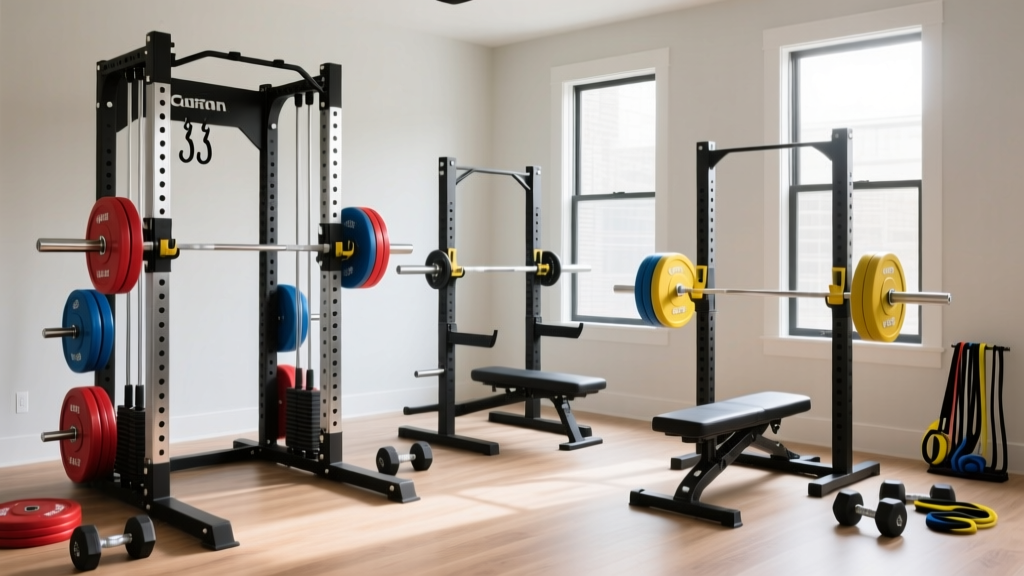
Power Rack vs Squat Rack vs Squat Stand: Beyond 3D Printed Dumbbells
Compare power racks, squat racks, and squat stands. Learn when to upgrade from 3D printed dumbbells to heavy barbell training for your 2026 home gym.

The Evolution of the Home Gym: Outgrowing DIY Gear
The home fitness landscape has shifted dramatically over the last few years. Driven by supply chain quirks and a booming maker community, many lifters began their fitness journeys experimenting with DIY solutions, including 3D printed dumbbells and concrete-filled PVC pipes. While printing custom ergonomic handles or lightweight warm-up plates is a fantastic weekend project, the laws of physics and progressive overload eventually demand a transition to heavy, calibrated iron.
As you transition from isolation movements with lightweight printed gear to heavy compound barbell lifts like squats, bench presses, and overhead presses, the centerpiece of your gym must evolve. You need a secure, load-bearing structure to rack your barbell. This brings us to the ultimate home gym crossroads: choosing between a power rack, a squat rack (half rack), and squat stands. In this 2026 buying guide, we break down the exact specifications, safety margins, and spatial requirements of each to help you build a gym that matches your strength.
The Ceiling Effect: Why 3D Printed Dumbbells Demand an Upgrade
Before diving into heavy steel racks, it is vital to understand the structural limitations of DIY and 3D printed fitness gear. The maker community frequently utilizes PLA (Polylactic Acid) and PETG (Polyethylene Terephthalate Glycol) to print hollow dumbbell shells, which are then filled with sand or concrete.
However, according to the MatterHackers Material Guide, standard PLA has a glass transition temperature of roughly 60°C (140°F) and becomes dangerously brittle under dynamic impact. Even when reinforced with steel rods, a standard 1.5-inch diameter 3D printed handle will experience severe bending moments and layer delamination when loaded beyond 35 to 40 pounds per hand.
⚠️ Safety Warning: Never attempt to drop or dynamically load 3D printed dumbbells. Layer adhesion failure in FDM (Fused Deposition Modeling) prints happens without warning, turning a heavy DIY dumbbell into a shrapnel hazard. Once your compound lifts require more than 40 lbs of resistance per limb, a barbell and a commercial-grade steel rack are mandatory.Defining the Contenders: Cages, Half Racks, and Stands
To safely load a 7-foot Olympic barbell, you need a racking system. Here is how the three primary categories compare in the current market.
1. The Power Rack (Full Cage)
A power rack is a fully enclosed, four-post (or six-post) steel cage. It is the gold standard for solo lifters. Because the barbell is racked inside the footprint of the rack, the structure is inherently stable and does not require bolting to the floor (though it is recommended for heavy pull-ups).
- Industry Benchmark: Rogue R-3 Power Rack (90" H x 49" W x 43" D).
- Material: 11-gauge 3x3-inch steel tubing.
- 2026 Pricing: $1,100 - $1,800+ (depending on attachments and UHMW plastic liners).
- Key Advantage: Includes built-in safety spotter straps or pin-pipe catchers that span the entire width of the cage, allowing you to fail a squat or bench press safely without a human spotter.
2. The Squat Rack (Half Rack)
Often confused with squat stands, a true "half rack" features two main uprights where the barbell is racked on the outside of the posts, combined with a rear stabilizing base and uprights for weight plate storage. The rear storage acts as a counterweight to prevent the rack from tipping forward when you unrack a heavy barbell.
- Industry Benchmark: Titan Fitness T-2 Series Half Rack (82" H x 48" W x 24" D).
- Material: 14-gauge 2x2-inch steel tubing.
- 2026 Pricing: $350 - $600.
- Key Advantage: Offers an open front for unrestricted movement (great for Olympic lifting variations) while maintaining a relatively compact footprint compared to a full cage.
3. Squat Stands
Squat stands are two independent, freestanding vertical posts with J-cups and minimal base plates. They are the most minimalist and affordable option, but they carry the highest risk profile. Because they lack a rear crossmember or integrated weight storage, they rely entirely on the user to anchor them.
- Industry Benchmark: Rogue S-2 Squat Stands (90" H, 24" x 30" base footprint).
- Material: 11-gauge 2x3-inch steel.
- 2026 Pricing: $250 - $350 per pair.
- Key Advantage: Ultimate space efficiency. They can be pushed into a corner or closet when not in use, making them ideal for garage gyms that double as parking spaces.
Head-to-Head Comparison Matrix
| Feature | Power Rack (Full Cage) | Half Rack | Squat Stands |
|---|---|---|---|
| Footprint | Large (approx. 4x4 ft to 4x8 ft) | Medium (approx. 4x2 ft) | Minimal (approx. 2x2.5 ft per stand) |
| Solo Lifting Safety | Exceptional (Full-width catchers) | Good (Requires spotter arm extensions) | Poor (High tipping risk on failure) |
| Weight Capacity | 1,000 - 1,500+ lbs | 600 - 800 lbs | 500 - 800 lbs (Static only) |
| Attachment Ecosystem | Massive (Cable pulleys, dip bars, lat rows) | Moderate (Pull-up bars, landmines) | None / Very Limited |
| Best For | Dedicated garage gyms, heavy powerlifting | CrossFit, Olympic lifting, medium spaces | Apartments, tight budgets, temporary setups |
The Physics of Failure: Spotter Arms and Tipping Moments
When upgrading from lightweight 3D printed dumbbells to a 225-pound barbell, the most critical factor to evaluate is the tipping moment. According to safety guidelines outlined by the ExRx Weight Room Safety Directory, a lifter must always have a reliable method to dump a failed lift.
With squat stands, the J-cups are positioned roughly 34 to 36 inches off the ground. If you fail a squat and push the bar forward onto the spotter arms (which extend outward), you create a massive lever. Without heavy 45-pound bumper plates loaded onto the rear storage horns of the squat stands to act as a counterweight, the stands will tip forward, dropping the barbell onto your chest or neck.
Half racks mitigate this by integrating the weight storage directly into the rear base frame, lowering the center of gravity. Power racks eliminate the issue entirely; because the safety straps are mounted between two heavily braced uprights, the downward force of a dropped bar is transferred directly into the floor, not into a tipping lever.
"If you are training alone and do not have the floor space for a full power rack, you must bolt a half rack to a concrete slab or wooden platform. Freestanding half racks and squat stands should never be used for heavy, unspotted bench pressing." — Adapted from NSCA resistance training safety principles.
Space, Ceilings, and 2026 Budgeting
Before pulling the trigger on a rack, measure your ceiling height. Standard power racks and squat stands are typically 90 inches (7.5 feet) tall. If you are building a gym in a basement with low-hanging HVAC ducts, or an attic space, you will need to look for "Shorty" racks (usually 72 to 82 inches tall). Keep in mind that a 90-inch rack allows you to mount a pull-up bar and perform overhead presses without the barbell striking the ceiling joists.
The 2026 Budget Breakdown
- Entry-Level (Squat Stands + DIY Matting): $300 - $450. Ideal if you are just graduating from 3D printed dumbbells and adjustable kettlebells, and your max squat is under 185 lbs.
- Mid-Tier (Half Rack + Rubber Flooring): $600 - $900. The sweet spot for intermediate lifters who need plate storage and basic pull-up capabilities.
- Elite (Power Rack + Cable Attachments): $1,500 - $2,500+. A complete commercial-grade ecosystem that will last a lifetime and support advanced accessory work.
Expert Verdict: Which Should You Buy?
The transition from DIY gear and 3D printed dumbbells to a barbell-centric routine is a major milestone in your fitness journey. Your choice of rack should be dictated by your spatial constraints and your tolerance for risk.
If you have a dedicated two-car garage, a standard 90-inch ceiling, and a budget over $1,000, buy a full power rack. The ability to safely fail heavy reps alone, combined with the modular attachment ecosystem (lat pulldowns, low rows, monolifts), makes it the undisputed king of the home gym.
If you practice Olympic weightlifting (cleans and snatches) and need an open front to bail the bar forward, a half rack bolted to a reinforced platform is your best option. Finally, reserve squat stands strictly for renters, apartment dwellers, or those on a severe budget who can commit to strictly counter-weighting the base and never lifting to absolute failure without a human spotter.
More gear to consider
All reviews
Gym Setup for Dumbbell Exercises for Men Over 50: Plate Types

Overhead Dumbbell Pullover: Olympic vs Standard Plates Compared

Best Dumbbell Racks for Incline Dumbbell Fly Setups (2026)

Bumper Plate vs Iron Plate Trends & Dumbbell Chest Exercises

Reverse Lunge Dumbbell vs Barbell: Weight & Knurling Guide
