Space Layouts: Bumper vs Iron Plates & Hammer Strength Dumbbell Set
Optimize your gym layout with our bumper vs iron plate comparison. Learn spatial clearances and how to integrate a Hammer Strength dumbbell set.

The Spatial Reality of Free Weight Selection
Designing a high-performance home gym in 2026 requires more than just picking a power rack and ordering a barbell; it demands rigorous spatial planning. Every inch of your lifting zone dictates your safety, workflow, and equipment longevity. When mapping out your floor plan, the debate between bumper plates and cast iron plates is rarely just about noise or drop-safety—it is fundamentally a question of footprint, rack clearance, and storage geometry. Furthermore, integrating premium fixed-weight stations, such as a hammer strength dumbbell set, into this ecosystem requires precise measurements to avoid creating congested choke points in your workout space.
In this guide, we break down the exact dimensional differences between bumper and iron plates, calculate barbell sleeve capacities, and provide actionable layout blueprints that accommodate elite dumbbell racks without sacrificing your primary lifting zone.
Spatial Warning: Never base your squat rack placement on the diameter of a 45lb iron plate. If you plan to occasionally use bumper plates for deadlifts, your rack-to-wall clearance must accommodate the 17.7-inch diameter of a bumper, plus your shins, plus bar whip. Plan for a minimum 36-inch clearance behind the bar sleeves.The Dimensional Divide: Bumper vs. Iron Plate Footprints
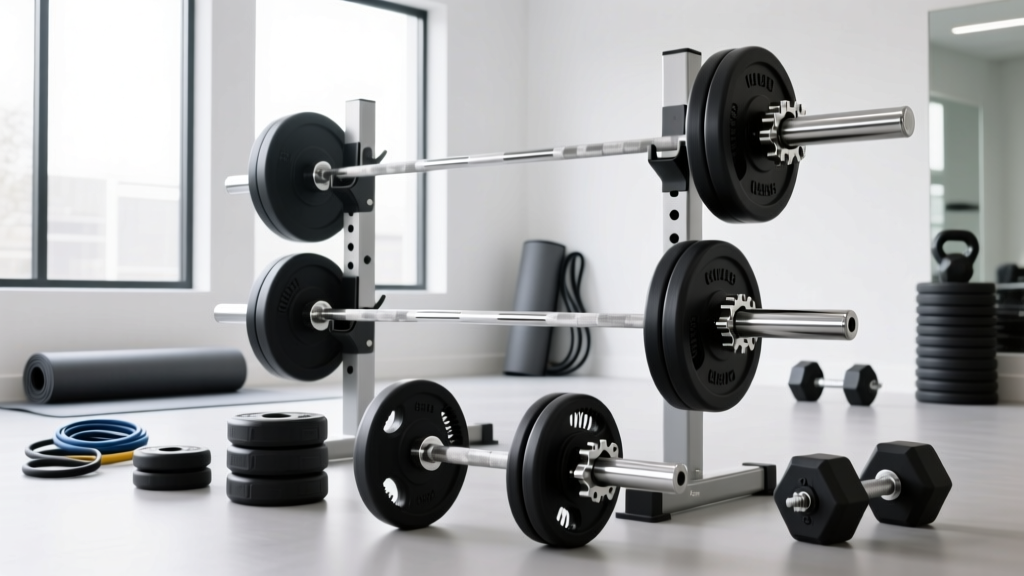
To optimize your gym layout, you must first understand the physical geometry of your weight storage. Cast iron plates are dense and compact, while bumper plates are engineered to a uniform International Weightlifting Federation (IWF) diameter, drastically altering their storage footprint and spatial footprint on the floor.
| Weight | Iron Plate Diameter / Thickness | Bumper Plate Diameter / Thickness | Storage Tree Footprint Impact |
|---|---|---|---|
| 10 lbs | 9.0″ / 0.9″ | 17.7″ / 1.2″ | Bumpers require full-height tree pegs; irons can use lower pegs. |
| 25 lbs | 12.5″ / 1.0″ | 17.7″ / 2.2″ | Bumpers consume 2.2x more horizontal peg space. |
| 45 lbs | 14.6″ / 1.2″ | 17.7″ / 3.25″ | A pair of 45lb bumpers takes up 6.5″ on a storage peg vs 2.4″ for iron. |
As noted by the equipment experts at Garage Gym Reviews, the uniform diameter of bumper plates means that even a 10lb bumper takes up the same vertical floor space as a 45lb bumper when standing upright. If you are storing plates vertically against a wall or on a low-profile holder, a full set of bumpers (10s, 15s, 25s, 35s, 45s) will require a continuous horizontal wall span of nearly 60 inches. A comparable iron set, nested by diameter, can be tucked into a 30-inch corner footprint using a vertical A-frame tree.
Rack Clearance and Barbell Sleeve Math
Space optimization extends to the micro-environment of your barbell sleeves. A standard Olympic barbell features a 16.3-inch loadable sleeve length. The thickness of your plates dictates not only how much weight you can load, but how close you can space your J-cups and spotter arms.
The Sleeve Capacity Formula:
Collar (1.0″) + Plates + Spring Collar (0.5″) = Total Sleeve Usage.
Iron Setup: Six 45lb plates (7.2″) + Two 10lb plates (1.8″) = 9.0″. You can easily load 500+ lbs and maintain 6 inches of safety margin.
Bumper Setup: Four 45lb bumpers (13.0″) + One 10lb bumper (1.2″) = 14.2″. You are nearing the sleeve limit at just 415 lbs, leaving minimal room for heavy spring collars.
Because iron plates allow for denser loading, you can position your squat rack closer to the center of the room without the barbell sleeves extending dangerously far into your walking pathways. For more on how plate composition affects barbell dynamics and facility safety, refer to the BarBend plate comparison guide.
Integrating the Hammer Strength Dumbbell Set
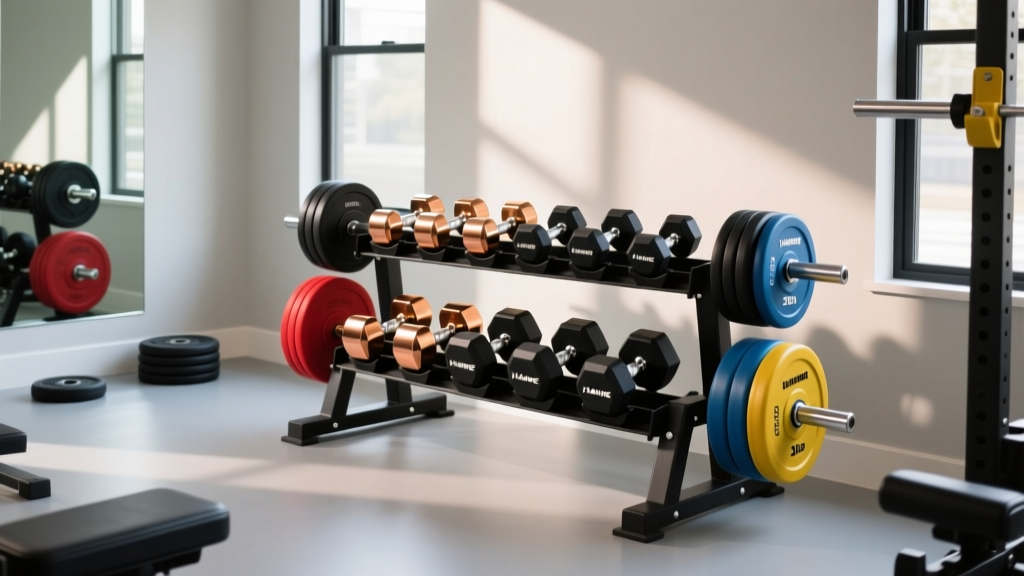
Once your barbell zone is mapped, you must address the auxiliary lifting areas. Fixed-weight dumbbells are essential for hypertrophy and joint-friendly accessory work, but their storage racks are notorious space-hogs. When outfitting a premium commercial-grade home gym, many lifters opt for a hammer strength dumbbell set (typically the 5-50 lb urethane collection) due to its ergonomic handle design and durable casing.
However, integrating this specific set requires deliberate layout planning. The official Hammer Strength 3-Tier Dumbbell Rack measures approximately 47.25 inches wide, 28 inches deep, and 30.5 inches high. This 9-square-foot footprint is substantial.
Placement Strategy for the 3-Tier Rack
- The Dead-Zone Placement: Place the rack perpendicular to the back of your power rack, utilizing the 'dead space' behind the squat stand where you cannot safely walk during a lift.
- The Wall-Hugger Configuration: If using a foldable wall-mount rack, the Hammer Strength rack can serve as a physical barrier 36 inches away from the wall, preventing users from rolling the barbell into the drywall during failed deadlifts.
- Traffic Flow: Never place the 28-inch deep rack parallel to your primary lifting platform. The 30.5-inch height creates a visual and physical blind spot if you are attempting walking lunges or farmer carries across the gym floor.
2026 Layout Blueprints: Mapping Your Space
How do you combine the plate decision with the dumbbell rack footprint? Here are two space-optimized blueprints based on standard 2-car garage dimensions (approx. 400 sq. ft. of usable space).
Blueprint A: The Compact Powerlifter (Iron Plate Focus)
Best for: Low ceilings, narrow garages, heavy static lifts.
Plate Choice: Calibrated Steel or Machined Iron Plates.
Storage: Vertical 10-peg tree (Footprint: 24″ x 24″).
Dumbbell Integration: Because the iron plate tree is compact, you can position the Hammer Strength 3-tier rack directly adjacent to it, creating a unified 'free weight wall'. This leaves a massive 10×10 foot open turf area in the center of the room for sled pushes and walking lunges.
Blueprint B: The Functional Fitness Drop Zone (Bumper Focus)
Best for: High ceilings, Olympic lifting, CrossFit-style WODs.
Plate Choice: Virgin Rubber or Crumb Bumper Plates.
Storage: Horizontal wall-mounted plate shelves or a wide-base A-frame tree (Footprint: 36″ x 30″).
Dumbbell Integration: Bumper storage demands width. To prevent the gym from feeling cluttered, mount the Hammer Strength dumbbell rack on a mobile heavy-duty caster base (if floor type permits) or place it on the opposite side of the room to balance the visual weight. Ensure a minimum 48-inch walkway between the bumper tree and the dumbbell rack to allow for carrying heavy kettlebells or plates without clipping your elbows.
Acoustic Space and Flooring Thickness
Space optimization is not strictly two-dimensional; it includes vertical acoustics and flooring thickness. If you choose iron plates, you must invest in thicker flooring (minimum 3/4″ horse stall mats over a plywood subfloor) to protect your concrete slab from catastrophic cracking during re-racking. This raises your floor height by nearly an inch, which subtly alters the clearance of your pull-up bar relative to the ceiling.
Bumper plates, while quieter, require a dedicated 'drop zone'. If your garage gym shares a wall with a living space, the low-frequency vibration of dropped iron plates will travel through the foundation, whereas bumpers dissipate energy laterally. Therefore, your spatial layout must account for acoustic buffering—keeping the bumper drop zone at least 4 feet away from shared drywall partitions.
Frequently Asked Questions
Can I mix iron and bumper plates on the same barbell?
Yes, but spatial awareness is critical. You must place the bumper plates closest to the barbell collar, and the iron plates on the outside. If you place a 14.6-inch iron plate inside a 17.7-inch bumper plate, the iron plate will never touch the ground during a deadlift, altering your pulling mechanics and potentially bending your barbell sleeve if dropped.
Does the Hammer Strength dumbbell set require assembly?
The urethane dumbbells themselves arrive fully welded and molded. However, the accompanying 3-tier steel rack requires bolting the vertical uprights to the horizontal base rails. You will need a 17mm socket wrench and roughly 45 minutes. Factor this 28″ x 47″ assembly footprint into your room before unboxing.
Which plate type offers better long-term spatial efficiency?
For pure spatial density, calibrated iron plates are unmatched. You can store 500 lbs of iron in the same physical volume as 250 lbs of bumpers. If your gym space is under 150 square feet, iron plates paired with a compact adjustable dumbbell set (instead of a full Hammer Strength rack) is the only mathematically viable option for maintaining safe walkways.
More gear to consider
All reviews
Dumbbell Glute Kickbacks: Rubber Hex vs Urethane 2026 Market Trends

Barbell Collars vs Clamps: Safety Guide & Best Dumbbell for Shoulder Exercise

Barbell Setup vs Dumbbell Exercises for Hamstrings: Weight Guide
The Golden Dumbbell Setup: Loadable Plates for Small Gyms

Bumper vs Iron Plates for Dumbbell Tenements: 2026 Guide