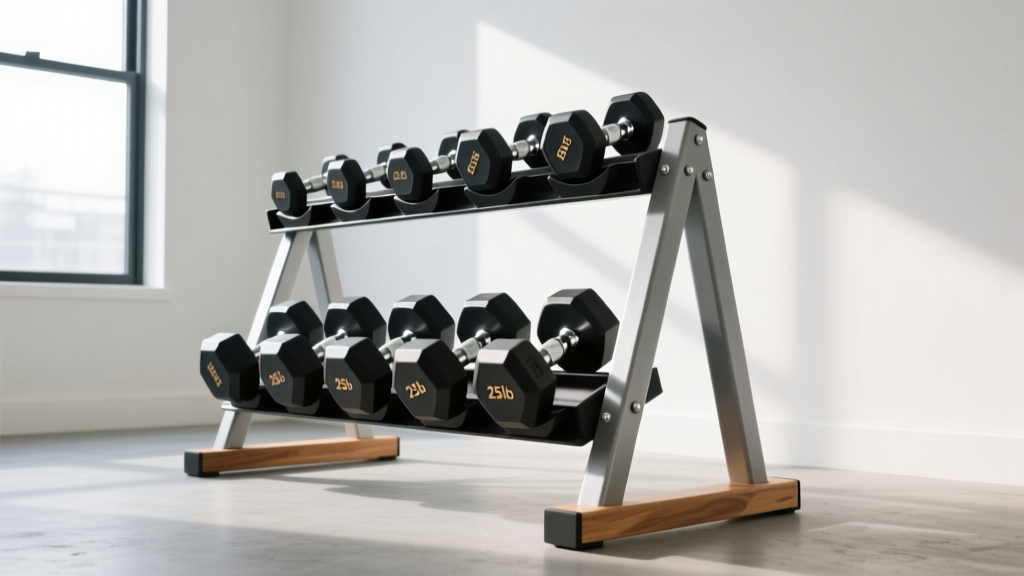
Budget Dumbbell Racks for Side Bends with Dumbbells & Core Workouts
Discover the best budget dumbbell racks and storage solutions for side bends with dumbbells. Compare A-frames, tiered stands, and wall mounts today.

The Hidden Costs of Poor Dumbbell Storage
When building a home gym, lifters often allocate 90% of their budget to the weights themselves, treating storage as an afterthought. However, if your training involves heavy, unilateral core movements—specifically side bends with dumbbells—your storage solution directly impacts your workout efficiency and safety. Scattered weights create tripping hazards, while poorly designed racks can tip when you extract a heavy 50-pound bell for a weighted oblique crunch.
As we navigate the 2026 fitness equipment market, supply chain stabilization has driven prices down, making high-quality, 11-gauge steel storage more accessible than ever. This budget breakdown and value analysis will help you select the optimal dumbbell rack that supports the specific weight ranges and spatial demands of heavy core training, without blowing past your financial limits.
Why Core Training Dictates Your Storage Needs
The biomechanics of lateral flexion require precise progressive overload. When performing side bends with dumbbells, you are not just using a single pair of weights; you need rapid access to incremental jumps (e.g., 20 lbs, 25 lbs, 30 lbs, and 40 lbs) to properly fatigue the obliques and quadratus lumborum. According to the American Council on Exercise (ACE), unilateral core loading requires strict form and controlled tempos, meaning you need to swap weights quickly to maintain your rest-pause intervals.
This training style demands a rack that:
- Houses 5 to 8 pairs of medium-to-heavy dumbbells (20–60 lbs).
- Accommodates wide profiles: Rubber hex dumbbells (the most common budget choice) are significantly wider than urethane bells. A rack with narrow trays will force you to stagger them, wasting space.
- Prevents tipping torque: Pulling a 50-lb dumbbell from the top tier of a cheap, narrow-base rack shifts the center of gravity dangerously forward.
2026 Storage Value Matrix: Comparing the Big Three
To determine the best ROI for your home gym, we must compare the three dominant storage architectures. The table below breaks down the average market pricing, footprint, and ideal use cases for each style.
| Rack Type | Avg. Price (2026) | Footprint (Sq. Ft.) | Max Capacity | Best For |
|---|---|---|---|---|
| 3-Tier Horizontal | $140 - $190 | ~12.5 sq ft | 800 - 1,200 lbs | Full sets (10-50 lbs), Garage gyms |
| A-Frame Tower | $160 - $220 | ~4.5 sq ft | 600 - 800 lbs | Tight spaces, Apartment gyms |
| Wall-Mounted | $80 - $130 | 0 sq ft (Floor) | 300 - 500 lbs | Light sets, Minimalist setups |
Budget Breakdown: Top Value Racks Analyzed
Let us dissect the specific models that offer the highest value per dollar, keeping in mind the structural integrity required for heavy core work.
1. Titan Fitness 3-Tier Dumbbell Rack (The Heavy-Duty Budget King)
Priced consistently around $149.99, the Titan 3-Tier is the undisputed champion of budget storage. Constructed from 11-gauge steel with a 2x2-inch upright profile, it can hold up to 1,200 pounds.
The Value Proposition: At roughly $0.12 per pound of storage capacity, this rack is a financial no-brainer. The trays are spaced widely enough to accommodate 50-pound rubber hex dumbbells without overlapping, ensuring you can smoothly grab your next set for side bends without pinching your fingers.Edge Case Warning: The base measures 48 x 30 inches. While this provides immense stability, it requires a dedicated 4-foot stretch of wall space. If your gym is in a cramped spare bedroom, this footprint may be prohibitive.
2. REP Fitness A-Frame Dumbbell Rack (The Footprint Champion)
Retailing for approximately $179.99, the REP A-Frame solves the spatial dilemma. By stacking weights vertically on an angled, A-shaped chassis, it holds up to 10 pairs of dumbbells while occupying less than 5 square feet of floor space.
For lifters performing side bends with dumbbells in a high-intensity circuit, the A-Frame places all weights at a similar visual plane, reducing the time spent scanning tiers. However, the angled trays mean that round dumbbells (like neoprene or cast iron) can roll if the rubber end-caps are worn down. Stick to hex dumbbells with this rack.
3. BCC Wall-Mounted Dumbbell Shelves (The Ultra-Budget Route)
If your budget is strictly under $100, heavy-duty wall-mounted brackets (typically $89.99 for a set of two tiers) offer zero-floor-impact storage. However, this comes with a massive structural caveat: you must mount these directly into wooden wall studs or masonry. Drywall anchors will rip out under the sheer shear-force of a 40-pound dumbbell set.
The Tipping Hazard: A Critical Physics Edge Case
When analyzing budget racks, manufacturers often boast about 'total weight capacity.' But static capacity is not the same as dynamic stability.
Consider the physics of extracting a heavy dumbbell for a weighted side bend. If you pull a 50-lb bell from the top tier of a lightweight, narrow-base rack, you are applying lateral force. According to equipment safety guidelines highlighted by Rogue Fitness's engineering specs, a rack's base must extend past the center of gravity of the heaviest loaded tier.
'A rack's safety is determined not by how much weight it can hold while sitting still, but by how it handles the dynamic extraction of an off-center load.' — Home Gym Engineering Principles
The Fix: If you buy a budget rack with a narrow base (less than 24 inches deep), you must bolt it to the floor or a wall stud. Alternatively, store your heaviest dumbbells (40+ lbs) on the bottom tier to lower the center of mass, reserving the top tier for lighter 10-20 lb bells used for warm-ups or high-rep lateral raises.
Calculating Your Cost-Per-Pound of Storage
To truly evaluate budget racks, use this simple formula before checking out:
Value Score = Total Rack Price / Total Weight of Your Dumbbell Set
- Scenario A: You buy a $180 rack for a 300 lb set of dumbbells. Your cost is $0.60 per pound of stored weight. (Poor Value)
- Scenario B: You buy a $150 3-Tier rack for an 800 lb set of dumbbells. Your cost is $0.18 per pound. (Excellent Value)
If you are only buying a few pairs of light neoprene dumbbells for high-rep, unweighted side bends and core endurance work, a $150 3-tier rack is overkill. A $60 vertical tower or wall mount makes more financial sense. But if you are progressively overloading your obliques with heavy urethane or hex bells, investing in a high-capacity 3-tier rack immediately yields a better long-term ROI, as you will not need to upgrade when your strength increases.
Floor Protection and Maintenance Costs
A frequently ignored line item in the storage budget is floor protection. Dropping a 40-pound rubber hex dumbbell onto a concrete garage floor or hardwood while transitioning between side bend sets will cause catastrophic damage over time.
Allocate $40 to $70 of your storage budget for a 3/4-inch thick vulcanized rubber mat (4x6 feet). Place your rack on this mat. Not only does it protect the floor, but the high-friction coefficient of vulcanized rubber prevents the rack's steel feet from sliding outward when you aggressively pull a heavy dumbbell from the top shelf.
Final Verdict: Maximizing Your Storage ROI
For the majority of home gym owners focusing on heavy, unilateral core work like side bends with dumbbells, the 3-Tier Horizontal Rack remains the undisputed king of budget value. Models from Titan Fitness or REP Fitness offer commercial-grade 11-gauge steel, wide tray spacing for hex bells, and a low center of gravity for under $200.
Do not compromise on steel thickness or base width to save $30. The right storage solution not only protects your investment in free weights but keeps your training space safe, organized, and primed for progressive overload. Review your current dumbbell footprint, measure your available wall space, and choose the architecture that supports your training intensity, not just your wallet.
More gear to consider
All reviews
Bowflex Dumbbells Stuck on One Side? Storage & Rack Layout Fixes

Front Squats With Dumbbells: Loadable Dumbbell Care & Longevity
Space-Saving Squats with Dumbbells: Men's Loadable Guide
Barbell Clamps Compared: Gear for Dumbbell Rows for Rear Delts
Bumper Plate vs Iron Plate: Budgeting for Incline Dumbbell Chest Flys
