Beyond the Shake Weight Dumbbell: Smart Storage Layouts
Upgrade your home gym layout. Discover space-saving dumbbell racks, adjustable storage solutions, and floor load tips for optimal weight zone design.

The Evolution: From Novelty to Progressive Overload
A decade ago, the viral shake weight dumbbell promised sculpted arms through oscillating inertia, taking up virtually zero space in the bedroom closet. While it introduced millions to the concept of daily movement, the fitness industry has long since moved on. As home gym enthusiasts in 2026 prioritize genuine hypertrophy and functional strength, the limitations of dynamic inertia gadgets are obvious. Real strength requires progressive overload—systematically increasing the resistance your muscles must overcome.
According to the CDC muscle-strengthening guidelines, adults need to engage in activities that work all major muscle groups at a moderate or greater intensity at least twice a week. You cannot achieve this with a fixed, low-resistance oscillating tube. Upgrading to a serious set of adjustable or fixed hex dumbbells is non-negotiable for real results. However, this upgrade introduces a new challenge: spatial optimization. Real iron and urethane demand intentional storage solutions, precise floor loading calculations, and ergonomic layout design.
The Gimmick vs. Iron Reality: A shake weight dumbbell occupies roughly 0.5 square feet and offers a maximum resistance of 2.5 lbs of inertial drag. A standard pair of 50lb adjustable dumbbells occupies 2.5 square feet but provides up to 100 lbs of true progressive resistance, requiring a dedicated structural footprint and safety clearance.Spatial Dynamics: Calculating Your Weight Zone
Designing a dumbbell zone is not just about where the rack sits; it is about the operational envelope required to move the weight safely. The American Council on Exercise (ACE) consistently emphasizes that inadequate clearance is a leading cause of home gym tripping hazards and equipment damage. Below is a matrix to help you calculate the true footprint of your storage solutions.
| Storage Type | Physical Footprint | Operational Clearance | Best For |
|---|---|---|---|
| Adjustable Cradle (Nuobell/PowerBlock) | 17" x 9" (1.06 sq ft) | +36" walkway | Compact apartments, spare bedrooms |
| A-Frame Vertical Rack (5-50 lbs) | 28" x 31" (6.02 sq ft) | +48" radial clearance | Garage gyms with limited wall space |
| 3-Tier Horizontal Rack (5-100 lbs) | 47" x 28" (9.13 sq ft) | +60" radial clearance | Dedicated basement studios, commercial layouts |
Storage Tier 1: Adjustable Dumbbell Cradles
If you are transitioning away from novelty fitness gear, adjustable dumbbells are your first logical step. They collapse an entire 15-pair dumbbell rack into a single, elegant footprint. However, their storage trays dictate your layout.
Nuobell and PowerBlock Configurations
- Nuobell (up to 80 lbs): The Nuobell system uses a traditional handle-and-dial mechanism. The cradle footprint is roughly 16.5" x 8". Because the weight plates extend outward as you dial up, your storage bench or shelf must be at least 20" deep to prevent overhang and tipping hazards.
- PowerBlock Elite: PowerBlock utilizes a cubic, blocky design. The footprint is a compact 12" x 6.5". This allows them to be stored on narrow shelving units or custom wall-mounted brackets, freeing up valuable floor space for a lifting platform or bench.
Pro Tip: Never store adjustable dumbbells directly on the floor. The exposed dial mechanisms and internal retaining pins are highly susceptible to dust ingestion and moisture corrosion, which will void your warranty and cause the plates to stick.
Storage Tier 2: Fixed Hex and Urethane Rack Layouts
For those who prefer the durability and drop-resistance of fixed rubber hex or urethane dumbbells, selecting the right rack geometry is critical for space optimization.
A-Frame vs. Horizontal 3-Tier
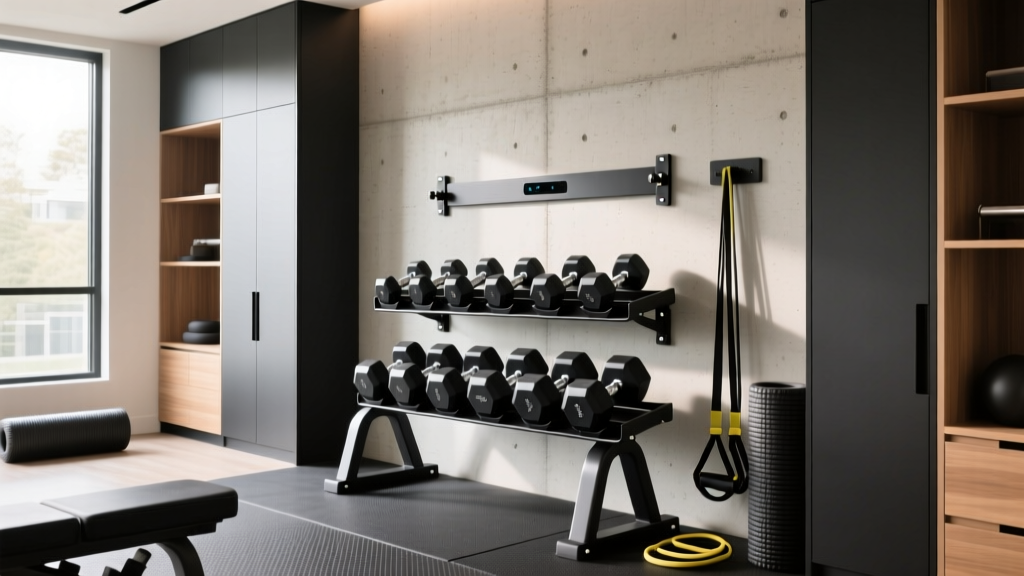
When deciding between an A-Frame (like the REP Fitness AB-3100, priced around $299) and a Horizontal 3-Tier (like the Rogue 3-Tier Dumbbell Rack, priced around $495), consider your room's geometry:
- A-Frame Racks: These push the footprint upward rather than outward. They are ideal for placing in the corner of a room or at the head of a bench. However, they require the user to bend and twist at awkward angles to retrieve heavier pairs from the bottom tiers, which can compromise lumbar safety.
- Horizontal 3-Tier Racks: These require more linear wall space (nearly 4 feet wide) but allow for ergonomic, spine-neutral retrieval. They are the gold standard for dedicated spaces where the user can approach the rack straight-on.
Structural Integrity: Floor Loading and Safety
One of the most overlooked aspects of home gym layout design is structural floor loading. A complete set of rubber hex dumbbells (5-50 lbs) weighs roughly 550 lbs. If placed on a 3-tier rack with a base footprint of just 3 square feet, you are generating over 180 pounds per square foot (PSF) of concentrated dead load.
Warning: Standard residential floor joists are typically rated for a live load of 40 PSF. Concentrating 550 lbs of iron on a small rack footprint on a second-floor bedroom or over a basement span can cause long-term joist deflection or catastrophic failure.
The Solution: Always distribute the load. Place a 4x8 foot sheet of 3/4" tongue-and-groove plywood beneath your rack, topped with a 3/4" vulcanized rubber horse stall mat. This spreads the concentrated 180 PSF down to a safe ~17 PSF across the joist span, protecting your home's structural integrity while dampening acoustic vibrations.
The Triangle Layout Framework
To optimize the flow of your workout space, arrange your dumbbell zone using the Triangle Framework. This minimizes carrying heavy loads across the room, reducing the risk of drops and floor damage.
- Point A (The Anchor): Position your adjustable bench at the center of the room, facing a mirror or a wall. Ensure there is 24" of clearance on both sides for dumbbell flyes and floor presses.
- Point B (The Arsenal): Place your dumbbell rack exactly 36" behind the head of the bench. This specific measurement allows you to stand up, take one step back, and safely unrack heavy dumbbells for incline presses without straining your lower back during the carry.
- Point C (The Dump Zone): Designate a reinforced corner with extra matting for heavy drop-sets. Never drop urethane or hex dumbbells on standard laminate flooring or near drywall; the impact force of a 60lb dumbbell dropped from 3 feet is enough to crack subflooring and punch through gypsum board.
Final Thoughts on Space Optimization
Leaving behind the era of the shake weight dumbbell means embracing the reality of serious resistance training. True fitness requires real mass, and real mass requires intelligent spatial planning. By calculating your operational clearances, respecting your home's structural load limits, and implementing the Triangle Layout Framework, you can build a 2026-ready home gym that is as safe and functional as it is space-efficient.
More gear to consider
All reviews
Bumper vs Iron Plates: Market Trends and the Face Pull with Dumbbells

Tricep Workouts with Dumbbells for Women: 2026 Loadable Plate Trends

Lat Workouts at Home with Dumbbells: Rubber Hex vs Urethane

Squats With Two Dumbbells: 2026 Urethane vs Rubber Hex Market Trends
Best Dumbbell Racks & Storage for Heavy Incline Dumbbell Presses
