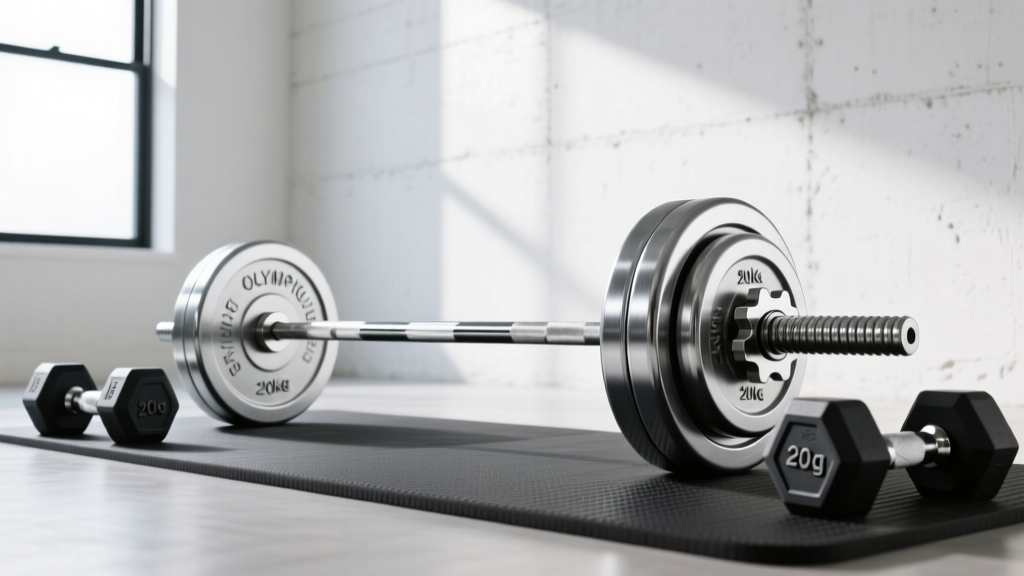
Beyond Arm Workouts with Dumbbells at Home: Barbell Guide
Ready to progress beyond arm workouts with dumbbells at home? Our step-by-step guide decodes Olympic barbell weights, knurling, and shaft specs.

Most lifters begin their fitness journey in a spare bedroom or garage, focusing heavily on arm workouts with dumbbells at home. While adjustable sets like the Bowflex 552 or PowerBlock Elite are fantastic for bicep curls, tricep extensions, and lateral raises, they eventually hit a hard ceiling for heavy compound movements. Once you can comfortably press 50-pound dumbbells for reps, your chest, back, and legs require a more scalable stimulus. This is where the Olympic barbell enters the picture.
Transitioning from dumbbells to a barbell is a massive milestone, but the buying process can be deeply confusing for beginners. Between tensile strength ratings, knurl patterns, and weight classes, it is easy to overpay for features you do not need or, worse, buy a cheap bar that bends under load. In this step-by-step 2026 buying guide, we will decode Olympic barbell weights and knurling so you can make a confident, lifelong investment in your home gym.
Step 1: Recognizing the Ceiling of Dumbbell Training
Before diving into barbell specifications, it is important to understand why you are upgrading. Dumbbells are exceptional for isolating muscles and correcting imbalances during arm workouts with dumbbells at home. However, they fall short in three critical areas:
- Neurological Limitation: Stabilizing two heavy, independent weights limits the raw force your central nervous system can output compared to a fixed barbell path.
- Incremental Loading: Most adjustable dumbbells jump in 5-pound increments. A barbell allows for micro-loading (adding 1 to 2.5 pounds), which is vital for progressive overload on lifts like the overhead press.
- Grip Fatigue: Holding heavy dumbbells for Romanian deadlifts or rows will cause your grip to fail long before your hamstrings or lats do. A barbell with proper knurling solves this bottleneck.
Step 2: Selecting the Correct Barbell Weight Class
The term 'Olympic barbell' refers to the 2-inch (50mm) diameter sleeves that fit standard bumper and iron plates. However, not all Olympic bars weigh the same. Choosing the right weight class depends on your current strength level and the primary lifts you plan to perform.
| Bar Type | Weight | Total Length | Shaft Diameter | Best Use Case |
|---|---|---|---|---|
| Men's Olympic | 20kg (44 lbs) | 2,200mm | 28mm - 29mm | Powerlifting, general strength, squats |
| Women's Olympic | 15kg (33 lbs) | 2,010mm | 25mm | Olympic lifting, smaller hand sizes, beginners |
| Technique Bar | 10kg (22 lbs) | 1,500mm - 2,200mm | 25mm - 28mm | Form practice, youth lifters, rehab |
Beginner Recommendation: If you are a male lifter or a female lifter with larger hands transitioning from heavy dumbbell work, the standard 20kg Men's bar is the most versatile choice. It fits standard power racks (which are typically 49 inches wide) and accommodates all standard plates. According to BarBend's comprehensive barbell guide, starting with a 20kg bar ensures you won't outgrow your equipment as your deadlift and squat numbers climb past 135 pounds.
Step 3: Navigating the Knurling Landscape
Knurling is the cross-hatched pattern machined into the steel shaft of the barbell. It is the single most important point of contact between you and the weight. For someone used to the smooth, rubberized handles of hex dumbbells, aggressive barbell knurling can be a shock to the system. Here is how to decode the three primary knurl patterns available in 2026:
The 3 Knurl Profiles
1. Hill Knurl (Mild): The peaks of the knurl are flattened off. It feels smooth and is forgiving on the hands, but can become slippery during heavy, sweaty deadlifts. Example: Eleiko OP Bar.
2. Volcano Knurl (Medium): The peaks are rimmed with a small crater in the center. This provides a sharp 'bite' that grips the skin without tearing calluses. It is the gold standard for multi-purpose home gyms. Example: Rogue Ohio Bar.
3. Mountain Knurl (Aggressive): Sharp, pointed peaks that dig deeply into the hands. Excellent for heavy powerlifting, but painful for high-rep bicep curls or front squats. Example: Rep Fitness Deep Knurl Bar.
If you are upgrading specifically because you want to mix heavy compound lifts with your traditional arm workouts with dumbbells at home (like barbell curls or skull crushers), a Volcano knurl is your safest bet. It offers enough aggression to hold onto a 300-pound deadlift, but won't shred your palms during a high-volume tricep workout.
Step 4: Evaluating Shaft Diameter and Tensile Strength
Beyond weight and grip, the structural integrity of the bar dictates its lifespan. This is measured in PSI (Pounds per Square Inch) tensile strength. This number represents the maximum stress the steel can withstand before permanently bending or snapping.
The Tensile Strength Hierarchy
- Under 100,000 PSI: Avoid at all costs. These are typically cheap, $99 department store bars that will permanently bend if you drop a 225-pound deadlift.
- 165,000 to 190,000 PSI: The sweet spot for beginners and intermediate lifters. Bars in this range (like the Rep Fitness OB-86V2, priced around $229 in 2026) offer excellent durability and a lifetime warranty against bending.
- 190,000 to 215,000+ PSI: Elite competition grade. Found in bars like the Rogue Ohio Bar ($395) or Eleiko competition bars ($1,100+). Necessary for elite athletes dropping massive loads, but overkill for most home gym owners.
Shaft Diameter Note: A standard men's bar has a 28mm or 28.5mm shaft. This thickness provides the optimal balance of grip comfort and 'whip' (the elastic bounce of the bar at the bottom of a lift). Avoid 29mm+ shafts unless you are strictly powerlifting and prefer a completely stiff bar for squats.
Step 5: Your 2026 Step-by-Step Purchasing Framework
Ready to pull the trigger? Follow this checklist to ensure you are buying the right barbell for your specific home gym setup:
- Measure Your Rack: Ensure the bar's 'loadable sleeve length' is at least 16 inches. If you plan to load four 45-pound bumper plates per side, you need a sleeve length of 16.3 inches or more to accommodate the thicker rubber plates.
- Check the Center Knurl: Do you plan to back squat? Look for a bar with a center knurl strip to grip your shirt and prevent the bar from sliding down your back. If you primarily do deadlifts, presses, and arm workouts, a bar without a center knurl will be much more comfortable against your shins and chest.
- Verify the Bushings vs. Bearings: For slow, heavy lifts (squats, bench, curls), bronze bushings are preferred as they reduce sleeve spin and increase stability. For fast Olympic lifts (snatches, cleans), needle bearings are better. As a beginner focused on general strength, stick to high-quality bronze bushings.
- Budget Allocation: Set aside $250 to $350 for the barbell itself. Do not sacrifice bar quality to buy more weight plates; a $150 bar will ruin your lifting experience, whereas a $300 bar will literally last generations.
Troubleshooting Common Beginner Mistakes
Even with the right knowledge, new buyers often fall into a few common traps when transitioning from dumbbells to barbells:
⚠️ Warning: The 'Standard' Barbell Trap
Do not confuse 'Olympic' barbells with 'Standard' barbells. Standard bars have 1-inch diameter sleeves and are usually sold in cheap beginner kits on Amazon. They max out around 200-300 lbs of capacity and use proprietary, hard-to-find plates. Always buy an Olympic bar (2-inch sleeves) so you can use universal bumper and iron plates as you grow stronger.
Final Thoughts on Your Home Gym Evolution
Moving beyond arm workouts with dumbbells at home is an exciting evolution in your fitness journey. Dumbbells will always have a place in your routine for isolation work, joint health, and unilateral balancing. However, an Olympic barbell is the ultimate tool for building raw, foundational strength. By prioritizing a 20kg weight class, a medium volcano knurl, and a minimum of 165,000 PSI tensile strength, you are setting yourself up for a decade of safe, progressive, and highly effective training. Invest wisely in 2026, and your barbell will easily outlast your fitness goals.
More gear to consider
All reviews
2026 Rack Trends: Storing Heavy Weights for Dumbbell Glute Bridges

Bumper vs Iron Plate Care & Incline Dumbbell Skull Crusher Longevity
Dumbbell Good Morning Exercise: Rack Storage & Longevity Tips

Kettlebell Guide: Cast Iron vs Competition & How to Hold a Dumbbell Correctly
Olympic Barbell Guide: Weight, Knurling & Seated Dumbbell Hammer Curl
