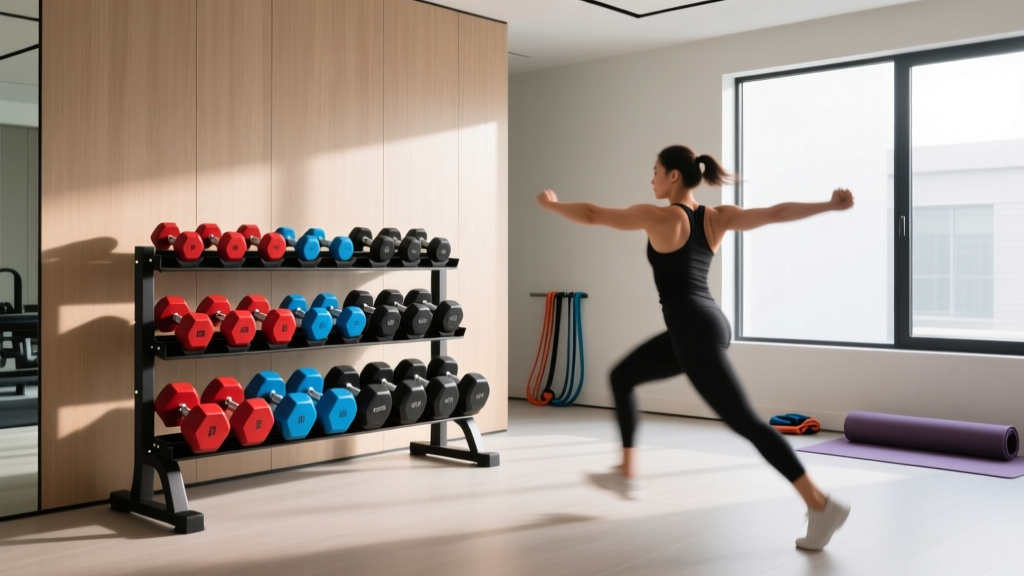
Dumbbell Racks: Clearing Space for Rear Delt Exercises with Dumbbells
Optimize your home gym layout with space-saving dumbbell racks. Learn how to design clear movement zones for rear delt exercises with dumbbells.

The Spatial Geometry of Home Gym Storage
In 2026, the home fitness industry has fully pivoted from simply accumulating gear to mastering spatial efficiency. A cluttered lifting zone is not just an eyesore; it is a biomechanical hazard. When designing a free-weight area, the storage solution dictates the flow of your workout. The primary challenge for most lifters is not finding a rack that holds their weights, but finding a rack that preserves the necessary clearance for complex, multi-planar movements.
Nowhere is this more evident than when performing rear delt exercises with dumbbells. Movements like the bent-over reverse fly, the chest-supported rear delt row, and the seated bent-over lateral raise require significant lateral and posterior elbow extension. If your dumbbell storage is poorly placed or excessively bulky, you risk striking steel uprights mid-rep, leading to joint compensation or dropped weights. This guide breaks down the exact rack specifications, layout blueprints, and clearance mathematics required to optimize your space without sacrificing movement integrity.
Tiered vs. Vertical: Footprint and Capacity Analysis
Choosing the right rack requires balancing your available floor space against the weight capacity you need. The market is currently dominated by two primary configurations: the horizontal 3-tier rack and the vertical footprint saver. Below is a comparative analysis of the top-performing models in 2026, focusing on spatial impact and structural integrity.
| Rack Model | Footprint (W x D) | Capacity | Steel Gauge | 2026 Est. Price | Best Layout Application |
|---|---|---|---|---|---|
| Rogue Fitness 3-Tier | 23" x 34" | 10 Pairs (5-50 lbs) | 11-Gauge | $495 | Against-wall anchor in medium rooms |
| Rep Fitness 3-Tier | 22" x 32" | 10 Pairs (5-50 lbs) | 11-Gauge | $349 | Compact corner placements |
| Titan Fitness 3-Tier | 24" x 35" | 10 Pairs (5-50 lbs) | 14-Gauge | $279 | Budget-conscious open floors |
| Powerline Vertical | 22" x 22" | 10 Pairs (5-50 lbs) | 12-Gauge | $149 | Narrow galley-style home gyms |
While the Powerline Vertical rack saves approximately 4 square feet of floor space compared to a 3-tier model, it raises the center of gravity significantly. If you load 50 lb dumbbells on the top tier while the bottom tier is empty, the rack becomes highly susceptible to tipping during aggressive unloading. Always anchor vertical racks to wall studs using L-brackets if you have pets, children, or plan to load them asymmetrically.
Designing the "Movement Zone" for Unrestricted Flow
Storage is only half the equation; the void space around the storage is where the actual training happens. According to facility design principles outlined by the National Strength and Conditioning Association (NSCA), free-weight areas require a minimum of 3 feet of clearance around storage units to allow for safe loading, unloading, and spotting.
The Biomechanics of Rear Delt Clearance
When executing rear delt exercises with dumbbells, your body mechanics demand a specific spatial envelope. Consider the standing bent-over reverse fly. Your torso is hinged at roughly 45 degrees, and your arms sweep laterally and posteriorly.
- Average Male Shoulder Width: ~18 inches
- Arm Length + Dumbbell Extension: ~30 inches per side
- Total Wingspan Under Load: ~78 inches (6.5 feet)
Biomechanical data from ExRx confirms that posterior chain and lateral raise movements require maximum lateral clearance to prevent scapular retraction restriction. If your 3-tier dumbbell rack is placed parallel to your lifting zone, you must position your lifting platform at least 4 feet away from the front edge of the rack. This ensures that even with a slight backward drift during a heavy set of bent-over rows or rear delt flyes, your elbows will not collide with the 11-gauge steel uprights.
"A common failure mode in home gym design is placing the dumbbell rack directly behind the lifting bench. When a lifter transitions from a chest press to seated rear delt exercises with dumbbells, the lack of posterior clearance forces them to internally rotate the shoulder joint to avoid hitting the rack, severely limiting rear delt activation and increasing impingement risk."
3 Layout Blueprints for Space Optimization
How you position your rack dictates the efficiency of your supersets and the safety of your isolation work. Here are three proven layouts based on room dimensions.
1. The Galley Layout (Narrow Rooms: 8x12 ft)
For narrow spaces, a 3-tier rack will choke the room. Use a vertical rack (like the Powerline) placed in the furthest corner, angled at 45 degrees to the walls. This creates a triangular dead-space behind the rack for storing resistance bands and kettlebells. Your primary movement zone remains in the center of the room, providing the 78-inch wingspan necessary for standing rear delt exercises with dumbbells without lateral obstruction.
2. The Perimeter Flow (Square Rooms: 10x10 ft)
Place a compact 3-tier rack (like the Rep Fitness model) flat against the wall opposite your squat rack or power cage. This creates a distinct "heavy zone" and a "free-weight zone." By keeping the center of the room entirely empty, you can perform dynamic movements, lunges, and bent-over rear delt exercises with dumbbells without navigating around equipment. Ensure the rack is centered on the wall to maintain symmetrical traffic flow.
3. The L-Shape Integration (Attached Garages)
If you have a pull-up rig or power rack, utilize an L-shaped layout by placing your dumbbell rack perpendicular to the front uprights of your power rack, leaving a 36-inch walkway between them. This allows you to grab a pair of dumbbells and immediately step into the open garage bay for high-clearance isolation work. This layout is ideal for drop-sets, as you can move from heavy rows to lighter rear delt exercises with dumbbells in a single step.
Material Degradation and Maintenance in Tight Spaces
In optimized, smaller home gyms, ventilation is often compromised, leading to higher ambient humidity. This directly impacts your dumbbell storage and the weights themselves.
- Rubber vs. Urethane: If your rack is in a tight, unventilated corner, avoid cheap rubber-coated dumbbells. Rubber off-gasses and degrades when exposed to temperature fluctuations common in garages. Invest in urethane-coated sets, which resist UV and moisture degradation, ensuring they don't leave black scuff marks on your rack's powder-coated saddles.
- Saddle Wear: Racks with flat steel saddles (like some budget Titan models) will cause metal-handled dumbbells to slide and clang during re-racking. Look for racks with a 15-degree saddle tilt or add high-density rubber matting to the shelves to dampen noise and prevent rolling, which is crucial when you are fatigued midway through a high-volume posterior chain workout.
Frequently Asked Questions
Can I store adjustable dumbbells on a standard 3-tier rack?
Generally, no. Standard 3-tier racks are designed for the uniform cylindrical shape of fixed-weight hex or round dumbbells. Adjustable dumbbells (like Bowflex SelectTech or Nuobell) have wider, blockier profiles and different center-of-gravity distributions. Storing them on a standard angled saddle can cause the dial mechanisms to jam or the weights to slip. If you use adjustables, buy the proprietary storage stand designed specifically for that model to save space and protect the internal mechanics.
What is the best flooring to place under a dumbbell rack?
Use 3/4-inch thick vulcanized rubber stall mats. A dumbbell rack holding 10 pairs of weights can easily exceed 800 lbs. Standard foam puzzle tiles will compress and degrade within months, causing the rack to become unlevel. An unlevel rack causes dumbbells to roll off the saddles—a major safety hazard when you are stepping back to prepare for rear delt exercises with dumbbells and aren't expecting a shifting load.
How do I maximize wall space above the dumbbell rack?
Install a slatwall or pegboard system directly above your 3-tier rack, starting 24 inches above the top tier. This allows you to store lifting belts, wrist wraps, and resistance bands without increasing the floor footprint. Keep the immediate airspace above the top tier clear to allow for the vertical clearance needed when lifting 50 lb dumbbells off the top shelf.
More gear to consider
All reviews
EZ Curl vs Straight Bar: Space Layouts & Dumbbell Pullovers for Chest

Beginner Workout Routine With Dumbbells: Adjustable Set Review & Fixes
Cast Iron vs Competition Kettlebells & 120 Pound Dumbbell Value

Standing Shoulder Press With Dumbbells: Form & 2026 Adjustable Picks
Olympic Barbell Weight & Knurling Guide: Plus Dumbbell Organizer Setups
