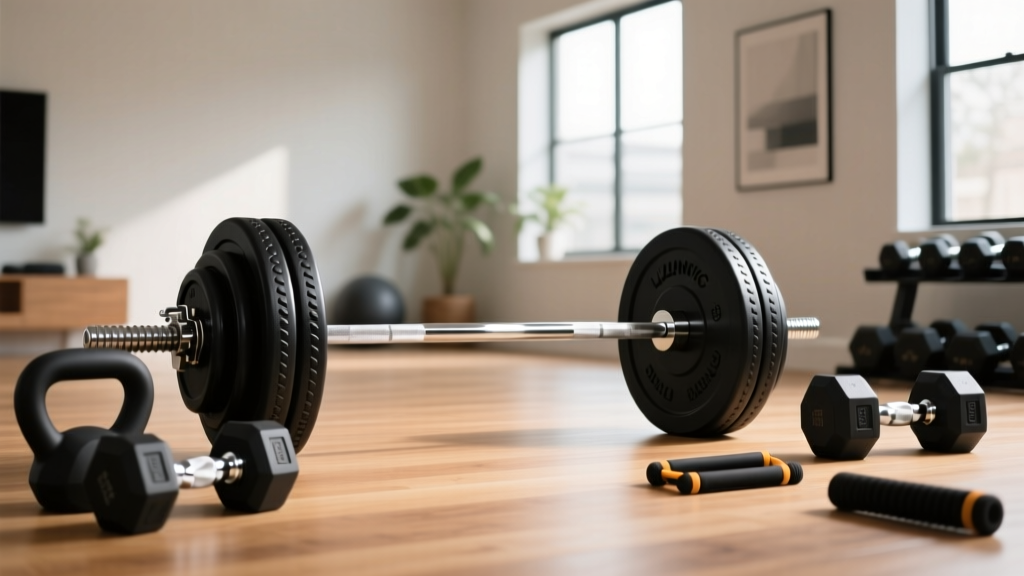
Barbell Buying Guide: Weight, Knurling & Dumbbell Isolation Curls
Master your home gym with our beginner-friendly Olympic barbell buying guide. Learn about weight, knurling, and pairing heavy lifts with dumbbell isolation curls.

The Beginner's Blueprint: Building Your Free Weight Arsenal
Welcome to the foundation of your home gym. If you are stepping into the world of serious strength training in 2026, navigating the sea of fitness equipment can feel overwhelming. A complete upper-body and arm-training setup requires two distinct tools: a high-quality Olympic barbell for heavy, systemic loading, and a set of adjustable dumbbells for targeted joint-friendly accessory work. According to comprehensive testing by Garage Gym Labs, investing in the right barbell early on prevents costly upgrades and protects your wrists and lower back from improper biomechanics.
This step-by-step guide will walk you through the exact specifications you need to look for when buying an Olympic barbell—focusing on weight tolerances, tensile strength, and the often-misunderstood world of knurling. Finally, we will cover how to seamlessly program your new barbell alongside dumbbell isolation curls to build a bulletproof, aesthetically pleasing physique without destroying your joints.
Beginner Callout: Never buy a 'standard' 1-inch diameter barbell. Always invest in an 'Olympic' barbell with 2-inch rotating sleeves. It is the universal standard for all reputable gyms and plate manufacturers.Step 1: Demystifying Barbell Weight, Dimensions, and Tensile Strength
Before you look at the grip, you must understand the steel. A standard men's Olympic barbell weighs exactly 20 kilograms (44.09 lbs), measures 2.2 meters (7.2 feet) in length, and features a 28mm to 29mm shaft diameter. Women's Olympic bars weigh 15 kilograms (33 lbs) and feature a thinner 25mm shaft, which is crucial for lifters with smaller hands to maintain a secure hook grip.
The Magic Number: Tensile Strength (PSI)
Tensile strength measures how much force the steel can withstand before permanently bending or snapping. In the current 2026 market, you should use 190,000 PSI as your absolute baseline for a multi-purpose bar.
- Under 165,000 PSI: Budget 'Amazon-special' bars. These will permanently bend if you drop them from overhead with bumper plates.
- 190,000 - 205,000 PSI: The sweet spot for multi-purpose and powerlifting bars. They offer enough 'whip' (elasticity) for Olympic lifts but remain stiff enough for heavy squats.
- 210,000+ PSI: Ultra-stiff powerlifting bars designed exclusively for squat, bench, and deadlift. Zero whip.
Step 2: The Knurling Matrix (What Actually Matters)
Knurling is the cross-hatched pattern machined into the steel shaft to provide grip. However, not all knurling is created equal. The geometry of the knurl dictates whether the bar will feel like sandpaper or a cheese grater. Expert reviewers at BarBend consistently rank knurl geometry as the number one differentiator between a $200 budget bar and a $350 premium bar.
The Three Knurl Profiles
- Volcano Knurling (The Gold Standard): The machine cuts a diamond pattern, and then the very tip of the peak is milled off. This leaves a microscopic 'crater' with four sharp edges. It provides an aggressive, toothy grip that locks into your calluses without tearing the skin. Look for this on premium bars like the REP Fitness AB-2000 or Rogue Echo 2.0.
- Mountain Knurling: The diamond peaks are left completely intact and sharp. It feels incredibly aggressive and can easily tear open your hands during high-rep accessory work. Common on older powerlifting bars and budget imports.
- Hill Knurling: The peaks are rounded off or poorly machined, leaving a smooth, almost slick surface. Avoid these at all costs; your grip will fail before your muscles do.
"A great volcano knurl should feel like gripping a piece of coarse sandpaper, not a bed of nails. It should provide friction through surface area, not by piercing the epidermis." — Home Gym Engineering Consensus
Step 3: 2026 Beginner-Friendly Olympic Barbell Comparison
To save you hours of research, we have compiled a data matrix of the top three entry-to-mid-level Olympic barbells dominating the 2026 home gym market. These models offer the best balance of tensile strength, knurl quality, and warranty coverage.
| Barbell Model | Price (Approx.) | Tensile Strength | Knurl Type | Best For |
|---|---|---|---|---|
| Rogue Fitness Echo Bar 2.0 | $245.00 | 190k PSI | Composite Volcano | All-Around / CrossFit |
| REP Fitness AB-2000 | $299.00 | 200k PSI | Deep Volcano | Powerbuilding / Hypertrophy |
| Titan Fitness Performance | $229.00 | 188k PSI | Moderate Mountain | Budget Powerlifting |
Note: Always check for bushings (bronze or composite) over needle bearings in this price range. Bearings are unnecessary for slow, controlled lifts and often rattle or seize up in budget manufacturing.
Step 4: Programming Heavy Barbell Work and Dumbbell Isolation Curls
Once you have selected your barbell, the next step is learning how to program it effectively. The barbell is the undisputed king of mechanical tension. Exercises like heavy barbell rows, strict barbell curls, and overhead presses allow you to move maximum load, triggering systemic central nervous system (CNS) adaptation and dense muscle fiber recruitment.
The Problem with Barbell-Only Arm Training
While the barbell is unmatched for overloading the biceps brachii and brachialis, the fixed wrist position can lead to medial epicondylitis (golfer's elbow) or wrist impingement over time. Because a straight barbell locks your radioulnar joint into forced supination, it ignores the natural carrying angle of your arms. To mitigate this, intelligent programming pairs heavy barbell compounds with dumbbell isolation curls.
The Step-by-Step Arm Day Protocol
By transitioning to dumbbells for your back-off sets, you maintain high muscular tension while sparing your connective tissue. Here is a beginner-friendly, step-by-step protocol to blend both modalities:
- The Heavy Primer (Barbell): Start with Strict Barbell Curls. Perform 3 sets of 5-8 reps at an RPE (Rate of Perceived Exertion) of 8. Focus on keeping the elbows pinned to your ribs. The aggressive volcano knurl on your barbell will ensure the bar doesn't slip from your grip as fatigue sets in.
- The Transition (Rest): Rest for exactly 120 seconds to allow ATP-PC system replenishment.
- The Joint-Sparing Accessory (Dumbbells): Move immediately to dumbbell isolation curls. Perform 3 sets of 10-15 reps. Start with a neutral grip (hammer position) at the bottom of the movement, and supinate (twist) your wrist outward as you pass the 90-degree mark. This mimics the natural biomechanical function of the bicep, which acts as both an elbow flexor and a forearm supinator.
- The Finisher (Incline Dumbbell Curls): Set a bench to a 45-degree angle. Let your arms hang fully behind your torso to stretch the long head of the bicep. Perform 2 sets to absolute failure.
Final Thoughts on Your Free Weight Investment
Building a resilient, aesthetic physique requires the right tools and the right knowledge. By investing in an Olympic barbell with 190k+ PSI tensile strength and a proper volcano knurl, you secure a lifetime piece of equipment that will handle your heaviest compound lifts. By strategically programming dumbbell isolation curls as your primary accessory movement, you ensure long-term joint health and optimal muscle targeting. Equip your gym intelligently, respect the biomechanics, and the results will follow.
More gear to consider
All reviews
Barbell Collar Types Compared: Securing 50kg Dumbbell and Bar Loads
Cast Iron vs Competition Kettlebells: Upper Chest Workout Dumbbell?

Power Rack vs Squat Rack vs Squat Stand: Setup Guide for the Dumbbell Pullover Crunch

Olympic vs Standard Plate Setup & What Muscles Do Dumbbell Rows Work

Cast Iron vs Competition Kettlebells & Jumping Jacks with Dumbbells