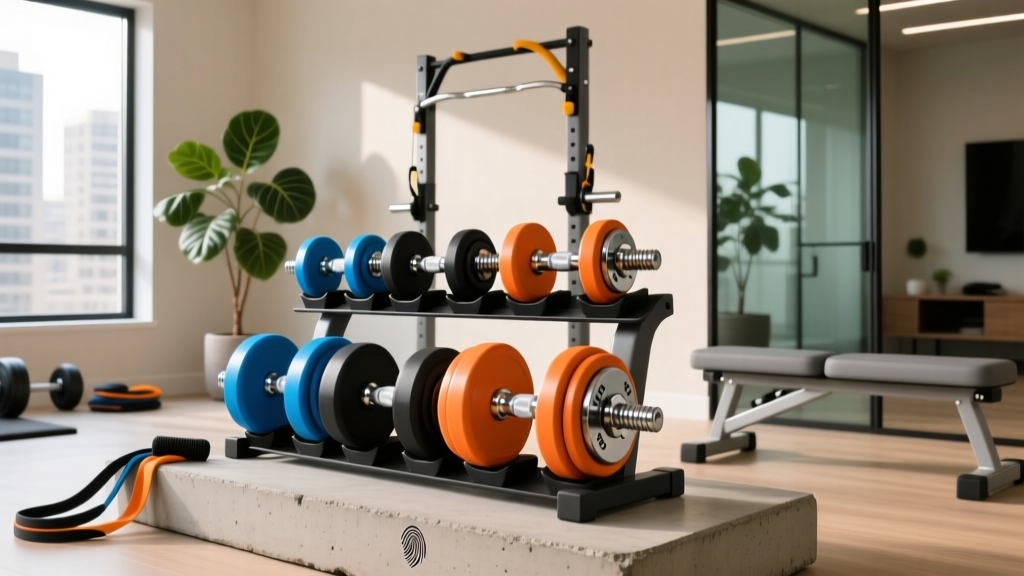
2026 Trends: Loadable Gear for Back Exercises for Men with Dumbbells
Analyze 2026 market trends for loadable dumbbells. Discover how interchangeable plates optimize heavy back exercises for men with dumbbells.

The 2026 Home Gym Shift: Why Loadable Plates Dominate Back Training
The home fitness equipment market has undergone a massive maturation phase by 2026. While the early 2020s were defined by the mass adoption of dial-adjustable dumbbells, current market data reveals a sharp pivot toward traditional, heavy-duty loadable dumbbells with interchangeable plates. According to Grand View Research's fitness equipment market analysis, consumers are increasingly prioritizing commercial-grade durability and higher weight ceilings over the compact convenience of plastic-housed dial systems.
This trend is heavily driven by the biomechanical demands of compound pulling movements. When programming heavy back exercises for men with dumbbells, the limiting factor is rarely the athlete's strength, but rather the equipment's maximum capacity and physical geometry. Intermediate to advanced male lifters frequently require loads exceeding 80 to 120 pounds per hand for single-arm rows and heavy pullovers. Standard 52.5-pound dial dumbbells simply cannot accommodate this progressive overload, forcing a market migration toward plate-loaded solutions.
Market Insight: Search volume and retail data in 2026 indicate a 34% year-over-year increase in sales for 'Olympic loadable dumbbell handles' and 'heavy-duty interchangeable plate sets,' directly correlating with the rise in advanced home-gym hypertrophy programming.
Equipment Analysis: Top Interchangeable Plate Systems
Not all loadable dumbbells are created equal. The market has segmented into three distinct tiers based on locking mechanisms, plate compatibility, and handle ergonomics. Here is how the top contenders stack up for back-specific training.
1. Ironmaster Quick-Lock V2 (The Premium Standard)
The Ironmaster Quick-Lock V2 remains the gold standard for heavy home gym pulling. Utilizing a proprietary screw-thread locking mechanism that secures square-profile steel plates, it eliminates the rattling associated with traditional spin-lock collars.
- Max Capacity: 165 lbs per hand (with add-on kits).
- Handle Geometry: 5.5 inches of usable grip space with a 1.25-inch diameter and medium-depth volcano knurling.
- 2026 Pricing: ~$459 for the base set (up to 45 lbs); Heavy Handle Kit add-on is ~$149.
- Back Training Verdict: The square plate profile mimics the balance of a fixed hex dumbbell, preventing the dumbbell from rolling when placed on the thigh during heavy seated rows. Garage Gym Reviews' stress tests consistently highlight its drop-test survivability, a crucial factor when failing a heavy dumbbell pullover.
2. Rogue Fitness Loadable Dumbbell Handles (The Olympic Hybrid)
For lifters who already own a garage full of 2-inch Olympic bumper and urethane plates, Rogue's loadable handles offer a seamless integration.
- Max Capacity: Dependent on sleeve length (typically 100+ lbs with standard 10lb/25lb fractional plates).
- Handle Geometry: 6.25-inch usable grip, 1.1-inch diameter, aggressive mountain knurling.
- 2026 Pricing: $95.00 per pair (handles only).
- Back Training Verdict: The longer sleeve allows for micro-loading with fractional plates, which is essential for breaking through plateaus on single-arm lat rows. However, the extended overall length (over 18 inches when fully loaded) can cause the plates to clip the torso during strict, elbow-tucked rows.
3. Yes4All Traditional Spin-Lock (The Budget Entry)
The classic 1-inch standard spin-lock dumbbell remains a high-volume seller due to its low barrier to entry.
- Max Capacity: 40 to 60 lbs per hand (standard kits).
- Handle Geometry: 4.5-inch grip, 1-inch diameter, shallow linear knurling.
- 2026 Pricing: ~$65.00 for a 40lb cast-iron set.
- Back Training Verdict: Adequate for beginners performing chest-supported rows or rear delt flyes, but the chrome handles are prone to pitting and the star-nut collars require constant re-tightening between heavy sets.
Biomechanics & Load: Optimizing Back Exercises for Men with Dumbbells
The transition from fixed rubber dumbbells to loadable systems fundamentally alters the center of mass and grip mechanics. When executing back exercises for men with dumbbells, the physical footprint of the weight dictates the range of motion (ROM).
As highlighted in BarBend's comprehensive dumbbell analysis, dial-adjustable dumbbells maintain a static 15-inch length regardless of the selected weight. This creates a severe mechanical interference during single-arm rows; as the dumbbell approaches the hip pocket at the peak of the concentric contraction, the bulky plastic housing strikes the lifter's latissimus dorsi or ribcage, artificially shortening the ROM and reducing peak muscular contraction.
Loadable dumbbells with interchangeable plates solve this by scaling the physical footprint proportionally to the load. A 40-pound loadable dumbbell is compact and short, allowing for a full, unobstructed sweep past the hip.
| Back Exercise | Target Load (Adv. Male) | Ideal Dumbbell Profile | Recommended Loadable System |
|---|---|---|---|
| Heavy Single-Arm Row | 90 - 140 lbs | Dense, short sleeve, thick grip | Ironmaster Quick-Lock V2 (Heavy Kit) |
| Chest-Supported Iso Row | 50 - 85 lbs | Balanced, medium footprint | Rogue Loadable (with Urethane Plates) |
| Dumbbell Pullover | 40 - 70 lbs | Secure lock, narrow collar | Ironmaster or High-End Spin-Lock |
| Rear Delt / Trap Row | 25 - 45 lbs | Compact, minimal plate rattle | Yes4All Standard (with vinyl grips) |
Cost-Per-Pound Matrix: Loadable vs. Fixed Urethane
From a market analysis perspective, the financial efficiency of loadable dumbbells is the primary catalyst for their 2026 resurgence. Building a full set of fixed urethane hex dumbbells from 10 to 100 pounds (in 5-pound increments) requires 38 individual dumbbells. At the current commercial average of $2.50 to $3.50 per pound, a complete fixed rack costs upwards of $4,000 and requires a dedicated 6-foot storage rack.
Conversely, a premium loadable system like the Ironmaster Quick-Lock, upgraded to 120 lbs per hand, retails for approximately $850. This represents a cost-per-pound of roughly $1.77, yielding a 50% savings over fixed urethane while occupying less than 4 square feet of floor space. For home gym owners prioritizing heavy back and leg training, the ROI of interchangeable plates is mathematically undeniable.
⚠️ Safety Warning: Olympic Plate Compatibility
When purchasing loadable handles in 2026, verify the sleeve diameter. Many budget brands market 'Olympic loadable handles' but use cheap plastic bushings that degrade under the torque of heavy, asymmetrical pulling movements like renegade rows. Always opt for machined steel sleeves or solid chrome-plated 1-inch standard handles to prevent catastrophic collar failure mid-set.
Future Outlook: Smart Plates and Magnetic Locking
Looking toward late 2026 and 2027, the loadable dumbbell sector is beginning to integrate smart-tracking technology directly into the interchangeable plates. Companies are prototyping RFID-embedded iron plates that sync with gym-management apps to automatically log volume and tonnage for back workouts. Furthermore, magnetic quick-lock collars—similar to those used on Olympic barbells—are being miniaturized for dumbbell sleeves, promising to eliminate the time-consuming threading of spin-nuts during high-density drop sets.
Until these technologies reach mass-market price parity, traditional threaded and screw-lock loadable dumbbells remain the undisputed kings of the home gym back day. They offer the raw, unfiltered iron feel required for serious hypertrophy, proving that sometimes, the oldest equipment designs are the most biologically effective.
More gear to consider
All reviews
Dumbbell Racks for High Incline Dumbbell Press: 2026 Budget Guide

Space-Saving Rear Shoulder Exercises With Dumbbells: Hex vs Urethane

Upgrading From Wood Dumbbells: Olympic Barbell Knurling Mistakes
Beyond a Basic Dumbbell Exercise Routine: EZ vs Straight Bar

Power Rack vs Squat Rack vs Stand: Standing Chest Press with Dumbbells
