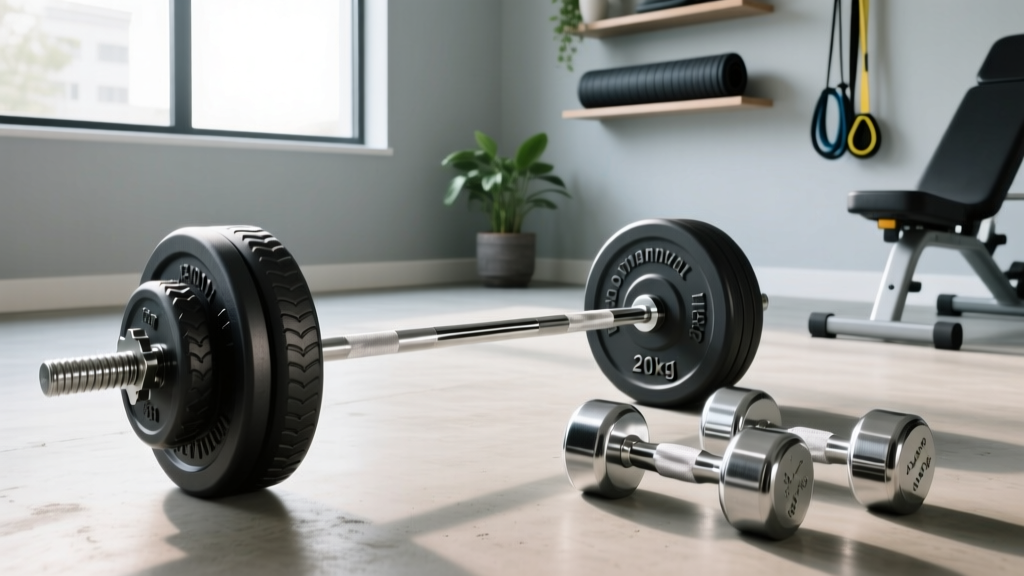
Olympic Barbell Knurling Guide & Incline Dumbbell Reverse Fly
Master your home gym with our Olympic barbell buying guide covering weight, knurling types, and pairing it with the incline dumbbell reverse fly.

The Foundation: Olympic Barbell Weight and Dimensions
Building a resilient free weight station requires a deep understanding of your primary lifting implement. As of 2026, the market is saturated with cheap imports, making it crucial to recognize the exact specifications of a true Olympic barbell. A standard men's Olympic bar weighs exactly 20 kilograms (44 pounds) and features a 28mm shaft diameter. The women's specification weighs 15 kilograms (33 pounds) with a 25mm shaft, designed for smaller hand grips and different whip dynamics.
When evaluating weight and structural integrity, tensile strength is your most critical metric. Measured in PSI (pounds per square inch), this number dictates how much load the bar can take before permanently bending or snapping. According to engineering standards highlighted by Rogue Fitness, a minimum of 190,000 PSI is required for a durable multi-purpose bar. Premium hybrid bars now routinely sit between 210,000 and 215,000 PSI, ensuring the barbell returns to true center even after heavy deadlift drops.
2026 Pricing Benchmark: Expect to pay between $225 and $295 for a high-quality, 210k PSI hybrid barbell with composite bushings. Anything under $150 likely compromises on tensile strength or sleeve machining.The Knurling Matrix: Hill, Mountain, and Volcano
Knurling is the machined, cross-hatched pattern on the shaft that provides friction. For beginners, choosing the right knurl is the difference between a secure grip and torn, bleeding calluses. Fitness equipment analysts at BarBend categorize knurling into three distinct geometric profiles. Understanding these will dictate how the bar feels during high-volume hypertrophy work versus heavy 1-rep max testing.
| Knurl Type | Geometry & Feel | Best Application |
|---|---|---|
| Hill | Rounded peaks, shallow valleys. Feels smooth and passive. | High-rep sets, beginners, pressing movements. |
| Mountain | Sharp, prominent peaks. Highly aggressive and abrasive. | Heavy 1-3 rep max deadlifts, chalk-heavy pulling. |
| Volcano | Sharp rims with a dipped center. Grippy without tearing skin. | The 2026 gold standard for hybrid, all-around lifting. |
For a beginner buying their first and only barbell, a volcano knurl is the undisputed choice. It provides enough bite to secure a heavy barbell row but remains forgiving enough for high-rep front squats where the bar rests against the clavicle.
Center Knurl and Sleeve Spin
Do not overlook the center knurl or the sleeve construction. Powerlifting (IPF) bars feature an aggressive center knurl to grip the back during low-bar squats. Olympic weightlifting (IWF) bars omit it entirely to prevent tearing the chest during cleans. For general fitness, a mild, 4-inch center knurl is ideal. Furthermore, ensure the sleeves utilize bronze bushings rather than cheap plastic or basic ball bearings. Bushings provide the necessary friction for heavy, slow lifts like squats, whereas needle bearings are reserved for expensive, dedicated Olympic lifting bars where rapid sleeve rotation is mandatory.
Accessory Isolation: The Incline Dumbbell Reverse Fly
While the Olympic barbell is unmatched for building raw mid-back thickness via bent-over rows, it heavily taxes the lumbar spine. To build a complete, injury-resistant posterior chain, you must pair heavy barbell pulls with strict isolation work. This is where the incline dumbbell reverse fly becomes a non-negotiable staple in your programming.
By using an incline bench, you eliminate momentum and lower back involvement, forcing the rear deltoids, rhomboids, and mid-trapezius to do 100% of the work. According to biomechanics guidelines supported by the National Strength and Conditioning Association (NSCA), isolating the rear delts is critical for balancing shoulder health, especially for beginners who tend to overdevelop the anterior deltoids from pressing.
Step-by-Step Execution Guide
- Bench Setup: Adjust an adjustable bench to a 30-degree or 45-degree incline. A 30-degree angle targets the mid-back and lower traps slightly more, while 45 degrees heavily biases the rear deltoids.
- Starting Position: Grab a pair of light dumbbells (beginners should start with 10 to 15 lbs). Lie chest-down on the bench. Let your arms hang straight down toward the floor with a neutral grip (palms facing each other) and a slight bend in the elbows.
- Scapular Retraction: Before lifting the weight, pinch your shoulder blades together. This pre-activation ensures the back muscles initiate the movement, not the biceps.
- The Concentric Phase: Exhale and raise the dumbbells out to the sides in a wide arc. Imagine you are trying to touch the walls on either side of you. Stop when your arms are parallel to the floor or slightly above.
- The Eccentric Phase: Inhale and slowly lower the weights back to the starting position over a 2-to-3 second count. Do not let the dumbbells clang together at the bottom; maintain tension on the rhomboids.
Programming Pulls and Flyes for Beginners
To synthesize your new barbell purchase with proper accessory work, structure your 'Pull' days to prioritize central nervous system (CNS) output before moving to metabolic isolation. Here is a highly effective, beginner-friendly back and rear-delt sequence:
- Barbell Bent-Over Row: 3 sets of 6-8 reps (Focus on heavy, explosive concentric pulls using your new volcano-knurled bar).
- Single-Arm Dumbbell Row: 3 sets of 10-12 reps per arm (Unilateral work to fix imbalances).
- Incline Dumbbell Reverse Fly: 3 sets of 15-20 reps (High volume, short rest periods of 45 seconds to flood the rear delts with blood and promote hypertrophy).
- Face Pulls (Cable or Band): 2 sets to failure (Final rotator cuff burnout).
Final Thoughts on Your Free Weight Investment
Navigating the free weights aisle can be overwhelming, but breaking it down into measurable data points simplifies the process. Invest in a 20kg, 210,000 PSI Olympic barbell with a volcano knurl to ensure your grip never fails during heavy compound lifts. Then, complement that raw power with the strict, chest-supported isolation of the incline dumbbell reverse fly. This dual approach guarantees you build a back that is not only thick and powerful but also structurally balanced and resilient for years of lifting ahead.
More gear to consider
All reviews
Olympic vs Standard Plates: Heavy Lifts & Dumbbell Belly Exercises
EZ vs Straight Bar Maintenance & How to Work Out Lats With Dumbbells

Beyond the Dumbbell Outline: Cast Iron vs Competition Kettlebells

Beyond the Dumbbell Symbol: Loadable Plates for Compact Gyms
Power Rack vs Squat Rack vs Squat Stand for Dumbbell Complexes
