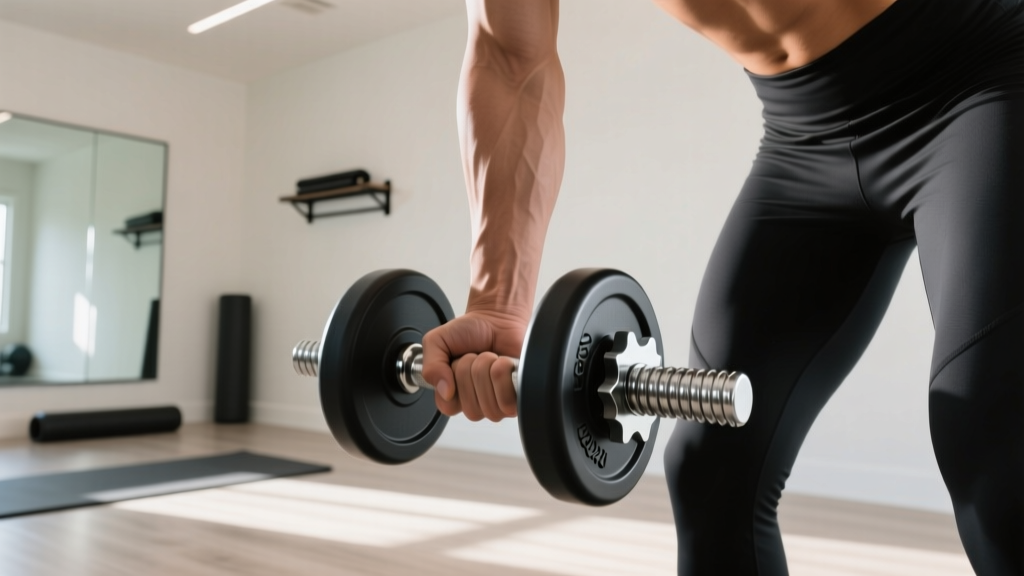
2026 Adjustable Dumbbell Review: Standing Single Arm Dumbbell Row
Discover the best adjustable dumbbells for the standing single arm dumbbell row. Our 2026 review compares grip, clearance, and biomechanics.

The Biomechanical Demand of the Standing Single Arm Dumbbell Row
When outfitting a home gym, most buyers evaluate adjustable dumbbells based on footprint and weight increments. However, as a domain expert in free weight ergonomics, I evaluate them based on how they perform during specific, high-demand movements. The standing single arm dumbbell row is a premier unilateral back exercise that exposes the design flaws of poorly engineered adjustable dumbbells. Unlike a supported chest row or a bent-over barbell row, the standing single arm dumbbell row requires intense anti-rotational core stability while demanding a strict, unobstructed line of pull for the latissimus dorsi and rhomboids.
According to kinesiology data from ExRx.net, the unilateral row requires the lifter to pull the elbow past the torso while maintaining a neutral spine. If your adjustable dumbbell is overly bulky, the lateral plates will collide with your thigh or oblique during the concentric phase, artificially shortening your range of motion. Furthermore, research published in the National Center for Biotechnology Information (NCBI) highlights that unilateral, unsupported movements place a 30-40% higher demand on the contralateral obliques and transverse abdominis to prevent spinal rotation. This means grip fatigue will often precede back fatigue if the dumbbell handle lacks proper knurling or features an awkward diameter.
Expert Insight: The Clearance Problem
Standard fixed hex dumbbells have a compact head. Many popular adjustable dumbbells, however, use a sleeve-and-dial mechanism that adds 2 to 4 inches of dead space on each side of the handle. When executing a standing single arm dumbbell row, this extra length forces the lifter to adopt an unnaturally wide stance or risk the dumbbell clacking against their knee at the bottom of the movement.
2026 Adjustable Dumbbell Comparison Matrix for Rowing
Below is a specialized comparison matrix evaluating the top adjustable dumbbells on the market specifically through the lens of unilateral rowing mechanics, grip ergonomics, and physical clearance.
| Model | Max Weight | Total Length | Handle Knurling | Rowing Clearance Rating |
|---|---|---|---|---|
| Nuobell 80lb | 80 lbs | 13.5 inches | Medium Diamond | Excellent |
| PowerBlock Elite USA | 90 lbs (Expandable) | 12.0 inches | None (Urethane) | Superior |
| Ironmaster Quick-Lock V2 | 75 lbs (Base) | 14.5 inches | Aggressive | Good |
| Bowflex SelectTech 552 | 52.5 lbs | 15.75 inches | Light / Smooth | Poor |
In-Depth Model Reviews: The Rowing Perspective
1. PowerBlock Elite USA (Best Overall for Unilateral Clearance)
Retailing around $399 for the base 50lb set (expandable to 90lbs), the PowerBlock Elite USA remains the undisputed king of spatial efficiency. Its blocky, cage-like design measures just 12 inches in total length. When performing a standing single arm dumbbell row, this compact footprint is a massive advantage. You can pull the weight high into your hip pocket without the dumbbell's ends clipping your thigh or torso.
The Drawback: PowerBlocks lack knurling. The straight, urethane-coated handle relies on friction. During heavy, high-rep rowing sets where palmar sweating is inevitable, grip strength becomes the limiting factor. You will likely need lifting straps for sets exceeding 70 lbs per arm.
2. Nuobell 80lb (Best for Grip Ergonomics and Feel)
At $429, the Nuobell 80lb adjustable dumbbell is the closest you will get to the feel of a commercial fixed dumbbell. The handle features genuine medium-diamond knurling and a slight taper, which locks into the metacarpal ridge of the hand beautifully. For the standing single arm dumbbell row, this means you can focus entirely on driving the elbow to the ceiling and contracting the scapula, rather than worrying about the implement slipping from a sweaty palm.
The Drawback: The Nuobell's dial mechanism is precise but fragile. Dropping a 70lb Nuobell at the end of a grueling set of rows will shatter the internal polycarbonate gears. You must bend down and place it on the rack between every set.
3. Ironmaster Quick-Lock V2 (Best for Heavy, Low-Rep Rows)
If your programming dictates heavy, 5-rep max standing single arm dumbbell rows, the Ironmaster Quick-Lock V2 ($899 for a 75lb set) is mandatory. The handle is thick, aggressively knurled, and built like a tank. The square weight plates mimic the profile of a vintage York barbell plate, providing decent clearance.
The Drawback: The screw-in locking mechanism takes roughly 15 to 20 seconds per dumbbell to adjust. If you are utilizing drop-sets or rest-pause techniques to push past muscular failure on your back day, the Ironmaster's adjustment time will ruin your metabolic conditioning.
4. Bowflex SelectTech 552 (Not Recommended for Standing Rows)
While the Bowflex 552 ($349) is a staple in millions of home gyms, it is fundamentally flawed for the standing single arm dumbbell row. At 15.75 inches long, the plastic housing extends far past the handle. To avoid hitting your body during the pull, you must externally rotate your shoulder or adopt a sumo-width stance, both of which compromise the biomechanical integrity of the latissimus dorsi engagement.
Programming the Standing Single Arm Row at Home
To maximize hypertrophy and postural health using adjustable dumbbells, proper execution is vital. The American Council on Exercise (ACE) emphasizes maintaining a rigid torso to isolate the back musculature. Follow this framework for your next session:
- The Staggered Stance: Step forward with the leg opposite to the working arm. This creates a stable base and naturally clears the hip, allowing the dumbbell to travel higher during the concentric phase without striking the thigh.
- The Tempo: Use a 2-0-1-2 tempo. Two seconds down (eccentric), zero second pause at the bottom, one second explosive pull (concentric), and a two-second isometric squeeze at the top where the elbow passes the ribcage.
- Core Bracing: Inhale deeply into the diaphragm before initiating the pull. Imagine someone is about to punch you in the obliques on the non-working side. This intra-abdominal pressure prevents the lumbar spine from twisting under the asymmetric load.
Form Warning: Never use momentum to heave the weight up. If your torso rotates more than 15 degrees toward the ceiling to get the weight to your hip, the load is too heavy. Drop the weight by one increment on your adjustable dumbbell and prioritize the mind-muscle connection in the mid-back.
Frequently Asked Questions
Can I use a bench for support instead of standing?
Yes, the three-point stance (one knee and one hand on a bench) is a valid variation. However, the standing single arm dumbbell row recruits significantly more stabilizer muscles, including the gluteus medius and quadratus lumborum, making it superior for functional, athletic carryover.
What weight increments are best for back training?
The back is a large, powerful muscle group. Adjustable dumbbells that jump in 5lb increments (like the Bowflex or Ironmaster) are generally better suited for heavy compound rows. Models that jump in 2.2lb/1kg increments (like the Nuobell) are excellent for isolation movements like lateral raises, but the micro-jumps are often unnecessary for heavy rowing progressions.
Why does my lower back ache during this movement?
Lower back pain during standing unilateral rows usually stems from a lack of hip hinge discipline or core bracing. Ensure you are pushing your hips back slightly (about a 45-degree torso angle) rather than just bending at the waist. If the pain persists, switch to a supported chest row until your posterior chain endurance improves.
More gear to consider
All reviews
Rubber Hex vs Urethane Dumbbells: Value & Dumbbell Bracelet for Men
Olympic vs Standard Plates: Plus, What Weight Dumbbells Should I Use?

Best Dumbbell Storage for Leaning Dumbbell Lateral Raise Workouts

One Dumbbell Shoulder Exercises: A Beginner's Neoprene Guide
Loadable Dumbbells 2026: Dumbbell Romanian Deadlift Muscles Worked
