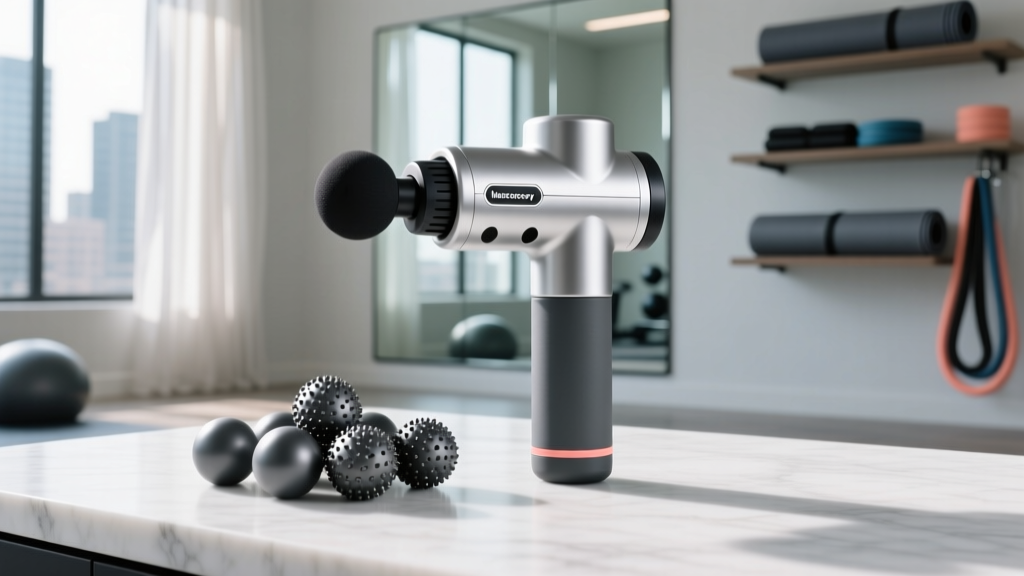
Massage Gun Flat Head vs Trigger Point Balls: 2026 Market Trends
Discover 2026 market trends comparing the massage gun flat head to traditional trigger point balls. Analyze efficacy, pricing, and recovery tech shifts.

The Evolution of Myofascial Release: 2026 Market Overview
The landscape of myofascial release and recovery technology has undergone a radical transformation over the last decade. As we analyze the 2026 recovery equipment market, a distinct battleground has emerged between traditional manual implements—specifically trigger point therapy tools and balls—and the advanced percussive attachments of modern recovery devices. At the center of this technological friction is the ubiquitous massage gun flat head, an attachment that has effectively bridged the gap between broad muscle sweeping and targeted ischemic compression.
Historically, athletes and physical therapists relied heavily on lacrosse balls, cork spheres, and EVA foam grids to apply sustained pressure to myofascial adhesions. Today, market data indicates a massive consumer shift toward dynamic percussive therapy. However, rather than rendering manual trigger point balls obsolete, the latest industry trends show a hybridization of recovery protocols. Sports medicine professionals are now prescribing specific use-cases for both modalities, driven by a deeper understanding of neurological pain gating and mechanoreceptor stimulation.
The 2026 Market Shift: Percussive vs. Static Trigger Point Tools
According to recent fitness industry analyses, the global percussion massage gun market continues to expand, but the growth is increasingly driven by attachment versatility rather than just raw motor power. The standard massage gun flat head—typically constructed from dense, non-porous polyurethane or dampened silicone—has become the most utilized attachment across all user demographics, surpassing the bullet and fork heads in daily clinical and athletic applications.
Conversely, the market for manual trigger point therapy tools and balls has matured into a highly specialized niche. Brands are no longer selling simple rubber spheres; they are engineering multi-density, ergonomically contoured tools designed to mimic the broad surface area of a percussive flat head while maintaining the static compression benefits of traditional ischemic therapy.
Market Insight: In 2026, consumer spending on manual trigger point tools remains steady at approximately $45–$75 per premium kit, while high-end percussive devices featuring advanced flat-head dampening technology command $400–$600. The ROI for consumers is increasingly calculated based on 'time-to-release' metrics, where percussive tools often outperform static balls in acute pre-workout scenarios.Biomechanical Breakdown: Flat Head Attachments vs. Therapy Balls
To understand why both modalities coexist in elite recovery facilities, we must examine the biomechanical and physical differences between a standard therapy ball and a massage gun flat head. The primary differentiators are surface area, depth of penetration (amplitude), and the nature of the applied force (static vs. dynamic).
| Feature | Standard Lacrosse / Cork Ball | Contoured EVA Foam Trigger Tool | Massage Gun Flat Head (16mm Amp.) |
|---|---|---|---|
| Surface Area | ~1.5 cm² (Highly Focal) | ~12 cm² (Broad & Contoured) | ~14.5 cm² (Broad & Dynamic) |
| Max Pressure | Bodyweight dependent (up to 100+ lbs) | Bodyweight / Lever dependent | Up to 60 lbs stall force + kinetic energy |
| Tissue Penetration | Superficial to Mid-Fascia | Superficial Myofascial Stretching | Deep Muscle Belly (16mm amplitude) |
| Primary Mechanism | Ischemic Compression | Fascial Adhesion Breakup | Percussive Analgesia & Blood Flow |
The traditional lacrosse ball excels at localized ischemic compression. By pinning a specific trigger point against a bony landmark (like the scapula or the iliac crest), the ball restricts local blood flow temporarily. Upon release, a reactive hyperemia occurs, flushing the area with oxygenated blood. However, this method requires high pain tolerance and can cause protective muscle guarding if the pressure is too acute.
In contrast, the massage gun flat head delivers rapid, repeated mechanical impulses (typically between 2,000 to 2,400 PPM). According to research published in the National Center for Biotechnology Information (NCBI), this high-frequency percussive force stimulates the Pacinian corpuscles, effectively overriding pain signals to the brain via the Gate Control Theory, allowing for deeper tissue penetration without the voluntary muscle guarding associated with static balls.
Top Trigger Point Tools & Flat Head Configurations in 2026
When outfitting a recovery kit, professionals recommend a strategic combination of both static and dynamic tools. Here is an analysis of the top-performing gear in both categories currently dominating the market.
1. The Percussive Standard: Theragun PRO Plus (with Standard Flat Head)
Retailing at $599, the Theragun PRO Plus remains the gold standard for deep-tissue percussive therapy. Its standard flat head attachment is engineered with a proprietary dampening foam core encased in a sweat-resistant polymer shell. The 16mm amplitude and 60 lbs of no-stall force allow the flat head to treat dense muscle groups like the gluteus medius and tensor fasciae latae (TFL) without bottoming out. The flat head's wide surface area prevents the 'stabbing' sensation often caused by bullet attachments, making it ideal for sweeping across the IT band while still delivering enough localized force to deactivate latent trigger points.
2. The Manual Contender: RAD Roll & RADBlock System
Priced around $110 for the bundle, the RAD system represents the pinnacle of modern manual trigger point therapy tools and balls. Unlike a perfectly spherical lacrosse ball, the RADBlock features a dual-lobe design with varying durometer (hardness) zones. This allows users to target the paraspinal muscles while avoiding direct pressure on the spinous processes of the vertebrae. It is heavily favored by powerlifters for thoracic extension work and precise rhomboid release, areas where a percussive gun might be too aggressive or difficult to angle correctly.
3. The Budget Hybrid: TriggerPoint GRID Foam Roller & Massage Ball Kit
At roughly $55, TriggerPoint’s multi-density EVA foam tools remain a staple in physical therapy clinics. The hollow-core design mimics the varying pressures of human hands. While it lacks the kinetic energy of a massage gun flat head, it provides a sustained, low-grade fascial stretch that is highly effective for postural correction and cool-down routines where the nervous system needs to be down-regulated rather than stimulated.
Neurological Mechanisms: Autogenic Inhibition vs. Percussive Analgesia
To optimize recovery, practitioners must understand the neurological intent behind their tool selection. The National Academy of Sports Medicine (NASM) emphasizes the role of the Golgi Tendon Organ (GTO) in myofascial release. When a static trigger point ball applies sustained pressure (typically for 30 to 90 seconds), the GTO senses the extreme tension and triggers autogenic inhibition—a reflex that forces the muscle spindle to relax, effectively 'melting' the trigger point.
Expert Protocol: The 2026 Hybrid Release Method
Leading sports physiotherapists now utilize a sequential protocol combining both tools:
- Phase 1 (Dynamic Flush): Use the massage gun flat head on Speed Setting 3 (approx. 2200 PPM) for 60 seconds per muscle group to increase local tissue temperature and induce percussive analgesia.
- Phase 2 (Static Pin): Immediately follow with a firm trigger point ball (e.g., cork or solid silicone) applied directly to the remaining nodular adhesion for 45 seconds to engage the GTO and achieve autogenic inhibition.
- Phase 3 (Active Mobilization): Perform dynamic stretching while the neurological pain threshold is temporarily elevated.
Cost-Benefit Analysis and ROI for Athletes
From a financial perspective, the barrier to entry for manual trigger point therapy tools and balls is exceptionally low. A high-density silicone massage ball costs between $12 and $25 and boasts an indefinite lifespan, making the cost-per-use virtually zero over a multi-year training cycle. Furthermore, manual tools require no charging, have zero electronic failure points, and are easily transportable in a gym bag or carry-on luggage without violating TSA lithium-ion battery restrictions.
Conversely, investing in a premium percussive device equipped with a high-quality massage gun flat head requires a capital expenditure of $250 to $600. However, the ROI is realized in time efficiency and compliance. A 2024 study highlighted by the American Council on Exercise (ACE) noted that athletes are 68% more likely to complete their recovery protocols when using percussive devices compared to manual foam rolling or ball-rolling, primarily due to the reduced physical exertion required and the immediate neurological pain relief provided by the vibration.
Decision Framework: When to Use Which Modality
Selecting between a static trigger point ball and a percussive flat head should not be an either/or proposition; it should be dictated by the physiological goal of the session.
- Pre-Workout Priming (Use Flat Head): The rapid percussion of the flat head increases blood flow, raises tissue temperature, and temporarily increases range of motion without the sedative effect of prolonged static compression. Spend 1-2 minutes per major muscle group.
- Pinpoint Joint-Adjacent Adhesions (Use Trigger Point Ball): Percussive guns should never be used directly over bony prominences, the cervical spine, or joint capsules. A manual trigger point ball allows for millimeter-precise placement to release the suboccipital muscles or the plantar fascia safely.
- Post-Workout Down-Regulation (Use Foam/Contoured Tools): High-frequency percussion can sometimes leave the sympathetic nervous system aroused. Slow, sustained pressure using a contoured EVA foam tool or a soft silicone ball encourages parasympathetic engagement, aiding in the transition to rest and recovery.
- Acute Spasm & Guarding (Use Flat Head): If a muscle is in acute spasm, pressing a hard lacrosse ball into it will trigger a stretch reflex, causing the muscle to contract further. The broad, dampened surface of a massage gun flat head used on a low speed can gently coax the muscle out of a spasm via reciprocal inhibition and pain-gating.
Conclusion
As the recovery technology market continues to mature in 2026, the narrative is no longer about percussive therapy replacing manual implements. Instead, the most effective recovery arsenals feature a synergistic approach. The massage gun flat head offers unparalleled dynamic blood flow, time efficiency, and neurological pain-gating for large tissue areas. Meanwhile, specialized trigger point therapy tools and balls remain irreplaceable for precise, joint-safe ischemic compression and autogenic inhibition. By understanding the distinct biomechanical and neurological profiles of both tools, athletes and clinicians can engineer highly specific, data-driven recovery protocols that maximize performance and minimize injury risk.
More gear to consider
All reviews
Massage Gun User Manual PDF & Setup Guide: 2026 Comparison

Theragun vs Hyperice: Best Massage Gun for Herniated Disc (2026)

Apollo Kinetics Massage Gun vs. Stretching Equipment: Flexibility Showdown

Normatec vs Hyperice: Best Debt Recovery Tools for Athletes

Do Massage Guns Help With Muscle Recovery? Compression Boot Guide
