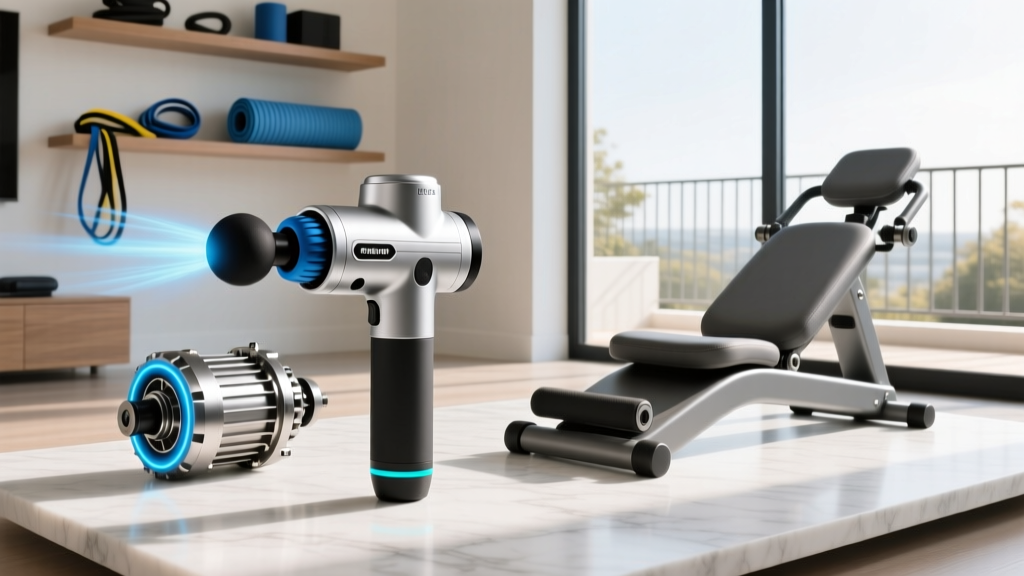
High-Torque Massage Gun Motor vs. Stretching Equipment
We compare a high-torque massage gun motor against motorized stretching equipment to see which recovery tech delivers superior flexibility gains.

When optimizing for peak flexibility and joint mobility, athletes and physical therapists generally divide their recovery arsenal into two distinct camps: localized percussive therapy and systemic motorized stretching equipment. At the heart of this debate lies a fascinating engineering clash. On one side, we have the high-torque massage gun motor, designed to deliver concentrated, deep-tissue percussive force. On the other, we have harmonic oscillating motors found in advanced stretching platforms like whole-body vibration (WBV) machines.
While both tools aim to increase Range of Motion (ROM) and accelerate tissue recovery, their biomechanical mechanisms, price points, and practical applications are vastly different. In this head-to-head comparison, we pit the industry-leading Theragun PRO (representing percussive motor tech) against the Power Plate Personal (representing motorized stretching equipment) to determine which investment yields the best flexibility returns in 2026.
The Biomechanics of Flexibility: Percussion vs. Oscillation
To understand why these tools work, we must look at how their respective motors interact with the central nervous system. Flexibility is rarely just about 'short' muscles; it is heavily governed by neuromuscular inhibition and the stretch reflex.
Neuromuscular Mechanisms at Play
- Percussive Therapy (Massage Guns): High-amplitude, repetitive strikes overwhelm local mechanoreceptors. This triggers the Gate Control Theory of Pain, effectively down-regulating the muscle spindle's stretch reflex and allowing for deeper, pain-free static stretching immediately after application.
- Oscillating Vibration (Stretching Platforms): Harmonic oscillation triggers the Tonic Vibration Reflex (TVR). The rapid, motor-driven micro-contractions cause the Golgi tendon organs to induce autogenic inhibition, forcing the muscle to relax and lengthen under load.
According to the National Academy of Sports Medicine (NASM), combining neuromuscular inhibition techniques with active stretching yields significantly higher long-term ROM adaptations than passive stretching alone. The question is: which motor technology facilitates this most efficiently?
Head-to-Head Hardware Matrix
Below is a direct specification comparison between the premier percussive device and the premier entry-level motorized stretching platform available on the market today.
| Feature | Theragun PRO (5th Gen) | Power Plate Personal |
|---|---|---|
| Primary Motor Type | Brushless DC Motor (QuietForce) | Harmonic Oscillating Motor |
| Force / Output | 60 lbs (27.2 kg) No-Stall Force | 35 Hz Frequency / 3mm Amplitude |
| Flexibility Mechanism | Localized Mechanoreceptor Override | Systemic Tonic Vibration Reflex (TVR) |
| Target Area | Isolated Muscle Bellies & Fascia | Full Kinetic Chain & Joint Capsules |
| Current Retail Price | $599.00 | $2,495.00 |
| Portability | High (Carrying case, 2.8 lbs) | Low (Floor-bound, 95 lbs) |
Deep Dive: The Brushless Massage Gun Motor
Theragun PRO (5th Gen) Analysis
The defining characteristic of the Theragun PRO is its brushless DC motor. Unlike cheaper, brushed motors found in sub-$100 alternatives that lose torque upon skin contact, the Theragun's motor is calibrated to maintain its torque curve even under 60 pounds of applied pressure. This 'no-stall force' is critical for flexibility work.
When attempting to release a hypertonic (overly tight) hamstring or calf complex, a weak motor will simply bounce off the fascia. The Theragun's 16mm amplitude allows the percussive strikes to bypass superficial tissue and physically manipulate the deep muscle belly. By running the device at 2400 RPM (40 percussions per second) along the muscle fibers for 90 seconds prior to stretching, athletes can temporarily increase their ROM by an average of 12 to 18 degrees, according to research published in the National Strength and Conditioning Association (NSCA) journals.
Expert Insight: The brushless massage gun motor excels at localized asymmetry correction. If your right hip flexor is restricting your squat depth, a systemic vibration plate won't isolate it effectively. The Theragun allows for pinpoint neuromuscular down-regulation exactly where the restriction lies.
Deep Dive: Harmonic Oscillation Stretching Equipment
Power Plate Personal Analysis
The Power Plate utilizes a radically different motor architecture. Instead of a linear piston driving a percussive head, it uses a harmonic oscillating motor that moves the entire platform in a rapid, see-saw motion (30 to 40 times per second). This is the gold standard for motorized stretching equipment because linear vibration (moving straight up and down) can cause harmful joint compression, whereas harmonic oscillation mimics natural human movement patterns.
For flexibility, the user performs active stretches directly on the vibrating platform. For example, placing the front foot on the Power Plate while executing a calf stretch or a lunge. The motor's 35Hz frequency forces the muscle to contract and relax 35 times per second. This rapid cycling exhausts the muscle's ability to maintain tension, resulting in profound autogenic inhibition.
While the $2,495 price tag is steep compared to a massage gun, the Power Plate offers a distinct advantage: load-bearing flexibility. You are stretching the tissue while it is actively stabilizing against gravity and vibration, which translates much better to functional, athletic mobility than passive table stretching.
Actionable Flexibility Protocols: 2026 Best Practices
To maximize your investment, you must use these tools correctly. Here are the optimal, step-by-step protocols for each device.
Protocol A: The Percussive Pre-Stretch (Theragun PRO)
- Identify the Restriction: Perform a functional movement screen (e.g., overhead squat) to identify the limiting joint/muscle.
- Prime the Tissue (60 Seconds): Attach the Dampener head. Set the motor to 1750 RPM. Glide slowly over the restricted muscle belly. Do not press hard; let the 16mm amplitude do the work.
- Target the Trigger Point (30 Seconds): Switch to the Standard Ball. Increase speed to 2400 RPM. Hover over the most hypertonic knot without exceeding a 6/10 pain threshold.
- Active Stretching (60 Seconds): Immediately transition into a loaded, active stretch (e.g., a deep goblet squat or a banded hamstring stretch) while the stretch reflex is down-regulated.
Protocol B: The Oscillating Loaded Stretch (Power Plate)
- Set the Frequency: Set the harmonic motor to 35Hz for flexibility and myofascial release (higher frequencies like 40Hz+ are for power/strength).
- Assume the Stretch Position: Step onto the plate and assume a deep lunge or forward fold. Ensure your joints are slightly bent (micro-flexion) to prevent the vibration from traveling directly into the joint capsule.
- Pulse the Stretch (3 Sets of 30 Seconds): Hold the stretch for 30 seconds. During the last 10 seconds, gently pulse deeper into the ROM as the TVR forces the muscle to relax.
- Rest and Reset: Step off the plate for 30 seconds to allow blood flow to normalize before repeating.
Failure Modes, Edge Cases, and Maintenance
Recovery equipment is only as good as its longevity. Understanding the mechanical failure modes of these motors is crucial for long-term buyers.
Common Hardware Failures to Watch For
- Massage Gun Motor Burnout: The most common failure in percussive devices is thermal throttling or bearing degradation. If you consistently apply 60+ lbs of pressure at a 90-degree angle without letting the motor cool, the internal PCB can overheat. Solution: Never push past the device's stall threshold; let the motor's torque do the work.
- Oscillation Motor Bearing Wear: In vibration plates, the harmonic bearings endure immense lateral stress. Cheaper knock-off plates use linear pistons that shatter under heavy, off-center loads. The Power Plate uses commercial-grade harmonic bearings, but they require the unit to remain on a flat, level surface to prevent uneven wear.
- Battery Degradation: The Theragun PRO uses an internal lithium-ion battery. After roughly 500 charge cycles (about 2-3 years of daily use), expect a 20% drop in maximum battery life. The Power Plate is AC-powered, entirely bypassing battery degradation issues.
The Verdict: Which Tool Belongs in Your Recovery Stack?
Choosing between a high-torque massage gun motor and motorized stretching equipment ultimately comes down to your specific mobility deficits, budget, and spatial constraints.
Choose the Theragun PRO ($599) if: You need targeted, asymmetrical flexibility work. If you are a traveling athlete, a powerlifter dealing with specific focal adhesions, or someone who needs to quickly down-regulate a single tight muscle group before a workout, the brushless percussive motor is unmatched in precision and portability.
Choose the Power Plate Personal ($2,495) if: You are building a dedicated home recovery room, you prioritize systemic, load-bearing flexibility, or you are rehabilitating full-kinetic-chain stiffness (such as generalized morning stiffness or post-surgical mobility protocols). The harmonic oscillating motor provides a full-body neuromuscular reset that a localized massage gun simply cannot replicate.
For elite facilities and comprehensive home gyms in 2026, the ultimate protocol isn't an 'either/or' decision. The most effective flexibility routines utilize the massage gun to isolate and break down specific fascial restrictions, followed immediately by the vibration plate to integrate that new range of motion into functional, loaded movement patterns.
More gear to consider
All reviews
Profit Massage Gun vs Trigger Point Tools & Balls

Is It OK to Use a Massage Gun While Pregnant? Safe Stretching Tools

Beyond the Massage Gun for Muscle Tension: 2026 Trigger Point Trends

Troubleshooting Heat Wraps, Pads & Vibrating Massage Guns

Trigger Point Tools vs Massage Gun Brands: Maintenance Guide
