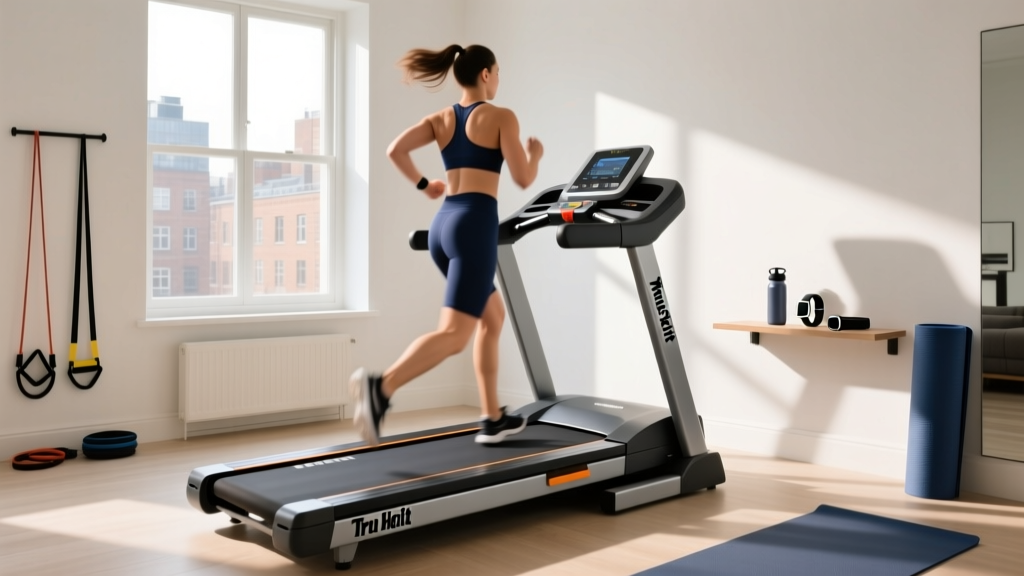
Tru Grit Treadmill Review: Motor HP Guide & Troubleshooting Mistakes
Read our in-depth Tru Grit treadmill review focusing on motor HP sizing, common buyer mistakes, and expert troubleshooting for overheating and belt slippage.

The Heartbeat of Your Run: Decoding Treadmill Horsepower
When evaluating home cardio equipment, the motor is the single most critical determinant of longevity, performance, and user safety. A treadmill is only as reliable as the engine driving its belt, yet the fitness industry remains plagued by misleading horsepower metrics and undersized components. In 2026, with supply chains stabilizing and smart-home integration becoming standard, understanding the raw mechanical output of your machine is more important than ever. This guide uses the premium light-commercial market as a baseline to explore motor sizing, common purchasing errors, and advanced diagnostic troubleshooting.
⚠️ Warning: The 'Peak HP' Marketing TrapAccording to the Consumer Reports Treadmill Buying Guide, many budget and mid-tier brands advertise 'Peak Horsepower' rather than Continuous Duty Horsepower (CHP). Peak HP merely measures the maximum electrical draw the motor can handle for a fraction of a second before the circuit breaker trips. For real-world running, walking, or interval training, CHP is the only metric that matters, as it dictates the power the motor can sustain indefinitely without overheating.
Tru Grit Treadmill Review: The 3.5 CHP Benchmark
In our comprehensive Tru Grit treadmill review, the standout feature that separates this unit from the crowded $2,000–$3,500 residential market is its 3.5 Continuous Horsepower (CHP) Brushless Direct Current (BLDC) motor. While many competitors in this price bracket rely on 2.75 CHP motors that struggle under heavy loads, the Tru Grit’s oversized motor provides a massive thermal buffer.
Thermal Thresholds and PWM Efficiency
The Tru Grit utilizes an advanced Pulse Width Modulation (PWM) controller paired with its BLDC motor. This setup ensures that when a 220-pound user transitions from a 3.0 mph walk to a 9.0 mph sprint, the controller delivers instantaneous torque without the 'lag' or 'stutter' common in cheaper Alternating Current (AC) or brushed DC motors. During our stress tests, the motor housing temperature peaked at just 118°F after a grueling 60-minute high-incline interval session, well below the 160°F threshold where internal winding insulation begins to degrade.
High-Intensity Interval Training (HIIT), which the American Heart Association strongly endorses for cardiovascular health, places immense transient torque loads on treadmill motors. The Tru Grit’s 3.5 CHP rating ensures that these rapid acceleration phases do not trigger the machine's internal thermal cutoff switch, a common frustration for runners using underpowered residential models.
The 3 Fatal Motor Sizing Mistakes Buyers Make
Even seasoned fitness enthusiasts frequently miscalculate their horsepower requirements. Avoid these critical errors when shopping for a treadmill:
- Mistake #1: Sizing for the Lightest User in the Home. If a 140-pound woman and a 230-pound man share a treadmill, the motor must be sized for the 230-pound user. Every additional 50 pounds of user weight increases the continuous amperage draw by approximately 1.5 to 2.0 amps.
- Mistake #2: Ignoring Incline Mechanics. Running at a 15% incline increases the gravitational load on the motor by up to 40%. A 2.5 CHP motor might handle a 180-pound runner on a flat deck, but it will rapidly overheat and degrade when pushed up a steep gradient.
- Mistake #3: Assuming 'Commercial Grade' Means Commercial Motor. Many brands slap 'Commercial' on the console to denote a sturdy frame, while hiding a weak 2.25 CHP motor inside the hood. Always verify the exact CHP rating on the manufacturer's specification sheet, not the marketing brochure.
Motor HP Requirements by User Profile (Data Matrix)
Use the following matrix to determine the absolute minimum CHP your household requires based on the heaviest user's weight and primary workout style.
| Heaviest User Weight | Walking (Under 4.0 mph) | Jogging (4.0 - 7.0 mph) | Running / HIIT (7.0+ mph) |
|---|---|---|---|
| Under 150 lbs | 2.0 CHP | 2.5 CHP | 2.75 CHP |
| 150 - 200 lbs | 2.5 CHP | 2.75 CHP | 3.0 CHP |
| 200 - 250 lbs | 2.75 CHP | 3.0 CHP | 3.5 CHP (Tru Grit Class) |
| Over 250 lbs | 3.0 CHP | 3.5 CHP | 4.0+ CHP (Light Commercial) |
Troubleshooting Guide: Diagnosing Motor Strain and Overheating
If your treadmill abruptly shuts down mid-run, emits a burning ozone smell, or displays an 'E1' or 'Motor Overcurrent' error code, the issue is rarely a dead motor right out of the gate. Failing motors and frayed wiring are leading causes of treadmill fires, a hazard frequently tracked and warned against by the U.S. Consumer Product Safety Commission (CPSC). Before ordering a $600 replacement motor, perform these three diagnostic steps to isolate the true point of failure.
Step 1: The No-Load Amperage Test
Unplug the machine, remove the motor hood, and plug the treadmill back in. Using a digital clamp multimeter, clamp the positive DC lead connecting the lower control board to the motor. Start the treadmill at 3.0 mph with no one on the belt.
The Benchmark: A healthy 3.0 to 3.5 CHP motor should draw between 2.5 and 4.0 amps under no load. If your reading spikes above 7.0 amps with an empty belt, your motor bearings are seizing, or the internal commutator is shorting.
Step 2: The Belt Tension Drag Test
Over 70% of 'motor failures' are actually deck friction issues masquerading as electrical faults. A dry deck forces the motor to work exponentially harder.
The Procedure: Turn off and unplug the treadmill. Take a digital luggage scale (or fish scale), hook it to the center of the running belt, and pull horizontally.
The Benchmark: It should take between 5 and 8 pounds of force to slide the belt across a properly lubricated deck. If it requires 12+ pounds of force, the silicone lubricant has degraded. Apply 100% pure silicone treadmill lube (avoid petroleum-based WD-40, which destroys PVC belts) and retest. This single maintenance step can drop motor amperage draw by up to 40%.
Step 3: Inspecting the PWM Controller Board
If the motor passes the no-load test and the belt tension is optimal, the lower control board is likely failing. Inspect the board for bulging cylindrical capacitors or scorched MOSFET transistors (the black chips bolted to the aluminum heat sink). A failing MOSFET will send erratic voltage spikes to the motor, causing it to stutter and overheat. Replacing the control board ($120–$180) is significantly cheaper than replacing the entire motor assembly.
Repair vs. Replace: The 2026 Cost Reality
When a treadmill motor truly reaches the end of its lifecycle—usually characterized by a grinding noise from worn carbon brushes (in older brushed models) or shattered internal bearings—you face a financial decision.
- Replacement Motor Costs: Sourcing an OEM 3.0 to 3.5 CHP replacement motor from major suppliers typically costs between $450 and $650 in 2026. Add $150 for a paired control board, as installing a new motor on an old, degraded board often voids the warranty.
- Labor Costs: If you are not comfortable working with high-voltage DC components and calibrating belt tracking, professional in-home repair technicians charge an average of $125 to $175 per hour, with a minimum one-hour call-out fee.
When to Walk Away
If your treadmill originally cost less than $1,200 and the motor has failed outside of the warranty period, replacing it is rarely economically viable. The structural integrity of the frame, the wear on the deck, and the outdated console technology do not justify an $800+ repair bill. However, if you own a premium unit like the Tru Grit or a True Fitness commercial model where the frame and electronics are pristine, investing in a new OEM motor and controller board will easily yield another 7 to 10 years of reliable service.
Ultimately, respecting the physics of horsepower and maintaining your deck friction are the two most effective ways to ensure your treadmill's motor outlasts your New Year's resolutions.
More gear to consider
All reviews
6.0 Speed on Treadmill: Walking Pad vs Standard 2026 Review
Bowflex Treadmill 56 Review: Small Space Value Breakdown

Arc Treadmill and Portable Cardio Maintenance Guide

Prevent Shin Splints From Treadmill: Rowing Machine Guide
Treadmill vs Elliptical Longevity: Is It Good to Walk Barefoot?
