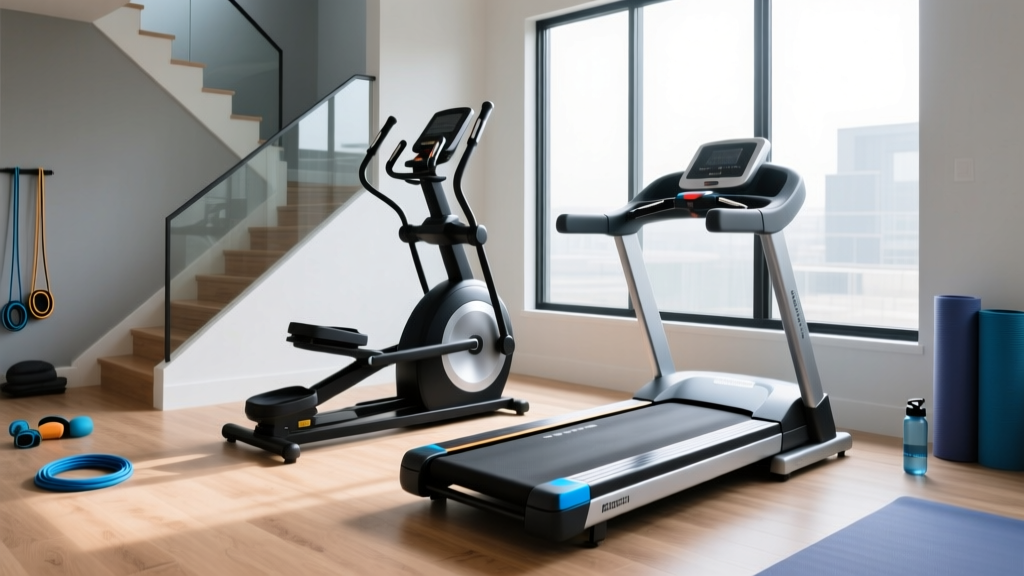
Stair Climber vs Walking on Manual Treadmill: 2026 Home Guide
Compare stair climber machines for home use against walking on manual treadmill models. Expert 2026 guide on specs, calorie burn, and joint impact.

The Core Debate: Vertical Climbing vs. Self-Powered Walking
Designing a high-performance home gym in 2026 requires making ruthless decisions about floor space, budget, and biomechanical efficiency. When athletes and fitness enthusiasts look to upgrade their cardiovascular conditioning, the debate frequently narrows down to two premium, high-intensity categories: the rotating stair climber machine for home use and the curved, non-motorized treadmill. Both machines command premium price tags and offer unparalleled metabolic conditioning, but they target the body's kinetic chain in fundamentally different ways.
This comprehensive head-to-head guide dissects the mechanical realities, joint kinetics, and spatial requirements of these two cardio titans. Whether you are outfitting a garage gym or a dedicated basement fitness studio, understanding the nuanced differences between stepping vertically and walking on manual treadmill equipment will ensure your investment aligns perfectly with your physiological goals and architectural constraints.
2026 Flagship Showdown: StepMill SM3 vs. AssaultRunner Pro
To provide concrete data, we are comparing the industry-standard rotating staircase—the StairMaster StepMill SM3—against the premier curved slat treadmill, the AssaultRunner Pro. These two models represent the gold standard for their respective categories in the 2026 commercial and high-end home market.
| Specification | StairMaster StepMill SM3 | AssaultRunner Pro (Curved) |
|---|---|---|
| Drive System | Motorized rotating staircase (8-inch steps) | Self-powered curved slat belt (30-degree arc) |
| Footprint (L x W) | 46" x 28" (Highly vertical) | 69" x 33" (Highly horizontal) |
| Machine Weight | 235 lbs | 280 lbs |
| Max User Capacity | 300 lbs | 350 lbs |
| Power Requirement | 120V dedicated outlet | None (100% human-powered) |
| Average 2026 Price | $2,499 - $2,799 | $3,299 - $3,499 |
Biomechanics and Joint Kinetics: Which is Safer?
The most critical factor in long-term cardio adherence is joint preservation. The Mayo Clinic consistently emphasizes selecting cardiovascular modalities that align with your orthopedic health and injury history.
The Stair Climber: Patellofemoral Load
Rotating stair climbers force the user into repetitive, loaded knee flexion and extension. While this builds immense quadriceps and gluteal strength, it significantly increases the compressive forces on the patellofemoral joint (where the kneecap meets the thigh bone). If you have a history of patellar tendinopathy or meniscus wear, the continuous 8-inch step height of the SM3 can exacerbate inflammation. Furthermore, users often cheat the machine by leaning heavily on the handrails, which reduces core engagement and alters spinal alignment.
The Curved Manual Treadmill: Posterior Chain Engagement
Conversely, the 30-degree upward curve of a manual treadmill naturally forces the user into a forward-leaning posture. This shifts the primary workload away from the knee extensors and heavily recruits the posterior chain—specifically the hamstrings, glutes, and calves. The slatted rubber belts also offer superior shock absorption compared to traditional motorized treadmill decks, reducing the ground reaction forces transmitted through the tibia and femur.
Expert Insight: According to guidelines from the American Heart Association, achieving optimal cardiovascular health requires 150 minutes of moderate-intensity or 75 minutes of vigorous-intensity aerobic activity per week. Both machines easily push users into the vigorous heart-rate zone (80-95% of max HR) within minutes, but the manual treadmill allows for a more natural, full-body gait cycle that mimics overground running mechanics.The Unique Physics of Walking on Manual Treadmill Units
Many buyers underestimate the sheer metabolic demand of these non-motorized machines. The physical demands of walking on manual treadmill models are significantly higher than on motorized counterparts. Because there is no motor to pull your feet backward, you must actively strike the belt with the ball of your foot and pull the slats backward using your hamstrings and hip flexors.
Studies indicate that the metabolic cost of walking on manual treadmill equipment is roughly 30% higher than walking on a standard motorized treadmill at the exact same speed. This means a brisk 3.5 mph walk on an AssaultRunner Pro will elicit the same heart rate response and caloric burn as a 4.5 mph jog on a traditional treadmill. For home gym owners who want to maximize calorie expenditure without the high-impact joint pounding of sprinting, this is a massive advantage.
Home Gym Failure Modes: What Buyers Miss
Before pulling out your credit card, you must evaluate the physical space and structural requirements of your home gym. Both machines present unique installation hurdles that catch amateur buyers off guard.
CRITICAL WARNING: The Ceiling Clearance TrapThe number one reason stair climbers are returned or sold at a loss is ceiling height. The steps on a StairMaster elevate the user by 8 to 10 inches above the floor. The Formula: Take your height, add 15 inches for the step elevation and headroom buffer, and add 2 inches for safety. If you are 6'2" (74 inches), you need a minimum ceiling height of 91 inches (7 feet, 7 inches). If your basement ceiling is a standard 7 feet, a stair climber will result in you hitting your head at the peak of the step cycle.
Electrical and Floor Reinforcement
- Stair Climbers: Require a dedicated 120V/15A circuit. Plugging an SM3 into a shared circuit with a refrigerator or AC unit will trip the breaker when the motor surges to maintain belt speed under heavy user weight.
- Manual Treadmills: Require zero electricity, making them ideal for off-grid garages or sheds. However, the 280 lb machine weight combined with a 250 lb user dynamically shifting their weight requires a reinforced concrete slab or heavy-duty rubber horse-stall mats to prevent floor warping over time.
Maintenance Realities
The StepMill SM3 relies on a complex internal drive chain and motorized sprockets. While largely maintenance-free for the first 3-5 years, out-of-warranty motor replacements can exceed $800. The AssaultRunner Pro, being human-powered, has no motor to burn out. However, the vulcanized rubber slats and guide rails require periodic vacuuming to remove dust and debris, and the belt tension must be checked bi-annually to prevent slippage during high-speed sprints.
Decision Matrix: Which Machine Earns Your Floor Space?
Choosing between a stair climber machine for home use and a curved manual treadmill ultimately depends on your specific athletic goals, spatial limitations, and orthopedic profile. The Centers for Disease Control and Prevention recommends mixing aerobic modalities to prevent overuse injuries, but if you only have the budget and space for one premium unit, use this framework:
Buy the Stair Climber (StepMill SM3) If:
- You have limited horizontal floor space but ample vertical ceiling clearance (8+ feet).
- Your primary goal is targeted lower-body hypertrophy, specifically isolating the quadriceps and glutes.
- You prefer a machine that paces you, forcing you to keep up with a set, motorized step rate.
- You want to simulate the exact mechanics of hiking steep mountain trails or climbing stadium stairs.
Buy the Curved Manual Treadmill (AssaultRunner Pro) If:
- You want to train for overground running events (5Ks, marathons) and need to practice natural gait mechanics and sprint intervals.
- You suffer from anterior knee pain and need a modality that shifts the load to the posterior chain (hamstrings/glutes).
- Your gym space lacks dedicated electrical circuits or you want to eliminate the noise of a drive motor.
- You want the ability to seamlessly transition from a 3.0 mph recovery walk to a 15+ mph all-out sprint without pressing any console buttons.
Final Verdict
Both the rotating stair climber and the curved manual treadmill are elite-tier cardiovascular tools that will transform your home gym in 2026. The stair climber remains the undisputed king of vertical, quad-dominant conditioning, provided your ceiling height accommodates it. However, for pure athletic transfer, joint-friendly biomechanics, and the unmatched metabolic spike of walking on manual treadmill units, the curved slat treadmill offers a slightly more versatile, full-body conditioning experience. Evaluate your ceiling tape measure, assess your knee health, and choose the machine that will keep you consistently moving for years to come.
More gear to consider
All reviews
Weslo Cadence Treadmill G40 Setup & Walking Pad Review
Is Deer Run Treadmill Legit? 2026 Noise Comparison
Compact Cardio Maintenance: Perfecting Your Strava Treadmill Run

Dick's Horizon Treadmill Motor Guide: HP, CHP, and Sizing

Stationary Bike Types vs Treadmill Class Costs: Budget Breakdown
