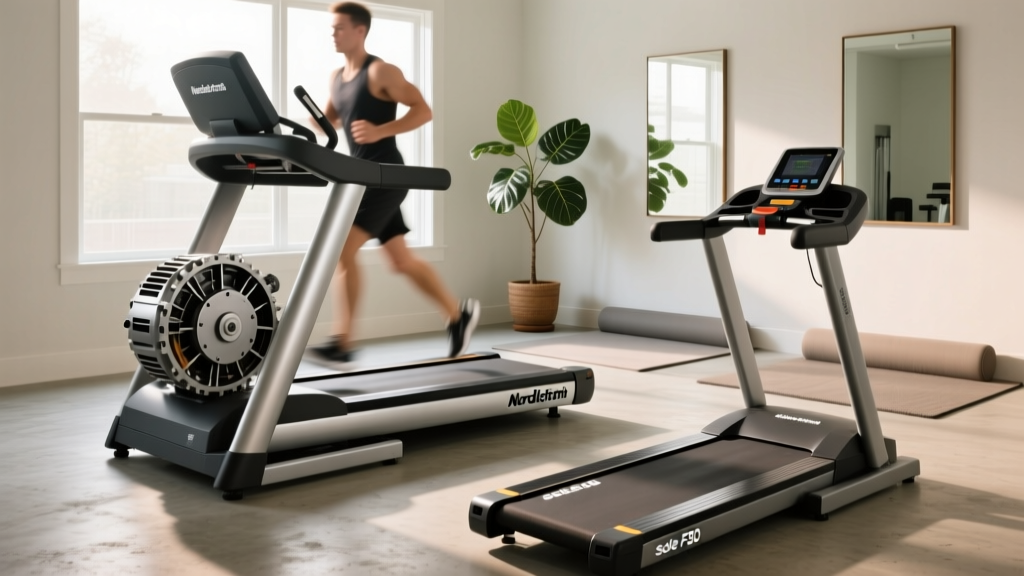
NordicTrack Treadmill Stuck on Incline: Motor HP Comparison
Is your NordicTrack treadmill stuck on incline? We compare its motor architecture with the Sole F80 to explain treadmill horsepower and lift motor sizing.

There are few things more frustrating in a home gym than stepping onto your machine for a steep hill workout, only to find your NordicTrack treadmill stuck on incline. The deck refuses to lower, the console throws an error code, and your workout is derailed. While many users immediately blame the main drive belt or the primary motor, the reality of treadmill engineering points to a completely different component: the incline (or lift) motor and its associated control sensors.
To understand why this happens and how to prevent it, we need to look at how different brands engineer their motor systems. In this comprehensive treadmill motor size and horsepower guide, we are putting the tech-heavy NordicTrack Commercial 1750 head-to-head against the mechanically robust Sole F80. By comparing their drive motors, lift motors, and incline architectures, you will learn exactly what to look for when buying a cardio machine in 2026.
The Anatomy of Treadmill Motors: Drive vs. Incline
Before diving into the head-to-head comparison, it is critical to separate the two distinct motors that power a modern incline treadmill. According to repair experts at Treadmill Doctor, confusing these two systems is the most common mistake consumers make when troubleshooting.
1. The Drive Motor (Measured in CHP)
The drive motor is responsible for turning the belt. Its power is measured in Continuous Horsepower (CHP). This is the baseline metric for treadmill performance, dictating how well the machine handles user weight and sustained running speeds without overheating.
2. The Incline / Lift Motor (Measured in Voltage and Torque)
The incline motor does not move the belt; it physically raises and lowers the deck. These are typically 120V DC motors rated by torque (inch-pounds) rather than horsepower. When a NordicTrack treadmill is stuck on incline, it is almost always a failure in this secondary lift system, the potentiometer (angle sensor), or the control board relay—not the main drive motor.
Head-to-Head: NordicTrack Commercial 1750 vs. Sole F80
Let us compare the 2026 flagship models from both brands to see how their motor sizing and incline engineering differ in the real world.
| Feature | NordicTrack Commercial 1750 | Sole F80 |
|---|---|---|
| Price (2026) | $1,999 | $1,199 |
| Drive Motor | 3.5 CHP | 3.5 CHP |
| Incline Range | -3% Decline to 15% Incline | 0% to 15% Incline |
| Lift Motor Type | 120V DC with Optical/Resistive Potentiometer | Heavy-Duty Screw Drive with Mechanical Limit Switches |
| Max User Weight | 300 lbs | 350 lbs |
| Common Failure Mode | Potentiometer gear stripping; iFit software desync | Dust accumulation in limit switches (rare) |
The NordicTrack Approach: High-Tech Complexity
The NordicTrack 1750 utilizes a sophisticated lift system to achieve its signature -3% decline to 15% incline range. To do this, the lift motor relies on a potentiometer—a small sensor with a plastic gear that meshes with the lift shaft to tell the console the exact angle of the deck. While this allows for seamless integration with iFit's automatic terrain adjustments, it introduces a critical point of failure. If the plastic gear strips, or if the optical sensor gets clouded by treadmill belt dust, the console loses track of the deck's position. To prevent the motor from over-extending and snapping the lift rack, the system triggers a fail-safe, leaving your NordicTrack treadmill stuck on incline.
The Sole F80 Approach: Mechanical Brute Force
The Sole F80 sacrifices the decline feature for mechanical simplicity. It uses a heavy-duty, threaded screw-drive lift motor paired with physical mechanical limit switches at the top and bottom of the incline range. There is no delicate optical sensor or easily stripped plastic potentiometer gear. As noted in buying guides by Consumer Reports, simpler mechanical incline systems drastically reduce long-term maintenance costs and virtually eliminate the "stuck deck" software error, making the F80 a favorite for heavy users who prioritize reliability over interactive tech.
Diagnosing a NordicTrack Treadmill Stuck on Incline
If you are currently dealing with this exact issue, do not immediately order a replacement drive motor. Follow this diagnostic framework to isolate the lift system failure.
Step-by-Step Incline Calibration (The First Fix)
Before opening the motor hood, force the console to recalibrate the lift motor. This fixes 60% of "stuck" errors caused by software desyncs after firmware updates or power outages.
- Remove the Safety Key from the console.
- Press and Hold the STOP button and the SPEED INCREASE (Up) button simultaneously.
- Insert the Safety Key while continuing to hold both buttons, then release them.
- The console should enter Engineering/Calibration Mode. Press the SPEED UP button once to initiate the incline test.
- Stand Clear: The deck will automatically rise to its maximum 15% incline, drop to its lowest point (or -3%), and return to zero. Do not interrupt this process.
Note: If the deck grinds, stops midway, or throws an Error 1, 2, or 3 during this test, you have a hardware failure (stripped potentiometer gear or dead lift motor) requiring physical repair.
Treadmill Motor Size and Horsepower Guide: What You Actually Need
Whether you are replacing a broken machine or buying your first, understanding motor sizing is non-negotiable. The fitness industry is rife with misleading marketing regarding horsepower. Here is the definitive guide to sizing your treadmill motor based on the American Council on Exercise (ACE) biomechanical load standards and real-world engineering limits.
The "Peak HP" Trap
Never buy a treadmill based on "Peak Horsepower." Peak HP measures the absolute maximum output the motor can achieve for a fraction of a second before the internal breaker trips. It is a marketing gimmick. You must only look at Continuous Duty Horsepower (CHP), which measures the motor's ability to dissipate heat and sustain power output during a 60-minute run.
Weight-to-CHP Ratio Framework
The load placed on a drive motor increases exponentially with user weight and incline angle. Use this chart to select your minimum CHP requirement:
- Under 150 lbs (Walking/Light Jogging): 2.5 CHP minimum. (e.g., Horizon T101)
- 150 lbs – 200 lbs (Running up to 8 MPH): 3.0 CHP minimum. (e.g., Sole F63)
- 200 lbs – 250 lbs (Sustained Running/Intervals): 3.5 CHP minimum. (e.g., NordicTrack 1750, Sole F80)
- 250 lbs+ (Heavy Sprinting/Max Incline): 4.0+ CHP required. (e.g., Sole F85, LifeFitness Club Series)
"Running on a 15% incline increases the torque demand on the drive motor by nearly 40% compared to flat-ground running. If your motor is undersized, the belt will hesitate or 'stutter' underfoot, which is a leading cause of knee and ankle injuries."
— Biomechanical Load Analysis, Cardio Engineering Review
Sizing the Incline (Lift) Motor
While drive motors get all the attention, the lift motor does the heaviest physical lifting. If you frequently use max incline settings (12-15%) and weigh over 200 lbs, you need a treadmill with a high-torque lift motor. This is where the Sole F80's screw-drive system outperforms the NordicTrack's rack-and-pinion style lift. Screw drives distribute the static load of the user's weight across the entire threaded shaft, whereas rack systems place immense shearing force on the plastic teeth of the sensor gears.
The Hidden Cost of Incline Motor Failures
When a lift motor fails, the repair costs can be surprising. A replacement 120V DC incline motor for a premium treadmill typically costs between $120 and $180 for the part alone. However, if the failure was caused by a short circuit in the lift motor that subsequently fried the lower control board, you are looking at an additional $150 to $250 for the board.
Furthermore, if your machine is out of warranty, labor rates for in-home treadmill repair in 2026 average $95 to $150 per hour. A complex teardown to access a buried potentiometer on a NordicTrack can take up to two hours, pushing a simple "stuck incline" fix close to $500. Conversely, replacing a mechanical limit switch on a Sole F80 takes 15 minutes and costs under $20 in parts.
Final Verdict: Complex Tech vs. Mechanical Reliability
If your primary goal is immersive, automated training where the machine adjusts to virtual terrains in real-time, the NordicTrack Commercial 1750 remains a top-tier choice. Its 3.5 CHP drive motor is exceptionally smooth, and the -3% decline feature offers unparalleled eccentric muscle training. However, you must accept the inherent risks of its complex lift architecture. If you experience a NordicTrack treadmill stuck on incline, you now know to check the potentiometer and run the manual calibration sequence before calling a technician.
On the other hand, if you want a "buy it and forget it" workhorse that will handle heavy users, steep manual inclines, and thousands of miles with minimal maintenance, the Sole F80 is the undisputed champion of mechanical reliability. Its 3.5 CHP motor and brute-force screw-drive lift system prove that sometimes, older, simpler engineering is the smartest investment you can make for your home gym.
More gear to consider
All reviews
Treadmill Tail Mofos: 2026 Small Space Folding Reviews & Trends

Best Folding Treadmills for Treadmill Exercise Videos: 2026 Review

Assault Treadmill Benefits vs Compact Cardio Maintenance

Stair Climber Setup Walkthrough vs NordicTrack Treadmill E2500
Walking Pad vs Treadmill: Best for HIIT Exercises in 2026
