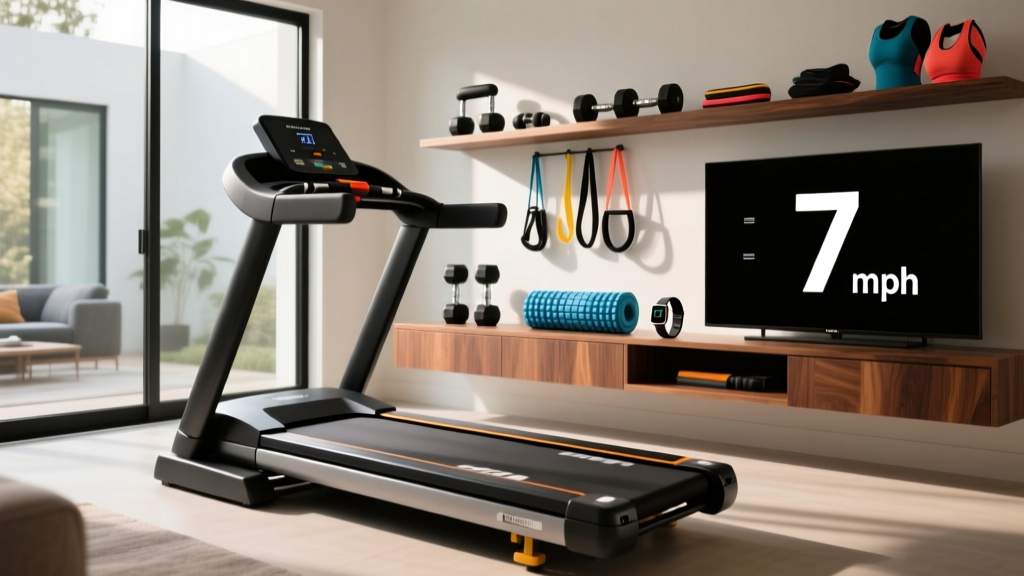
Treadmill Motor Guide: How Fast is 7 on a Treadmill & HP Needs
Discover how fast 7 on a treadmill really is and learn why Continuous Horsepower matters. Our 2026 motor size guide prevents overheating and failure.

When you step onto the belt and punch '7.0' into the console, you are making a specific biomechanical and mechanical demand. But while most buyers obsess over screen size and incline capabilities, the true heartbeat of the machine—the motor—is often misunderstood. If you have ever wondered how fast is 7 on a treadmill and whether your machine's motor can actually sustain that pace without degrading, you are asking the exact right questions. In this 2026 in-depth buying guide, we bridge the gap between your target speed and the Continuous Horsepower (CHP) required to get you there safely.
Decoding the Pace: How Fast is 7 on a Treadmill?
Setting your treadmill to 7.0 means you are moving at 7.0 miles per hour (mph), which translates to 11.26 kilometers per hour (km/h). In running terms, this equates to an 8:34 per mile pace. According to Mayo Clinic fitness guidelines, a 7.0 mph pace bridges the gap between a vigorous speed-walk for taller individuals and a moderate, steady-state jog for the average adult.
From a mechanical perspective, sustaining 7.0 mph requires the motor to spin the drive roller at a consistent RPM while fighting the kinetic friction of your body weight striking the deck. This is where motor sizing becomes critical. A weak motor will experience 'belt hesitation' or micro-stutters at this speed, which can lead to shin splints and joint instability.
The Horsepower Illusion: Peak HP vs. Continuous Duty (CHP)
The most pervasive marketing trap in the cardio equipment industry is the 'Peak Horsepower' metric. You will frequently see budget treadmills advertising a '4.0 HP Motor' for under $600. This is almost always Peak HP—the absolute maximum output the motor can hit for a fraction of a second before the thermal limiter trips.
⚠️ Buyer's Warning: Never buy a treadmill based on Peak HP. You must look for CHP (Continuous Horsepower). CHP measures the power the motor can sustain indefinitely during a standard workout without overheating. A '4.0 Peak HP' motor often masks a weak 1.75 CHP reality.For a runner maintaining a 7.0 mph pace, the motor operates in a sustained mid-to-high RPM range. According to Consumer Reports' treadmill reliability testing, motors that are consistently pushed beyond their CHP threshold suffer from premature brush wear, PWM (Pulse Width Modulation) controller burnout, and eventual lower-board failure.
Treadmill Motor Size & Speed Comparison Matrix
How much CHP do you actually need to hold a 7.0 mph pace? The answer depends heavily on your body weight. Heavier users create more downward force, increasing the friction coefficient between the belt and the deck, which forces the motor to draw more amperage to maintain the exact same 7.0 mph speed.
| User Weight | Primary Use Case | Min. CHP for 7.0 mph | Recommended 2026 Tier |
|---|---|---|---|
| Under 150 lbs | Walking / Light Jogging | 2.5 CHP | Entry-Level ($600-$900) |
| 150 - 200 lbs | Steady-State Running (7 mph) | 3.0 CHP | Mid-Range ($1,000-$1,500) |
| 200 - 250 lbs | Vigorous Running / Intervals | 3.5 CHP | Premium ($1,600-$2,500) |
| 250+ lbs | Heavy-Duty Sustained Pacing | 4.0+ CHP | Commercial/Light-Comm ($3,000+) |
Real-World Motor Stress: Why 7.0 MPH Exposes Weak Hardware
When testing treadmills, the team at Runner's World utilizes sustained high-speed runs to evaluate belt slippage and motor hesitation. At 7.0 mph, a user's foot strikes the deck roughly 160 to 170 times per minute. Each footstrike acts as a momentary brake on the belt.
If your treadmill features a 2.0 CHP motor and you weigh 210 lbs, the motor's internal temperature will spike rapidly as it fights to recover the RPM lost during your footstrike. This leads to thermal throttling, where the machine's computer intentionally slows the belt to prevent the motor from catching fire. You experience this as a terrifying 'lag' or 'stutter' in the belt beneath your feet.
The Amp Draw Test: A Technician's Secret
Before you blame the motor for a stuttering 7.0 mph pace, check your belt friction. Treadmill repair technicians use a clamp multimeter to measure the 'amp draw' on the motor wires while the machine runs at 7.0 mph with a user on board.
- 10 to 14 Amps: Normal operating range. Belt is well-lubricated.
- 15 to 18 Amps: High friction. The belt and deck need immediate 100% silicone lubrication.
- 20+ Amps: Danger zone. The motor is overworking, and the lower control board is at imminent risk of blowing a capacitor.
2026 Market Leaders: Motor Configurations Teardown
To contextualize how top brands engineer their machines for sustained 7+ mph paces, let us examine three dominant models in the 2026 home fitness market:
1. Sole F80 (3.5 CHP) - Approx. $1,199
The Sole F80 utilizes a heavy-duty 3.5 CHP motor paired with a massive 22-inch by 60-inch running surface. Because Sole prioritizes raw mechanical output over HD touchscreens, the F80's motor runs remarkably cool even during 10-mile tempo runs at 7.5 mph. It is the gold standard for users in the 180-220 lb range who demand reliability.
2. NordicTrack Commercial 1750 (3.5 CHP) - Approx. $1,999
NordicTrack pairs its 3.5 CHP motor with an advanced internal cooling fan and a self-cooling algorithm. However, because the 1750 powers a massive 14-inch pivoting touchscreen and automated incline/decline motors simultaneously, the overall electrical draw on your home circuit is higher. Ensure this is plugged into a dedicated 15-amp or 20-amp circuit to prevent breaker trips during high-speed intervals.
3. Horizon 7.4 (3.0 CHP) - Approx. $999
Horizon's 7.4 features a Johnson Health Tech-engineered 3.0 CHP motor. It is an exceptionally quiet motor, ideal for apartment dwellers. However, users over 220 lbs attempting to sustain a 7.0 mph pace for longer than 45 minutes may notice the motor housing getting warm. It is best suited for walkers and light joggers.
"A treadmill motor is only as efficient as the deck it pulls across. A 4.0 CHP motor on a dry, high-friction deck will fail faster than a 2.5 CHP motor on a perfectly lubricated, wax-infused commercial deck."
Maintenance Protocols to Prevent Thermal Throttling
If you frequently run at 7.0 mph or faster, your maintenance schedule must be more aggressive than the average walking-pad user. Follow this protocol to protect your motor's lifespan:
- Monthly Belt Check: Lift the belt from the center of the deck. It should lift about 2 to 3 inches. If it is tighter, you are putting undue lateral stress on the motor bearings.
- Quarterly Lubrication: Apply 1 oz of 100% pure silicone treadmill lubricant. Never use WD-40 or petroleum-based products, which will melt the belt backing and destroy the deck.
- Annual Vacuuming: Remove the motor hood (usually 4 to 6 Phillips screws) and use a soft brush attachment to vacuum carbon dust from the motor brushes and the PWM control board. Carbon buildup causes short circuits.
Final Verdict: Sizing Your Motor for the Long Run
Understanding how fast 7 on a treadmill is—an 8:34 mile pace—is only the first step in your fitness journey. The true test of your equipment is whether it can deliver that pace smoothly, safely, and consistently month after month. When shopping for a treadmill in 2026, ignore the flashy Peak HP stickers. Look squarely at the Continuous Horsepower, match it to your body weight using our matrix above, and commit to routine belt maintenance. By respecting the physics of the machine, you ensure that every time you hit '7.0', the machine responds with effortless power.
More gear to consider
All reviews
Stationary Bike or Treadmill for Weight Loss in Small Spaces
Expert Guide to Lubricating NordicTrack Treadmill Belts
Urevo Cyberpad for Home Smart Treadmill vs. Stationary Bike Types

Air Bike vs Assault Bike: PitPat Walking Treadmill Value Analysis

Under Desk Treadmill Review: Care Tips & 3.0 HP Treadmill Myths
