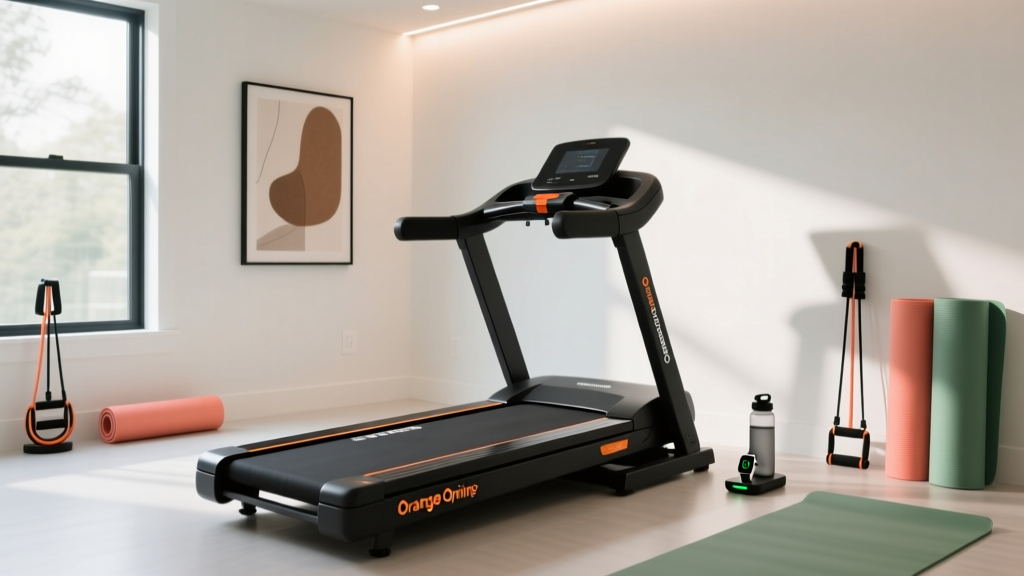
2026 Quiet Treadmills for Orange Theory Treadmill Workouts
Discover the best quiet treadmills for Orange Theory treadmill workouts. Compare noise levels, impact dampening, and top 2026 models for home use.

The Acoustic Challenge of High-Intensity Interval Sprints
Replicating the signature 'All-Out' blocks of Orange Theory treadmill workouts in a home environment presents a unique engineering challenge. These workouts demand rapid transitions from a 3.5 MPH base pace to 12.0+ MPH sprints, coupled with steep 10-15% incline climbs. While your cardiovascular system thrives on this variance, your home's acoustics—and your neighbors' sanity—often suffer. The primary culprit is not the treadmill's motor, but the structural impact noise generated by repeated footfalls at high velocities.
According to biomechanical data referenced by the American Council on Exercise (ACE), ground reaction forces (GRF) during a sprint can exceed 3 to 4 times a runner's body weight. When a 180-pound runner hits a standard treadmill deck at 10 MPH, they are generating over 600 pounds of downward force per strike. This kinetic energy transfers through the deck, into the frame, and directly into your subfloor as low-frequency structural vibration. To successfully execute Orange Theory treadmill workouts at home without triggering noise complaints, you must prioritize impact dampening, frame mass, and belt composition over simple motor horsepower.
Cardio Machine Noise Level Comparison Matrix
Before committing to a specific machine, it is critical to understand the acoustic footprint of various cardio modalities during max-effort intervals. The following table compares baseline motor noise against peak impact noise, measured in decibels (dB) at a distance of 3 feet. For context, the Environmental Protection Agency (EPA) recommends indoor noise levels remain below 70 dB to prevent long-term hearing fatigue and minimize household disruption.
| Machine Type | Motor/Drive Noise (3 MPH / Base) | Peak Impact Noise (Max Effort) | Structural Vibration Transfer | OTF Workout Suitability |
|---|---|---|---|---|
| Standard Folding Treadmill | 62 - 68 dB | 85 - 94 dB | High (Severe thudding) | Poor (Deck flex causes loud slapping) |
| Commercial Slatted Treadmill | 55 - 60 dB | 72 - 78 dB | Low (Absorbed by rubber slats) | Excellent (True studio feel) |
| Heavy-Duty Home Treadmill | 60 - 65 dB | 78 - 84 dB | Medium (Requires isolation mat) | Very Good (Stable, thick belt) |
| Air Resistance Bike | N/A (Chain/Belt drive) | 65 - 75 dB (Wind noise) | Negligible | Good (For power block alternatives) |
| Indoor Rowing Machine | N/A (Air/Fan) | 70 - 80 dB (Fan whoosh) | Low | Excellent (For rowing blocks) |
| Stair Climber | 58 - 64 dB | 68 - 74 dB (Step impact) | Low-Medium | Good (For power/incline blocks) |
Top Treadmill Picks for High-Impact Interval Training
To handle the rigors of Orange Theory treadmill workouts, you need a machine with a high-inertia flywheel, a thick running belt, and an advanced elastomer cushioning system. Here are the top performers for 2026, ranked by their acoustic and structural performance.
1. Woodway 4Front: The Acoustic Gold Standard
Price: $7,499 | Motor: 4.0 HP AC Brushless | Belt: Vulcanized Rubber Slats
The Woodway 4Front is the exact model found in many premium Orange Theory studios. Instead of a traditional fabric belt dragging over a wooden deck, the 4Front uses a patented slatted belt system. The thick vulcanized rubber slats absorb up to 90% of the shock from foot strikes. During a 12 MPH 'All-Out' sprint, the impact noise is reduced to a dull, muffled thud (roughly 75 dB) rather than the sharp, percussive slapping of standard treadmills. Furthermore, the AC motor operates at a near-silent 58 dB. The main drawback is the premium price tag and the massive 350 lb footprint, which actually aids in dampening vibration.
2. Sole F85: The Heavy-Duty Workhorse
Price: $1,899 | Motor: 4.0 CHP DC | Belt: 2-Ply, 22-inch
If the Woodway is out of budget, the Sole F85 is the best traditional treadmill for high-intensity intervals. Sole utilizes a 'Cushion Flex Whisper Deck' system that relies on heavy-duty elastomer pucks beneath the deck. The F85 weighs in at 280 lbs assembled; this sheer mass prevents the frame from resonating and amplifying low-frequency thuds into your floorboards. The 2-ply belt is significantly thicker than budget models, reducing the 'whip' effect that causes loud slapping noises at high speeds.
3. Horizon 7.8: The Budget-Conscious Sprinter
Price: $1,299 | Motor:3.5 CHP | Belt: 2-Ply, 22-inch
Horizon's 7.8 model features a variable response cushioning system (softer at the front for landing, firmer at the back for push-off). While it cannot entirely eliminate the thud of a 10 MPH sprint, its heavy-gauge steel frame and 3-zone cushioning keep impact noise around 82 dB—manageable for single-family homes, though potentially problematic for upstairs apartments without additional dampening.
Vibration Dampening: The Secret to Apartment-Friendly Sprints
No matter which treadmill you purchase, executing Orange Theory treadmill workouts on a second-floor apartment or over a finished basement requires secondary vibration isolation. Treadmill mats sold at big-box sporting goods stores are typically 1/8-inch thick PVC; these are useless for impact noise and only serve to protect hardwood from scratches.
Expert Callout: The 3/8-Inch Rule
To effectively decouple your treadmill from the subfloor, you must use a 3/8-inch thick vulcanized rubber mat. Often sold as 'horse stall mats' at agricultural supply stores or specialized acoustic mats online, this density is required to absorb the low-frequency kinetic energy generated by sprinting. Pair the mat with four 2-inch rubber isolation pucks placed under the treadmill's transport wheels and rear stabilizers to eliminate hard-point transfer.
Silent Alternatives for the 'Treadmill Block'
If structural noise makes treadmills entirely unviable for your living situation, you can still replicate the cardiovascular demands of Orange Theory workouts using alternative cardio machines that generate zero structural impact.
- Assault AirBike Pro X ($1,299): Uses a belt-drive system (eliminating chain clatter) and generates resistance via a massive 27-inch fan. The only noise is the 'whoosh' of displaced air, peaking at around 75 dB during max-effort intervals. It perfectly mimics the full-body fatigue of an 'All-Out' sprint.
- Concept2 RowErg ($1,100): The gold standard for rowing blocks. The air resistance flywheel creates a steady, white-noise hum that easily masks the mechanical track sounds. Because your feet remain strapped to the footrests, there is zero downward impact force transferred to the floor.
- Peloton Bike+ ($2,495): The magnetic resistance system is entirely frictionless and silent. The only acoustic footprint is the rider's breathing and the drivetrain's faint whir, making it the ultimate stealth machine for late-night interval blocks.
Frequently Asked Questions
Will a curved manual treadmill be quieter for sprint intervals?
Curved manual treadmills (like the Technogym Skillmill or AssaultRunner) eliminate motor noise entirely, but they do not eliminate impact noise. Because you are propelling the belt with the balls of your feet, the downward striking force remains high. Without a heavy frame and thick rubber slats, a curved treadmill on a hard floor will still generate significant low-frequency thudding during sprints.
How often should I lubricate my treadmill belt to reduce noise?
For high-intensity interval training, friction and heat build-up are accelerated. You should inspect and apply 100% silicone treadmill lubricant every 90 days or every 150 miles. A dry belt increases the drag on the motor, causing it to whine louder and run hotter, while also creating a harsher, slapping sound against the deck.
Is it safe to do high-intensity sprints on a treadmill with a 2.5 CHP motor?
No. Motors under 3.0 Continuous Horsepower (CHP) are designed for walking and light jogging. During an 'All-Out' sprint block, a weaker motor will bog down, stutter, and overheat. This not only creates a loud, straining mechanical noise but poses a severe safety risk as the belt can abruptly decelerate under heavy foot loads. Always opt for a minimum of 3.5 CHP for Orange Theory-style interval training.
For more information on managing indoor environmental stressors, including noise and air quality during intense home workouts, refer to guidelines published by the World Health Organization (WHO).
More gear to consider
All reviews
WalkFit Treadmill Review: Space-Saving Office Desk Setups
FitShow Treadmill Review: Small Space Care & Maintenance

Preventing Treadmill Murder: 2026 Belt Care Market Trends
Walking Pads vs Motorized Treadmills: Setup & Install Guide
Fixing ProForm 530x Treadmill Noise & Cardio Machine Comparisons
