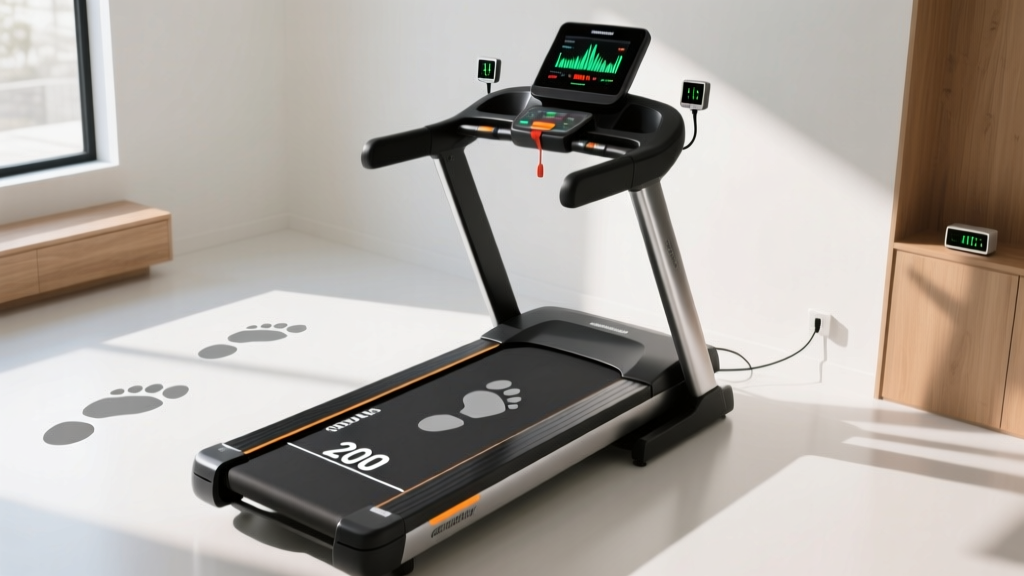
Setup Guide: 200 Meters on Treadmill Test & Noise Levels
Learn how to install your cardio gear and run a 200 meters on treadmill test to calibrate speed, measure decibels, and compare noise levels across machines.

The Acoustic Blueprint: Why Setup Dictates Noise
When outfitting a home gym in 2026, enthusiasts often obsess over motor horsepower and interactive screens, completely ignoring the acoustic footprint of their equipment. Cardio machine noise is rarely just about the motor; it is primarily about structure-borne vibration and impact resonance. A poorly installed treadmill on a second-floor bedroom will generate low-frequency thuds that travel through floor joists, annoying everyone in the house. Conversely, a properly isolated machine operates at a whisper.
This complete setup and installation walkthrough will guide you through base isolation, mechanical calibration, and the industry-standard acoustic baseline: the 200 meters on treadmill test. By the end of this guide, you will know exactly how to minimize decibel output and how different cardio machines compare when properly installed.
Expert Callout: Floor Joist OrientationBefore unboxing, locate your floor joists. If you are setting up on an upper level (second floor or above), position the heaviest cardio machines (like a 250 lb treadmill) perpendicular to the joists. This distributes the dynamic impact load across multiple structural beams rather than concentrating it on one, drastically reducing structural resonance and low-frequency hum.
Phase 1: Base Isolation and Leveling
Never place a cardio machine directly on hard flooring or thin carpet. The first step of any installation is creating an acoustic decoupling layer.
- The Mat: Invest in a 3/8-inch thick vulcanized rubber mat (typically 4x6 feet, costing between $60 and $90 in 2026). Avoid cheap PVC foam mats; they compress under the 200+ lb dynamic load of a running treadmill and lose their acoustic dampening properties within weeks.
- Leveling the Feet: Use a 24-inch carpenter's level across the deck. Adjust the threaded leveling feet at the rear of the machine until the bubble is perfectly centered. An unlevel deck causes the belt to track to one side, creating friction against the side rails—a primary culprit of high-pitched squeaking.
- Clearance: Maintain at least 2 inches of clearance from walls to prevent sound waves from amplifying in tight corners.
Phase 2: The 200 Meters on Treadmill Calibration Test
Once the machine is assembled, plugged into a dedicated 15-amp or 20-amp circuit, and isolated, you must calibrate the belt and measure the baseline noise. In fitness equipment testing, executing exactly 200 meters on treadmill equipment is the gold standard for initial acoustic and mechanical benchmarking. Why 200 meters? It takes roughly 60 to 90 seconds of running—enough time for the motor to engage fully, the belt to stretch to its operating tension, and the user to establish a consistent cadence, without inducing fatigue that alters stride mechanics.
Step-by-Step Execution
- Download a Decibel Meter: Use a calibrated app like the NIOSH Sound Level Meter (SLM) on your smartphone. Place the phone on a tripod exactly 3 feet from the motor hood and 4 feet off the ground (approximate ear level of a seated neighbor or adjacent room).
- The Walk Test (First 100 Meters): Start the machine at 3.0 MPH. Walk for 100 meters. Listen for rhythmic thumping (indicating a warped roller or uneven deck) or high-pitched whining (indicating a dry belt).
- The Run Test (Next 100 Meters): Increase the speed to 6.0 MPH. Run the remaining 100 meters. Focus on landing with a midfoot strike to isolate the machine's impact absorption from heavy heel-striking.
- Record the Leq: Note the Equivalent Continuous Sound Level (Leq) over the duration of the test. A properly installed, well-lubricated treadmill should peak between 72 dB and 78 dB during this 200-meter sprint. Anything above 82 dB indicates an installation or lubrication error.
'Prolonged exposure to noise levels above 85 decibels can cause permanent hearing damage, but in a home gym context, the real issue is low-frequency structural vibration that disrupts the household long before it reaches dangerous airborne volume thresholds.' — National Institute on Deafness and Other Communication Disorders (NIDCD)
Cardio Machine Noise Level Comparison Matrix
How does the treadmill compare to other cardio staples when properly installed? Below is a 2026 noise comparison matrix based on standardized home setups (3/8-inch rubber mat, hard subfloor, measured at 3 feet). Note that OSHA noise standards and acoustic engineering principles dictate that every 10 dB increase represents a perceived doubling of loudness.
| Machine Type & Model (2026) | Approx. Price | Idle / Motor dB | Peak In-Use dB | Primary Noise Source |
|---|---|---|---|---|
| Treadmill (Sole F80) | $1,199 | 55 dB | 74 - 82 dB | Footfall impact & belt friction |
| Elliptical (Sole E95) | $1,399 | 42 dB | 48 - 55 dB | Drive wheel bearing hum |
| Rower (Concept2 RowErg) | $1,000 | N/A (Manual) | 65 - 75 dB | Air resistance fan (flywheel) |
| Air Bike (Rogue Echo) | $750 | N/A (Manual) | 68 - 80 dB | Belt-drive fan & chain slap |
Insight: Ellipticals are the undisputed champions of apartment living. Because your feet never leave the pedals, the structure-borne impact noise is virtually zero, leaving only the faint, easily masked whir of magnetic resistance. Treadmills, even with perfect 200-meter calibration tests, will always generate higher decibel levels due to the physics of human footfall.
Phase 3: Troubleshooting Assembly-Induced Noise
If your 200 meters on treadmill test yielded a peak dB over 82, or if you hear distinct mechanical anomalies, do not accept it as 'normal motor noise.' Use this troubleshooting matrix to identify and fix the issue immediately.
1. The 'Squeak-Squeak' Rhythm (Belt Friction)
The Cause: The running belt is dry, creating immense friction against the wooden deck. This forces the motor to work harder, drawing excess amperage and generating a high-pitched squeal.
The Fix: Lift the edge of the belt. It should raise exactly 2 to 3 inches off the deck. If it's tighter, loosen the rear roller bolts by a quarter-turn. Apply 100% pure silicone treadmill lubricant (never use petroleum-based WD-40, which will melt the deck coating). Run the machine at 2.0 MPH for 5 minutes to distribute the silicone.
2. The 'Thump-Thump' at the Seams (Belt Alignment)
The Cause: The belt seam is slapping the deck, or the belt is tracking too far to the left/right, rubbing against the plastic side caps.
The Fix: Stand behind the machine while it runs at 3.0 MPH. If the belt drifts left, turn the left rear adjustment bolt clockwise by one-eighth of a turn. Wait 30 seconds for the belt to center itself before making further adjustments.
3. The 'Rattling' Motor Hood (Vibration Transfer)
The Cause: The plastic shroud covering the motor is vibrating against the metal frame due to loose assembly screws.
The Fix: Power down and unplug the machine. Remove the motor hood. Apply a small strip of weatherstripping foam tape or a dab of clear silicone sealant to the contact points where the plastic hood meets the metal frame before re-screwing it into place.
Never plug a treadmill into a shared circuit with high-draw appliances (like a microwave or space heater). Voltage drops cause the treadmill motor to compensate by drawing higher amperage, which not only creates a loud electrical hum but will eventually fry the motor control board. Always use a dedicated 15A or 20A outlet.
Frequently Asked Questions
Can I use a treadmill on the second floor without annoying my neighbors?
Yes, but it requires aggressive isolation. You must use a 3/8-inch vulcanized rubber mat, place the machine perpendicular to the floor joists, and ideally install acoustic underlayment beneath your flooring. Furthermore, adopting a forefoot or midfoot running strike drastically reduces the vertical impact force (which can exceed 2.5x your body weight during a heel strike) transmitted into the floorboards.
Why does my rower sound louder than my treadmill?
Air rowers like the Concept2 rely on a fan flywheel to generate resistance. The faster you pull, the more air the fan displaces, creating a 'whooshing' airborne noise that can peak at 75 dB. Unlike a treadmill's low-frequency thud, this high-frequency airborne noise easily travels through open spaces and standard drywall, making it seem louder to people in adjacent rooms despite registering lower on a decibel meter.
How often should I re-run the 200-meter calibration test?
For heavy users (4+ hours a week), perform the 200 meters on treadmill acoustic and tracking test every 3 months. Belts stretch over time, and dust accumulation alters the friction coefficient of the deck. Regular testing ensures you catch lubrication deficits before they cause irreversible motor strain.
More gear to consider
All reviews
Beginner's Horizon Treadmill Buying Guide: Features Compared

Stair Climber Home Guide vs Life Fitness Treadmill Models by Year

Curved vs Motorized Treadmills: Do You Need XTERRA Treadmill Lube?
Under Desk Treadmills 2026: Adapting a Popular Treadmill Workout

Rowing Machine Buying Guide & Technique: Beyond the Barry's Treadmill
