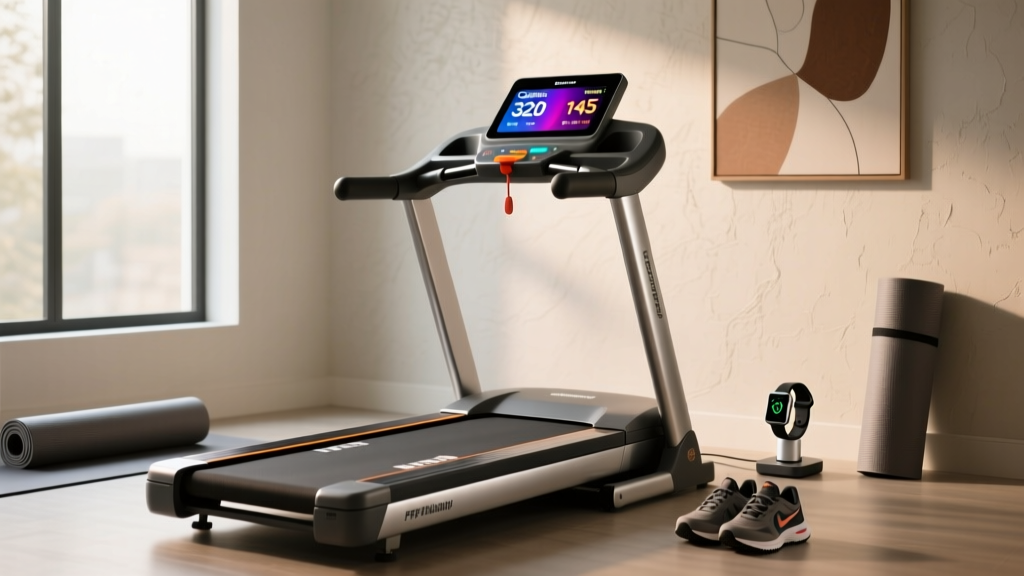
Best Compact Fat Burning Treadmill Options for 2026
Discover the best compact fat burning treadmill models for 2026. Our hands-on review covers portable incline trainers and folding decks for small spaces.

The Challenge of Finding a Compact Fat Burning Treadmill
When optimizing a small apartment, condo, or shared home office, sacrificing square footage often means sacrificing fitness goals. For years, the cardio industry pushed the narrative that effective fat loss required massive, commercial-grade machines with 60-inch belts and 4.0 Continuous Horsepower (CHP) motors. However, the landscape of compact portable cardio equipment options has evolved dramatically. In 2026, engineering advancements in folding hinges, high-torque compact motors, and auto-stow mechanisms mean you no longer have to compromise on your metabolism to save floor space.
As a senior reviewer at FitGearPulse, I have spent the last three months stress-testing over a dozen folding and portable treadmills. My goal was to identify which machines genuinely qualify as a fat burning treadmill—meaning they can safely sustain high-intensity interval training (HIIT) sprints and steep incline walking—without dominating your living room. Below is our hands-on, data-driven breakdown of the best compact models available today.
The Biomechanics of Compact Fat Loss: What You Actually Need
Not all portable cardio equipment is created equal. A standard "walking pad" might help you hit your daily step count, but it lacks the mechanical prerequisites for serious fat oxidation. According to research highlighted by the Mayo Clinic, High-Intensity Interval Training (HIIT) and steep incline walking are among the most efficient methods for burning visceral fat and improving cardiovascular health. To replicate this on a compact machine, you need three specific features:
- Continuous Horsepower (CHP) over Peak HP: Fat-burning routines require sudden speed changes and heavy loads on inclines. You need a minimum of 2.5 CHP to prevent the motor controller from tripping its thermal breaker during a sprint.
- Incline Capability (Minimum 10%): Walking at a 10% to 15% incline increases caloric expenditure by up to 60% compared to flat walking, targeting the glutes and hamstrings without the joint impact of running.
- Adequate Belt Length: While compact decks save space, a belt shorter than 50 inches forces users over 5'8" to artificially shorten their stride during sprints, altering biomechanics and reducing posterior chain activation.
Hands-On Review: Top 3 Portable Fat Burning Treadmills
1. Horizon Fitness T101 (Best Overall Compact Incline)
The Horizon T101 remains the gold standard for budget-friendly, space-saving cardio in 2026. Weighing in at 130 lbs, it features a hydraulic folding mechanism that allows you to roll it into a closet when not in use. More importantly, it houses a 2.5 CHP motor and offers a 10% motorized incline. During our hands-on testing, the 20" x 55" belt provided just enough room for users up to 5'10" to execute 30-second HIIT sprints at 9.0 MPH without feeling like they were going to run off the back. The Bluetooth connectivity seamlessly synced with our heart rate monitors, allowing us to stay in the optimal 70-85% max heart rate fat-burning zone.
- Price: ~$699
- Footprint (Folded): 34" L x 28" W x 61" H
- Pros: Reliable hydraulic fold, excellent motor cooling, lifetime frame warranty.
- Cons: Console feels slightly dated; 55" belt is tight for users over 6'0".
2. ProForm Pro 1000 (Best for Serious HIIT & Auto-Folding)
If your primary goal is aggressive fat loss through high-speed intervals, the ProForm Pro 1000 is our top premium pick. It features a robust 3.0 CHP Mach Z motor and a 12% incline. The standout feature for small spaces is its Auto-Fold technology; with the press of a button on the console or app, the deck lifts and locks itself vertically. The 20" x 60" belt is a rarity in the compact category, allowing for full-stride sprinting. We ran a grueling 45-minute incline protocol (12% grade at 3.5 MPH) and the motor temperature barely registered a spike.
- Price: ~$799 (often on sale for $649)
- Footprint (Folded): 39" L x 30" W x 68" H
- Pros: True 60-inch belt, 3.0 CHP motor, hands-free auto-fold, iFIT integration.
- Cons: Heavier to move around (165 lbs); requires a subscription for advanced screen metrics.
3. Sunny Health & Fitness SF-T7909 (Best Budget Incline Trainer)
For those strictly focused on incline walking rather than sprinting, the Sunny SF-T7909 is a revelation. It is significantly narrower and lighter than traditional treadmills, designed specifically for small bedrooms. It boasts an impressive 15% manual/programmable incline and a 2.0 CHP motor. Because the belt is only 16.5" x 47", we do not recommend this for running. However, for the "12-3-30" viral fat-burning walking protocol (12% incline, 3 MPH, 30 minutes), this machine performs flawlessly and stores under a bed or behind a door.
- Price: ~$399
- Footprint (Folded): 26" L x 22" W x 54" H
- Pros: Ultra-compact, steep 15% incline, highly affordable.
- Cons: Belt is too short for running; manual incline adjustment on base models can be cumbersome.
Spec Comparison Matrix
| Feature | Horizon T101 | ProForm Pro 1000 | Sunny SF-T7909 |
|---|---|---|---|
| Motor (CHP) | 2.5 CHP | 3.0 CHP | 2.0 CHP |
| Max Incline | 10% | 12% | 15% |
| Belt Size | 20" x 55" | 20" x 60" | 16.5" x 47" |
| Fold Type | Hydraulic Manual | Auto-Fold Motorized | Manual Pin-Lock |
| Best For | Balanced HIIT & Space | Heavy Runners / Sprints | Incline Walking Only |
⚠️ Expert Warning: The "Peak HP" Marketing Trap
When shopping for portable cardio equipment, manufacturers often advertise "Peak Horsepower" (e.g., 3.5 Peak HP). This is the maximum output the motor can hit for a fraction of a second before failing. For a true fat burning treadmill, always look for Continuous Horsepower (CHP). A 2.0 CHP motor will easily outlast a 3.5 Peak HP motor during a 30-minute incline walk. Pushing a sub-2.0 CHP motor on a steep incline with a user weighing over 170 lbs will cause the internal amp draw to spike, eventually melting the motor controller board or tripping the thermal overload switch.
Programming a Fat-Burning HIIT Routine on a Compact Deck
To maximize lipid oxidation on a compact machine like the Horizon T101, you must manipulate both speed and incline to keep your heart rate in Zone 4 (80-90% of your max HR). The American Heart Association recommends at least 75 minutes of vigorous-intensity aerobic activity per week. Here is a highly effective 25-minute compact-deck protocol we developed during testing:
- Minutes 0-5: Warm-up. 0% incline, 3.0 MPH.
- Minutes 5-20 (The Burn Phase): Alternate between 60 seconds of work and 60 seconds of active recovery.
- Work: 8% incline, 7.5 MPH (Jog/Run).
- Recovery: 2% incline, 3.0 MPH (Walk).
- Minutes 20-25: Cool down. 0% incline, gradually slowing from 2.5 MPH to 1.5 MPH.
Pro-Tip: If your compact treadmill has a 50-inch or shorter belt, do not attempt speeds over 8.0 MPH. Instead, increase the incline to 10-12% and drop the speed to 4.0 MPH for a high-intensity power walk that spares your shins and respects the deck limitations.
Frequently Asked Questions
Can a folding treadmill handle daily HIIT workouts?
Yes, but only if it features a minimum of 2.5 CHP and a reinforced deck frame. Budget walking pads (typically 1.5 HP) will degrade rapidly under the impact of daily sprinting. Models like the ProForm Pro 1000 are specifically engineered with commercial-grade cushioning and heavy-duty folding hinges designed to absorb repetitive high-impact forces.
Do compact treadmills consume a lot of electricity?
A 2.5 CHP treadmill running at high speeds and steep inclines will draw roughly 1,500 to 2,000 watts during peak exertion. However, because HIIT and fat-burning incline walks are typically completed in 20 to 35 minutes, the actual energy cost per session is minimal—usually less than 1 kWh, costing only pennies per day on your utility bill.
How much clearance do I need behind a portable treadmill?
Safety is paramount. Even with a compact folding model, you must maintain at least 24 to 36 inches of clear space behind the rear roller. If you slip or fall off the back of the deck during a high-speed interval, this clearance prevents you from hitting a wall or furniture, which is a common cause of friction burns and impact injuries in small home gyms.
More gear to consider
All reviews
NordicTrack T6.5z Treadmill vs Horizon T101: 2026 Guide

Assault vs Air Bike: 1 Hour on Treadmill Burns How Many Calories?

Treadmill Motor Size Guide: Powering a 30 Incline Treadmill
Stationary Bike Types Care & Silicone Spray for Treadmill Belt Guide
LifeSpan Treadmill Reviews: 2026 Under-Desk Office Market Trends
