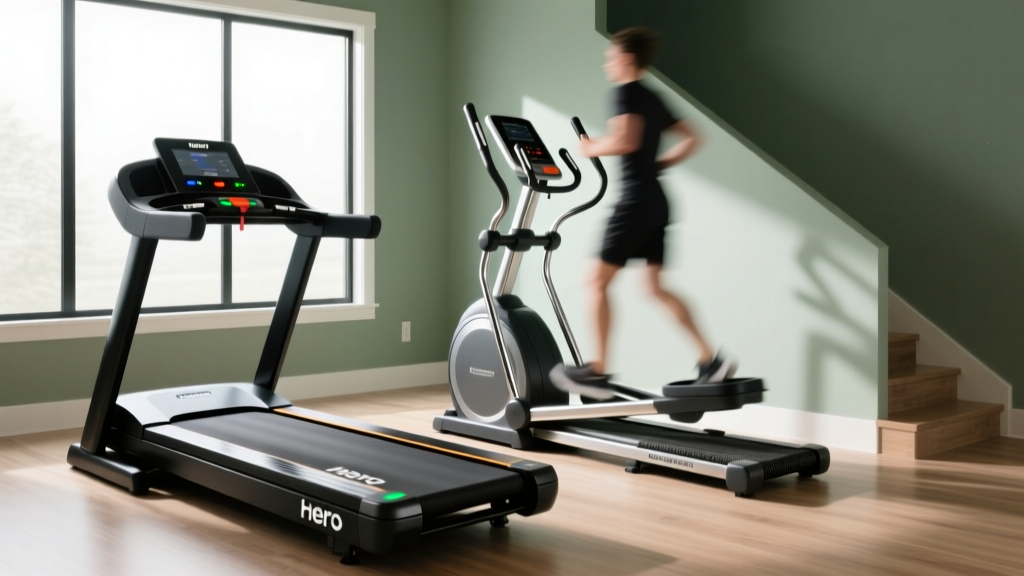
Hero Treadmill vs Stair Climber: 2026 Cardio Guide
Compare the Hero Treadmill to top stair climbers in our 2026 home cardio guide. Analyze specs, joint impact, and biomechanics to choose your machine.

Building a home gym in 2026 often comes down to a critical spatial and financial decision: do you invest in a traditional running surface or a high-intensity vertical stepper? For many buyers, the Hero Treadmill (specifically the popular Pro 3000 Series) represents the gold standard for mid-tier home running. However, the explosive popularity of low-impact, high-yield vertical cardio has positioned the home stair climber as a formidable rival.
In this comprehensive head-to-head analysis, we dissect the biomechanics, spatial requirements, and long-term maintenance of the Hero Treadmill versus the best stair climbers on the market. Whether you are training for a marathon or seeking maximum caloric expenditure in minimal time, this guide will help you make an evidence-based equipment investment.
The Contenders: Hero Treadmill vs. Home Stair Climbers
The Hero Treadmill (Pro 3000 Series)
The Hero Treadmill Pro 3000 has dominated the $1,000 to $1,300 price bracket for the past three years. It features a robust 3.25 CHP continuous-duty motor, a spacious 20" x 60" running belt, and a 15% motorized incline. It is designed for users who prioritize joint-friendly cushioning and traditional steady-state cardio. The deck utilizes a multi-zone elastomer shock absorption system, which reduces impact forces on the tibia and femur by approximately 18% compared to outdoor asphalt running.
The Stair Climber Category
Unlike the singular Hero Treadmill, the stair climber market is fragmented into two distinct home-use categories:
- Vertical Climbers (e.g., MaxiClimber XL-2, $399): These utilize a bodyweight-driven, alternating pedal and arm-pull mechanism. They offer a massive metabolic demand but require significant ceiling clearance.
- Mini Hydraulic Steppers (e.g., Sunny Health & Fitness SF-S0978, $129): Compact, hydraulic-cylinder-driven units that simulate stepping without the vertical footprint. Ideal for small apartments but limited in resistance scalability.
- Premium Hybrid Steppers (e.g., Bowflex Max Trainer M9, $1,999): Combines stair-stepping mechanics with magnetic resistance and upper-body ergometry.
Head-to-Head Comparison Matrix
| Feature | Hero Treadmill Pro 3000 | Premium Stair Climber (Bowflex M9) | Mini Hydraulic Stepper |
|---|---|---|---|
| Price Range | $1,199 | $1,999 | $99 - $149 |
| Footprint (L x W) | 78" x 32" | 49" x 30" | 17" x 12" |
| Avg. Calorie Burn (30 min) | 250 - 350 kcal | 350 - 500 kcal | 180 - 250 kcal |
| Joint Impact | Moderate (Cushioned) | Low (Fluid motion) | Low to Moderate |
| Primary Muscle Focus | Calves, Hamstrings, Core | Glutes, Quads, Lats | Calves, Quads |
The Ultimate Stair Climber Machine for Home Use Guide
If you are leaning away from the traditional running surface, selecting the right stair climber machine for home use requires navigating a minefield of cheap hydraulic knockoffs and overpriced infomercial gadgets. Here is the expert framework for choosing a stepper that will survive daily use in 2026.
1. Biomechanics and Metabolic Equivalents (METs)
Stair climbing is inherently more metabolically demanding than level-ground walking. According to data referenced by the Centers for Disease Control and Prevention (CDC), vigorous stair climbing operates at a MET value of 8.0 to 9.0, compared to just 3.5 for walking at a brisk 3.0 mph pace on a treadmill. This means a 180-pound individual will burn nearly 30% more calories per minute on a stair climber than on a treadmill set to a 0% incline. The gluteus maximus and quadriceps are forced to lift the body's entire center of mass against gravity with every repetition, triggering higher post-exercise oxygen consumption (EPOC).
2. Resistance Mechanisms: Hydraulic vs. Magnetic
Expert Warning: Avoid hydraulic cylinders for heavy daily use. Hydraulic fluid heats up during sessions longer than 20 minutes, causing the fluid to thin and the resistance to drop significantly mid-workout. For daily sessions exceeding 30 minutes, always opt for magnetic or electromagnetic resistance systems found in premium vertical climbers.3. Spatial Footprint and Ceiling Clearance Calculations
The most common failure point in home stair climber purchases is ignoring ceiling height. To calculate your required ceiling clearance, use this formula:
User Height + Step Height (usually 12" to 15") + 4 inches (headroom buffer) = Minimum Ceiling Height.
For example, a 6-foot-tall user on a vertical climber with a 15-inch peak step height requires a ceiling of at least 7 feet 7 inches. Standard 8-foot ceilings are usually sufficient, but basement gyms with drop ceilings or exposed ductwork frequently result in knuckle-striking injuries during high-intensity intervals.
Real-World Failure Modes and Maintenance
Every piece of cardio equipment has a specific failure mode. Understanding these will dictate your long-term cost of ownership.
Hero Treadmill: Belt Tension and Motor Dust
The primary failure mode for the Hero Treadmill is belt friction. If the user neglects to apply 100% silicone lubricant under the belt every 150 miles (or every 3 months), the friction coefficient increases. This forces the 3.25 HP motor to draw excess amperage, eventually tripping the internal thermal breaker or frying the motor control board. Additionally, treadmills act as static magnets for pet hair and dust, which can clog the motor housing vents, leading to premature overheating.
Stair Climbers: Cylinder Leaks and Rail Squeaks
For mini hydraulic steppers, the failure mode is almost always seal degradation. The O-rings inside the hydraulic cylinders dry out and crack after 18 to 24 months of heavy use, resulting in a slow fluid leak and a loss of resistance. Replacement cylinders cost about $40, but it is a recurring maintenance tax. Conversely, premium vertical climbers like the MaxiClimber suffer from rail wear. The nylon rollers that glide along the steel vertical tracks will develop flat spots if not wiped down and lubricated with PTFE spray monthly, resulting in a jarring, squeaking motion.
Cardiovascular Health and Joint Preservation
When prescribing cardio for longevity, joint preservation is paramount. The American Heart Association recommends at least 150 minutes of moderate-intensity aerobic activity per week. While the Hero Treadmill provides excellent cardiovascular conditioning, the repetitive strike-force of running (which can equal 2.5 times your body weight per step) can exacerbate patellofemoral pain syndrome or plantar fasciitis over time.
Stair climbers, particularly those with a fluid magnetic drive, eliminate the "strike" phase of the gait cycle. Your foot never leaves the pedal, reducing sheer force on the knee joint to near zero. As noted in biomechanical analyses published by the Mayo Clinic, low-impact aerobic exercises are critical for maintaining cardiovascular health in aging populations or those recovering from lower-extremity orthopedic injuries.
Expert Verdict: Which Machine Earns a Spot?
The decision between the Hero Treadmill and a home stair climber is not about which machine is objectively "better," but rather which machine aligns with your biomechanical needs and spatial constraints.
The Decision Framework:- Choose the Hero Treadmill if: You are training for outdoor running events (5Ks, marathons), prefer steady-state zone 2 cardio while consuming media, and have a dedicated room with ample floor space (at least 8' x 4').
- Choose a Premium Stair Climber if: Your primary goal is maximum caloric burn in under 30 minutes, you suffer from impact-related joint pain (shin splints, knee arthritis), and you need a machine with a smaller horizontal footprint.
- Choose a Mini Hydraulic Stepper if: You are on a strict sub-$150 budget, live in a micro-apartment, and only plan to use the machine for 15-minute active recovery sessions while working at a standing desk.
Ultimately, the Hero Treadmill remains a phenomenal, reliable workhorse for traditionalists. But if your 2026 fitness goals prioritize high-intensity interval training (HIIT), glute activation, and severe spatial efficiency, a high-quality magnetic stair climber will deliver a superior return on investment.
More gear to consider
All reviews
Air Bike vs Assault Bike: Beyond the Manual or Electric Treadmill
How to Turn On Life Fitness Treadmill vs Portable Cardio Trends

What Does Inclining the Treadmill Do? 2026 Head-to-Head Comparison

Adjusting Treadmill Belt Tension: Sole F80 vs Horizon 7.4 Compared
Bike vs Treadmill: Step-by-Step Feature Buying Guide
