Stationary Bike Types: Matching a 150 Calories Burn on Treadmill
Compare upright, recumbent, and spin bikes. We analyze budgets, joint impact, and how they match a 150 calories burn on treadmill for maximum value.

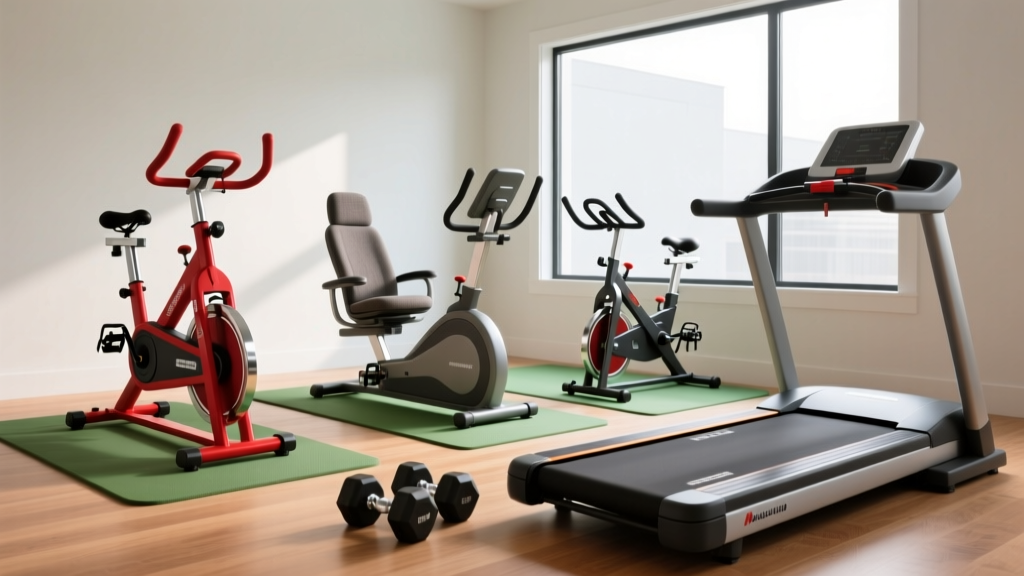
When building a home gym, the treadmill is often the default baseline for cardiovascular conditioning. However, spatial constraints, joint health, and long-term maintenance costs are forcing buyers in 2026 to look closely at stationary bike alternatives. To make an apples-to-apples financial and metabolic comparison, we need a standard benchmark. For a 155-pound individual, achieving a 150 calories burn on treadmill at a moderate jogging pace (roughly 6 mph) takes about 12 to 15 minutes. But how do the three main stationary bike types—spin, upright, and recumbent—stack up against this benchmark in both time efficiency and overall financial value?
In this budget breakdown, we analyze the true cost of ownership, calorie-burn efficiency, and biomechanical value of upright, recumbent, and indoor cycling bikes to help you maximize your fitness ROI.
The Calorie and Cost Benchmark: Bikes vs. Treadmills
Before diving into specific bike types, we must establish the baseline costs associated with our treadmill benchmark. According to metabolic data from Harvard Health Publishing, a 155-pound person burns approximately 372 calories in 30 minutes of vigorous stationary cycling, which easily eclipses the time required for a 150 calories burn on treadmill. However, the equipment cost to achieve this safely varies wildly.
| Machine Type | Time to 150 Cal (155lb User) | Avg Entry Price (2026) | Footprint (Sq Ft) | Hidden Cost Factor |
|---|---|---|---|---|
| Budget Treadmill | 12-15 mins (6 mph jog) | $599 - $899 | 18 - 22 | Motor burnout, belt replacement |
| Spin / Indoor Cycle | 10-12 mins (Vigorous) | $450 - $800 | 8 - 10 | Mandatory app subscriptions |
| Upright Bike | 18-22 mins (Moderate) | $250 - $500 | 10 - 12 | Seat discomfort, pedal strap wear |
| Recumbent Bike | 22-26 mins (Moderate) | $700 - $1,500 | 16 - 20 | Electronic console failures |
Spin Bikes: High-Intensity ROI and Premium Pricing
Indoor cycling bikes (spin bikes) are the closest metabolic match to running. Because you can manipulate both cadence (RPM) and heavy magnetic resistance, hitting a 150 calories burn on treadmill equivalent takes roughly the same amount of time—or even less if you incorporate HIIT sprints.
The Budget Breakdown
In 2026, the mid-tier magnetic resistance market is highly competitive. The Schwinn IC4 (retailing around $799) features a 40-pound flywheel and dual-sided pedals, offering a commercial-gym feel without the $2,500 price tag of a Peloton Bike+. However, the true cost of spin bikes often lies in the software. To access live classes that keep your heart rate in the calorie-torching zone, expect to pay $13 to $44 per month in subscription fees.
Value Verdict: Spin Bikes
- Best For: Time-crunched users wanting maximum calorie burn per minute.
- Financial Edge Case: If you refuse to pay for monthly streaming apps, a spin bike loses 40% of its motivational value. In that scenario, an upright bike with a built-in LCD console offers better standalone value.
- Failure Mode: Sweat corrosion on the handlebars and seat post. Budget spin bikes under $400 often use non-coated steel that will pit and rust within 14 months if not wiped down with a neutralizing spray.
Upright Bikes: The Budget-Friendly Middle Ground
Upright bikes mimic the geometry of a traditional outdoor bicycle but with a heavier frame and smaller flywheel. They require a slightly longer time commitment to match a 150 calories burn on treadmill because the seated position engages fewer stabilizing muscles than running or standing on a spin bike.
Where the Value Lies
Upright bikes are the undisputed champions of entry-level budgets. Models like the Sunny Health & Fitness SF-B901 can be found for under $350. They require zero subscriptions, have a small footprint, and use simple belt-drive systems that require virtually no maintenance.
'While upright bikes are excellent for budget-conscious buyers, the primary point of failure is user compliance. The standard narrow saddle causes perineal discomfort for beginners, leading to abandoned workouts before the cardiovascular adaptation phase is complete.' — Biomechanical Analysis of Indoor Cycling, Journal of Sports Science & Medicine
The Fix: Factor a $45 to $80 investment into a premium gel seat cover or a replacement wide-comfort saddle into your initial budget to ensure you actually use the machine long enough to see a return on your investment.
Recumbent Bikes: Valuing Longevity and Joint Preservation
Recumbent bikes place the user in a reclined position with a backrest and pedals situated in front of the body. According to the Cleveland Clinic, this design drastically reduces shear force on the knee joints and eliminates lower back strain. Consequently, achieving a 150 calories burn on treadmill might take 12 minutes, but doing it on a recumbent bike will take 22 to 26 minutes of steady-state pedaling.
The Premium Price of Comfort
Recumbent bikes are the most expensive stationary bike type due to their complex framing, larger seats, and extended rail systems. A reliable, gym-quality recumbent like the NordicTrack Commercial R35 costs upwards of $1,799. Budget options under $500 often feature wobbly seat rails and poorly calibrated magnetic brakes that slip during high-cadence intervals.
Spatial Budgeting: The Hidden Cost
When evaluating value, you must calculate the 'spatial cost' of the equipment. A recumbent bike requires a footprint of roughly 65 inches in length and 28 inches in width. In a multi-use room or small apartment, the opportunity cost of dedicating 15 square feet to a single piece of cardio equipment can outweigh the metabolic benefits. If space is at a premium, a foldable upright bike or a compact spin bike provides a vastly superior financial and spatial ROI.
The Final Value Verdict: Which Machine Wins Your Budget?
Choosing between a treadmill and a stationary bike—or choosing among the bike types themselves—requires aligning your metabolic goals with your financial and spatial realities.
- Choose a Spin Bike if: Your primary goal is time efficiency. You want to match or beat a 150 calories burn on treadmill in under 15 minutes, and you have the budget for a mid-tier magnetic bike ($600-$800) plus a monthly streaming subscription.
- Choose an Upright Bike if: You are on a strict budget (under $400), have limited square footage, and prefer steady-state, moderate-intensity cardio without the pressure of live coaching.
- Choose a Recumbent Bike if: You are recovering from an injury, managing chronic lower back pain, or prioritize long-term joint preservation over rapid calorie expenditure. Be prepared to invest over $1,000 for a machine with a durable seat rail and accurate telemetry.
Ultimately, the most valuable cardio machine is the one that aligns with your biomechanical needs and remains in your daily routine. While the treadmill sets the standard for calorie burning, the modern stationary bike market offers highly specialized, budget-friendly alternatives that deliver exceptional long-term health ROI.
More gear to consider
All reviews
Elliptical vs Treadmill: Is Treadmill Walking Bad for Your Knees?
SereneLife Treadmill Buying Guide: 2026 Feature Comparison & Review
What Burns More Fat: StairMaster or Treadmill? Compact Budget Guide

Rowing Machine Buying Guide & Setup: Smii7y Treadmill Alternative
Bike Types vs Treadmill Workout with Dumbbells: Space Guide