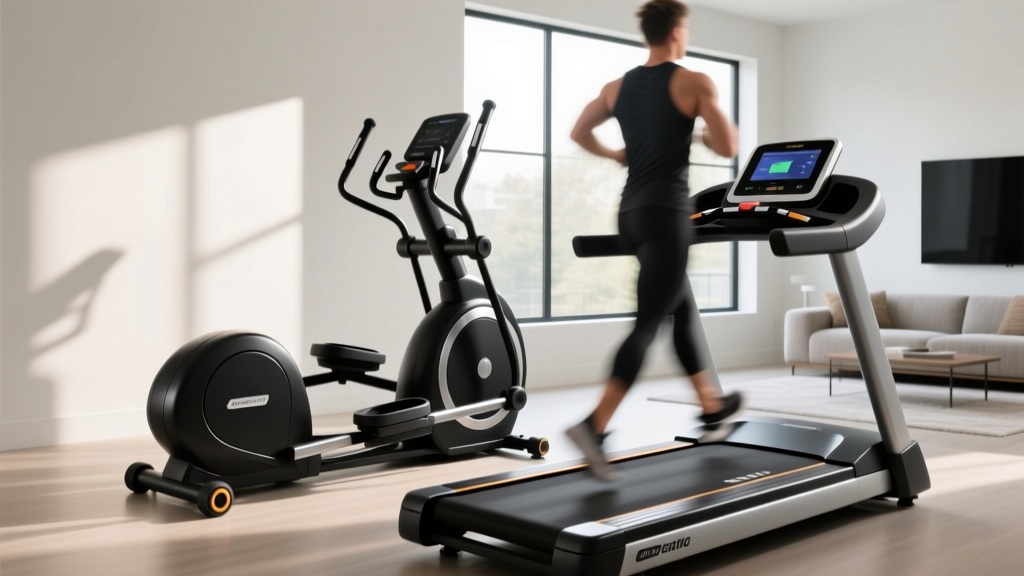
Elliptical vs Treadmill: Is a Treadmill Put Together Worth the Cost?
Compare the true costs of an elliptical vs treadmill. We break down assembly, electrical needs, and long-term value to see which machine wins.

The True Cost of Home Cardio: Beyond the Sticker Price
Choosing between an elliptical and a treadmill for your home gym is rarely as simple as comparing the retail prices on a manufacturer's website. While a high-end elliptical and a premium treadmill might share a similar $2,000 price tag, the financial reality of owning, installing, and maintaining these machines diverges sharply once they arrive at your door. Many buyers overlook the logistics of delivery and installation. When you finally have your treadmill put together in your basement, the true cost extends far beyond the initial purchase.
In this 2026 budget breakdown, we analyze the elliptical vs. treadmill debate strictly through the lens of financial value, spatial economics, and long-term maintenance. Whether you are outfitting a dedicated garage gym or squeezing a machine into a spare bedroom, understanding the hidden costs of home cardio is essential for maximizing your return on investment.
Upfront Capital: 2026 Pricing & Value Matrix
To establish a baseline, we must compare machines of equivalent build quality and user weight capacities. The market has stabilized in 2026, with mid-tier and premium models offering the best longevity-to-cost ratios.
| Tier | Treadmill Model (Avg. Price) | Elliptical Model (Avg. Price) | Price Delta |
|---|---|---|---|
| Budget | Horizon T101 ($799) | Schwinn 430 ($899) | Elliptical +$100 |
| Mid-Range | Sole F80 ($1,199) | Sole E95 ($1,499) | Elliptical +$300 |
| Premium | NordicTrack Commercial 1750 ($2,599) | NordicTrack Commercial 14.9 ($1,799) | Treadmill +$800 |
At the premium tier, treadmills command a significant price premium. This is largely due to the cost of continuous-duty direct current (DC) motors, advanced shock-absorption decks, and high-tensile steel framing required to withstand repetitive impact forces. Ellipticals, relying on magnetic resistance and flywheel momentum, require less expensive drive-train components, making premium ellipticals generally more affordable than their treadmill counterparts.
The Assembly Tax: Getting Your Equipment Ready
The most frequently ignored line item in a home gym budget is assembly. Unlike an elliptical, which can often be assembled by one moderately handy person, having a heavy-duty treadmill put together usually requires professional freight delivery and specialized labor.
Treadmill Installation Realities
Treadmills are notoriously dense, often weighing between 220 and 350 pounds out of the box. They arrive palletized via LTL (Less Than Truckload) freight carriers.
- Delivery Fees: Standard curbside delivery is usually free, but getting a 300-pound pallet into your home requires a "Room of Choice" upgrade, typically costing $150 to $250.
- Professional Assembly: Because the deck must be perfectly leveled and the motor belt calibrated to prevent friction burns, professional assembly is highly recommended. Expect to pay $200 to $350 for a certified technician.
- Electrical Upgrades: Premium treadmills with 3.5 to 4.0 CHP motors draw significant current. If your home office or basement only has standard 15-amp circuits shared with other rooms, you may need an electrician to install a dedicated 20-amp line to prevent breaker trips during high-incline sprints. This can add $300 to $600 to your project.
Elliptical Assembly Nuances
Ellipticals are lighter (typically 150 to 230 pounds) and ship in standard cardboard boxes via FedEx or UPS Ground, eliminating freight surcharges.
- DIY Feasibility: A single adult can assemble most ellipticals in 90 to 120 minutes using included tools. The primary challenge is aligning the pivot arms and greasing the rail wheels.
- Professional Assembly: If you prefer to hire help, elliptical assembly is cheaper, usually ranging from $100 to $150.
- Electrical Footprint: Ellipticals use magnetic resistance and draw less than 2 amps of power. They can be plugged into any standard household outlet or even run on a heavy-duty extension cord without fire risks.
Spatial Economics and Clearance Requirements
Square footage is expensive. How a machine occupies three-dimensional space directly impacts its value proposition in a home environment.
⚠️ The Ceiling Height Trap: Treadmill decks elevate the user by 8 to 10 inches. If you are 6 feet tall, you need a minimum ceiling height of 7 feet 6 inches. Ellipticals, however, have a pedal clearance of 12 to 18 inches at the apex of the stride. Placing an elliptical in a basement with a 7-foot drop ceiling often results in the user's head striking the ceiling joists. Modifying a ceiling or relocating the machine can cost thousands in contractor fees.Foldability vs. Footprint: While many treadmills feature hydraulic folding mechanisms, the folded footprint is still roughly 30 by 30 inches, and the machine cannot be easily rolled on carpet. Ellipticals generally do not fold, requiring a permanent dedicated footprint of roughly 70 by 30 inches. If space optimization is a priority, a folding treadmill offers superior spatial ROI.
Biomechanical ROI: Joint Health vs. Caloric Output
Value is also measured in physiological return. According to the Centers for Disease Control and Prevention (CDC), adults need at least 150 minutes of moderate-intensity aerobic activity per week. Both machines fulfill this requirement, but the biomechanical cost to your body differs.
"Low-impact exercises like the elliptical are highly recommended for individuals with osteoarthritis or previous joint injuries, as they eliminate the ground-reaction forces associated with running."
— American Academy of Orthopaedic Surgeons (AAOS) Guidelines on Low-Impact Conditioning
The Treadmill Advantage: Running on a treadmill yields a higher caloric burn per minute (roughly 10-15% more than an elliptical at perceived equivalent exertion) because the user must support their entire body weight and stabilize their core. Furthermore, weight-bearing exercise is critical for maintaining bone mineral density as we age.
The Elliptical Advantage: The elliptical provides a zero-impact, closed-kinetic-chain movement. For users over 40, or those with lower back and knee vulnerabilities, the elliptical offers a higher "usability ROI"—meaning you are less likely to miss workouts due to joint inflammation or recovery fatigue.
Maintenance and Depreciation Over 5 Years
Cardio machines are mechanical investments that require upkeep. Neglecting maintenance voids warranties and leads to catastrophic failure modes, such as a seized motor or a snapped drive belt.
| Maintenance Task | Treadmill | Elliptical |
|---|---|---|
| Routine Lubrication | 100% Silicone belt lube every 3-6 months ($15/year) | White lithium grease on pivot joints annually ($10/year) |
| Cleaning | Vacuum motor compartment quarterly to prevent overheating | Wipe down polyurethane rail wheels weekly to prevent stuttering |
| Common Failure Point (Year 3-5) | Drive belt stretching or deck warping ($150-$300 repair) | Pivot bearing degradation causing squeaking ($80-$150 repair) |
| Estimated 5-Year Upkeep Cost | ~$175 (excluding major repairs) | ~$90 (excluding major repairs) |
Treadmills endure significantly more mechanical stress. A 200-pound user running at 7 mph generates thousands of pounds of cumulative downward force on the deck and motor. Consequently, treadmill depreciation is steeper, and the secondary resale market values used treadmills much lower than used ellipticals of the same vintage.
Final Decision Framework
To determine which machine provides the best financial and physical value for your specific situation, use this decision matrix:
- Choose the Treadmill if: You have a dedicated room with standard 8-foot ceilings, a 20-amp electrical circuit, and the budget to pay $300+ for professional delivery and assembly. You prioritize maximum caloric burn and bone-density benefits, and you don't mind the ongoing maintenance of belt lubrication.
- Choose the Elliptical if: You are installing the machine in a basement with low clearance, you want to avoid freight delivery and electrical upgrade costs, or you have a history of joint pain. The elliptical offers a lower total cost of ownership, cheaper assembly, and superior long-term joint preservation.
Ultimately, the best value is the machine you will consistently use. When you finally get your treadmill put together or your elliptical calibrated, the true ROI is measured in the thousands of miles you log from the comfort of your home.
More gear to consider
All reviews
Treadmill Abuse Dad-Proof: Walking Pad vs Treadmill 2026

Elliptical vs Treadmill: Space & Apple Fitness Treadmill Workouts
How Long Did The Inventor Of The Treadmill Live? 2026 Folding Trends
Mobvoi Home Walking Treadmill Care: Compact Cardio Longevity
Horizon 7.0 AT Treadmill Specs & Noise Level Setup Guide
