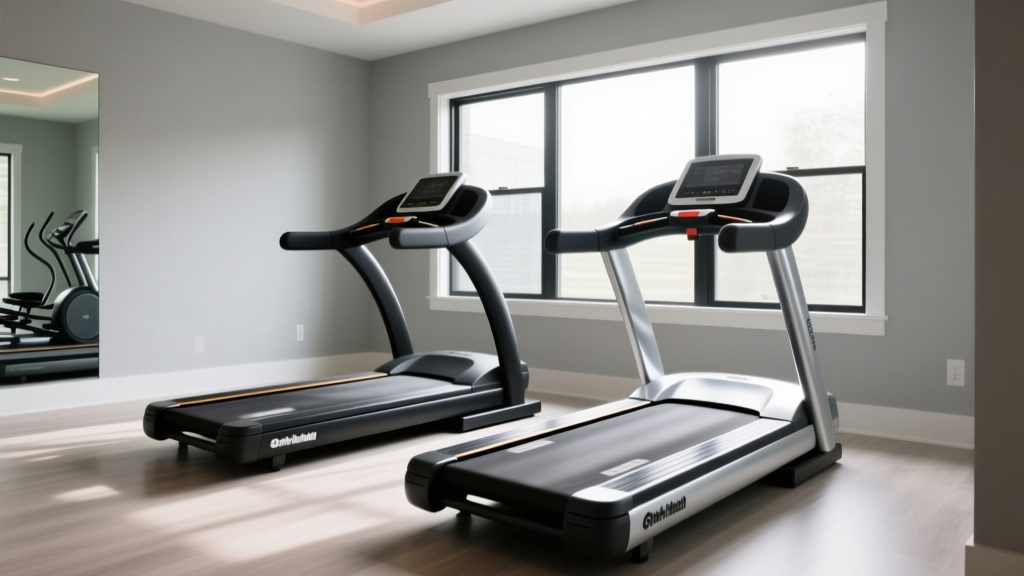
Curved vs Motorized Treadmill Setup: Are Treadmills Accurate?
Discover if curved and motorized treadmills are accurate out of the box. Our complete setup, calibration, and installation walkthrough ensures precise data.

The Great Debate: Are Treadmills Accurate Out of the Box?
When investing thousands of dollars into home cardio equipment in 2026, one critical question remains for data-driven athletes: are treadmills accurate when it comes to tracking distance, speed, and caloric burn? The short answer is that factory settings are merely a baseline. Out of the box, a motorized treadmill can have a distance variance of up to 4%, while a curved manual treadmill might suffer from micro-slippage that skews optical speed sensors by 5% or more.
Accuracy is not just about the software; it is fundamentally tied to the physical installation, belt tensioning, and sensor calibration. In this complete setup and installation walkthrough, we will compare the assembly and calibration requirements of modern motorized treadmills (like the Sole F80) versus curved manual treadmills (like the TrueForm Trainer) to ensure your metrics are rock-solid from day one.
Pre-Installation: Space, Power, and Flooring Requirements
Before unboxing, you must prepare your environment. A poorly prepared floor or electrical circuit is the leading cause of long-term sensor degradation and motor stuttering, which directly impacts data accuracy.
| Requirement | Motorized Treadmill (e.g., Sole F80) | Curved Manual (e.g., TrueForm Trainer) |
|---|---|---|
| Electrical | Dedicated 20-Amp circuit. Voltage drops cause motor RPM fluctuations, ruining speed accuracy. | Standard 15-Amp outlet for console only. Motor is human-powered. |
| Footprint | 82" L x 35" W. Requires 24" clearance on all sides for safety and airflow. | 68" L x 33" W. Compact, but requires strict lateral leveling. |
| Flooring | High-density EVA foam mat to absorb 3.0 CHP motor vibrations. | Rigid, perfectly level surface. Uneven floors cause slat-belt tracking drift. |
| Weight Capacity | Unit weighs ~280 lbs; supports up to 400 lbs. | Unit weighs ~350 lbs; supports up to 350 lbs. |
Step-by-Step Motorized Treadmill Installation & Calibration
Motorized treadmills rely on a magnetic reed switch or optical sensor to count the revolutions of the front roller. If the belt is too loose, the belt slips over the roller while the roller continues to spin, resulting in the console over-reporting your distance. If the belt is too tight, it creates drag, forcing the motor to draw excess amperage and potentially under-reporting speed due to RPM strain.
1. Assembly and Belt Tensioning
After assembling the uprights and console, check the factory belt tension. Lift the running belt in the center of the deck. According to Consumer Reports treadmill testing guidelines, you should be able to lift the belt exactly 2 to 3 inches off the deck. If it lifts higher, use the provided Allen wrench to turn both rear roller adjustment bolts clockwise by exactly one-quarter turn. Re-test until the 2-3 inch rule is met.
2. Entering Engineering / Calibration Mode
To guarantee the software accurately reads the hardware, you must run the auto-calibration sequence. On most premium 2026 models, including the Sole F80 and NordicTrack T-Series:
- Remove the safety magnetic key from the console.
- Press and hold both the START and SPEED + (or Incline +) buttons simultaneously.
- While holding the buttons, insert the safety key. The screen will enter 'Engineering Mode'.
- Press START to initiate the auto-calibration. Do not stand on the belt.
- The treadmill will automatically cycle through speeds from 0.5 mph to max speed (usually 12 mph), and then test the incline from 0% to 15%. This process takes roughly 12-15 minutes and resets the internal potentiometer and optical sensor algorithms.
Assembling a Curved Manual Treadmill: Precision is Everything
Curved treadmills, such as the AssaultRunner Pro or TrueForm Trainer, do not have a motor. You dictate the speed by shifting your center of mass forward on the curve. But are treadmills accurate when they rely entirely on human biomechanics and optical slat-tracking? Only if the physical installation is flawless.
1. Slat Belt Alignment and Tension
Curved treadmills use a heavy vulcanized rubber slat belt riding on ball-bearing rollers. During assembly, the rear tensioning bolts must be perfectly symmetrical. If the left bolt is tightened 2mm more than the right, the belt will track laterally, grinding against the side guides. This friction creates micro-stutters.
Because curved treadmills measure speed via an optical sensor reading the passing slats, a micro-stutter causes the sensor to register 'ghost' passes or miss passes entirely, leading to sudden, erratic speed spikes on the console.
2. Leveling the Deck
Use a 24-inch carpenter's level across the width of the running surface. Adjust the four corner leveling feet until the bubble is perfectly centered. A tilted deck forces the runner to unconsciously compensate laterally, which alters the biomechanical curve and ruins the validity of your pacing data.
Accuracy Showdown: Distance, Speed, and Caloric Burn
How do these two machine types actually compare in real-world data accuracy once properly installed? A landmark biomechanical study published by the National Institutes of Health (NIH) demonstrated that running on a curved manual treadmill elicits significantly higher physiological demands than a motorized treadmill at the same perceived speed.
| Metric | Motorized Treadmill | Curved Manual Treadmill |
|---|---|---|
| Distance Accuracy | ± 1% to 2% (Highly accurate if belt is tensioned and calibrated) | ± 3% to 5% (Prone to optical sensor misreads if slats stutter) |
| Speed Accuracy | Exact (Motor dictates the pace via PWM controllers) | Variable (Dependent on runner's exact placement on the curve) |
| Caloric Burn | Overestimates by 15% - 20% (Standard algorithm flaw) | More accurate to true metabolic cost (Requires ~30% more energy) |
| Elevation / Incline | Accurate via internal inclinometers (post-calibration) | N/A (Fixed mechanical curve simulates ~8% incline effort) |
The Caloric Paradox: While motorized treadmills are more accurate at tracking distance, their caloric algorithms are notoriously flawed. Ironically, because curved treadmills require up to 30% more energy expenditure due to the lack of motorized belt propulsion and the constant uphill curve, the 'inaccurate' caloric readout on a curved treadmill console often accidentally aligns closer to a runner's true metabolic burn than a motorized treadmill's readout.
Troubleshooting Common Setup Errors That Ruin Accuracy
Even with meticulous installation, environmental factors in 2026 can degrade your machine's accuracy over time. Use this troubleshooting matrix to maintain data integrity:
- Motorized Belt Slip (Distance Over-reporting): If your treadmill says you ran 3.0 miles but your GPS watch says 2.8 miles, your belt is slipping. Fix: Tighten both rear roller bolts by 1/4 turn and re-run the engineering calibration mode.
- Curved Treadmill Speed Drops (Sensor Dust): Curved treadmills use optical sensors positioned near the bottom roller. Dust and rubber debris from the slat belt will block the infrared beam, causing the console to show a slower speed than you are actually running. Fix: Wipe the optical sensor eye with a microfiber cloth and isopropyl alcohol monthly.
- Incline Drift on Motorized Units: If the console reads 0% but the deck feels sloped, the internal potentiometer has lost its zero-point. Fix: Enter calibration mode and allow the machine to cycle through its incline limits to reset the physical limit switches.
- Curved Belt Drag (Pacing Inconsistency): If the belt feels 'sticky' and requires excessive effort to maintain a 7:00/mile pace, the rear roller is over-tensioned. This alters the biomechanical curve and invalidates your pacing metrics. Fix: Loosen the tension bolts counter-clockwise by 1/8th of a turn until the slat belt glides smoothly underfoot without lateral drift.
Final Verdict: Which Setup Yields the Most Reliable Data?
So, are treadmills accurate? The truth is that accuracy is a byproduct of proper installation and routine maintenance. If your primary goal is strict, repeatable pacing and exact distance tracking for marathon training, a properly calibrated motorized treadmill remains the gold standard, offering a ±1% margin of error.
However, if you are focused on high-intensity interval training (HIIT), metabolic conditioning, and true caloric expenditure, a curved manual treadmill provides a superior physiological stimulus. While its distance tracking may carry a slightly higher margin of error (±4%), the biomechanical data and true energy cost it demands make it an invaluable tool for the modern athlete. By following this exact setup and calibration walkthrough, you ensure that whichever machine you choose, the data on your console reflects your actual sweat equity.
For more in-depth biomechanical standards and equipment testing protocols, refer to the American College of Sports Medicine (ACSM) guidelines on exercise equipment calibration.
More gear to consider
All reviews
Reebok Jet 100z Treadmill Product Info and Reviews: Belt Care Guide
Does Nike Run Club Work on Treadmills? Setup & 2026 Buyer Guide

Stair Climber vs ProForm 750 Treadmill: Home Guide
ReneStar Treadmills vs Ellipticals: Space-Saving Cardio (2026)
Cardio Machine Noise Level Comparison & Treadmill Removal Service
