Curved Manual vs Motorized Fixes & The Hot Tub With Treadmill Trap
Troubleshoot curved manual vs motorized treadmills. Learn belt tension fixes, motor errors, and why the hot tub with treadmill layout destroys electronics.

The Luxury Gym Trap: Why the 'Hot Tub with Treadmill' Layout Destroys Equipment
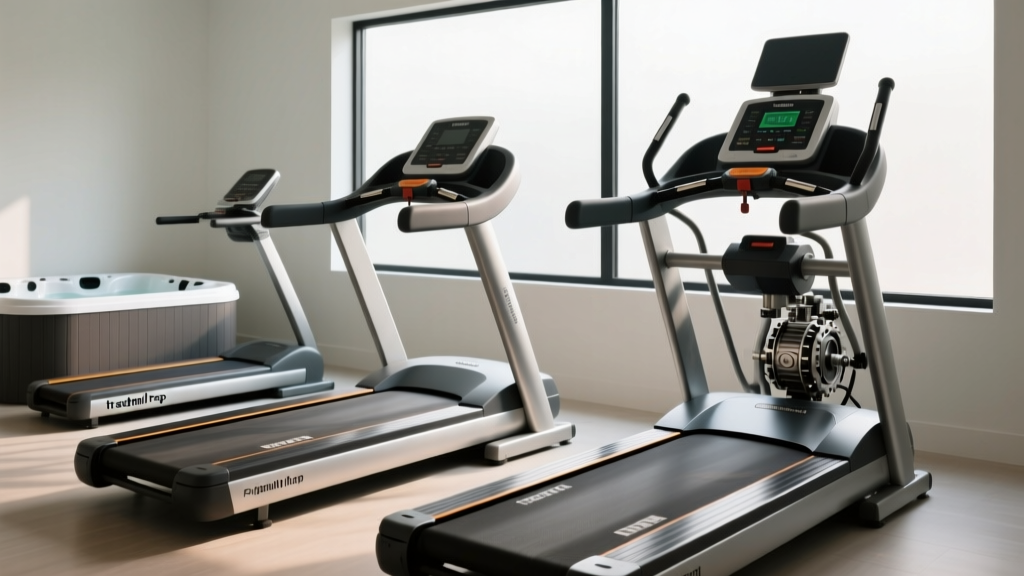
As high-end home gym designs evolve in 2026, a dangerous architectural trend has emerged among luxury fitness enthusiasts: the integrated wet room. Specifically, the 'hot tub with treadmill' concept—placing high-performance cardio machines inside the same climate-controlled enclosure as an indoor pool or hot tub. While it looks incredible on social media, it is a catastrophic mistake for your equipment's lifespan.
Indoor pool and hot tub enclosures typically maintain an ambient temperature of 82°F to 86°F with relative humidity hovering between 60% and 80%. When you introduce the heavy respiration of a treadmill workout into this environment, the dew point shifts dramatically. Condensation forms inside the motor shrouds and control panels of your cardio equipment. Furthermore, evaporated chlorine or bromine from the water combines with ambient moisture to create trace amounts of hydrochloric and hydrobromic acid in the air. This highly corrosive vapor settles on the copper traces of your treadmill's motor control board (MCB), leading to galvanic corrosion and catastrophic short circuits within 6 to 12 months.
⚠️ Environmental Warning: Never place a motorized treadmill in a room with an indoor pool or hot tub. If you must have a cardio machine in a high-humidity recovery room, a curved manual treadmill is your only viable option, as it lacks the sensitive MCB and PWM (Pulse Width Modulation) electronics that fail in wet environments. Even then, you must upgrade to IP65-sealed bearings.Curved Manual Treadmill Troubleshooting: Slat Tension and Rail Friction
Curved manual treadmills, like the Woodway Curve ($6,800) or the AssaultRunner Elite ($3,499), rely on human kinetics and a complex system of polyurethane slats and ball-bearing wheels. Because they lack a motor, troubleshooting is entirely mechanical. Here are the most common mistakes owners make when maintaining these premium machines.
Mistake 1: Using Petroleum-Based Lubricants on UHMWPE Rails
The slats on a curved treadmill glide along guide rails made of UHMWPE (Ultra-High-Molecular-Weight Polyethylene). A common mistake is applying standard WD-40 or petroleum-based greases to reduce friction. Petroleum degrades UHMWPE, causing the rails to swell, warp, and eventually crack under the 250+ lbs of dynamic impact force.
- The Fix: Use only 100% pure liquid silicone spray. Apply a light mist to the guide rails every 300 miles or every 3 months. Wipe away excess with a microfiber cloth to prevent dust buildup, which creates a grinding paste.
Mistake 2: Ignoring Slat Belt Tension and Tracking
Unlike a flat motorized belt, a curved treadmill's running surface is made of 144 individual rubberized slats connected by a Kevlar-reinforced belt. Over time, the Kevlar stretches, causing the slats to slip over the drive sprockets during heavy sprint intervals, resulting in a jarring 'skipping' sensation.
- Diagnose: Stand on the treadmill and perform a hard push-off. If you feel a micro-slip before the belt catches, tension is too low.
- The Fix: Locate the tensioning bolts on the rear axle (usually requiring a 6mm or 8mm Allen key). Turn both the left and right bolts clockwise by exactly one-quarter turn. Test the belt. Never adjust one side more than the other, or the slat belt will track sideways and shred the edge guides.
Motorized Treadmill Diagnostics: Decoding MCB Errors and Deck Friction
Motorized treadmills, such as the NordicTrack Commercial 1750 ($1,899) or the Sole F80 ($999), are engineering marvels but are highly susceptible to electrical and friction-based failures. According to Consumer Reports, the majority of motorized treadmill warranties are voided due to improper deck maintenance and electrical surges.
Troubleshooting the Dreaded 'E1' and 'E2' Error Codes
When a motorized treadmill halts abruptly and flashes an error code, users often assume the motor is dead. In 90% of cases, the motor is fine; the issue lies in the sensor feedback loop.
- E1 Error (Speed Sensor Failure): The optical or magnetic speed sensor on the front roller has lost alignment with the motor's flywheel. Fix: Unplug the machine, remove the motor shroud, and locate the sensor. Ensure the gap between the sensor and the flywheel magnet is exactly 2mm to 4mm. Clean the sensor eye with isopropyl alcohol.
- E2 Error (Incline Calibration Fault): The potentiometer inside the incline lift motor is out of sync with the console. Fix: Enter the machine's engineering mode (usually by holding 'Stop' and 'Speed Up' simultaneously for 5 seconds) and run the auto-calibration sequence. The deck will move from 0% to 15% and back to reset the potentiometer limits.
The Deck Friction Trap: Amp Draw Testing
The most common reason motorized treadmills overheat and shut down is excessive friction between the running belt and the wooden deck. When friction increases, the DC motor must draw more amperage to maintain speed. A healthy treadmill operating at 6 MPH with a 180 lb user should draw between 4 to 6 amps. If your multimeter reads 10+ amps at the wall outlet, your deck is dry or worn.
'Neglecting deck lubrication is the number one killer of treadmill motors. The excessive amp draw generates heat inside the motor windings, eventually melting the internal insulation and causing a dead short.' — Insights aligned with Woodway USA Customer Support maintenance guidelines.
The Fix: Lift the belt and apply 1 oz of 100% silicone treadmill lubricant in a zig-zag pattern across the deck. Run the treadmill at 3 MPH for 5 minutes to distribute the fluid. If amp draw remains above 10 amps after lubrication, the phenolic coating on the MDF deck is worn through, and the deck must be replaced.
Curved Manual vs. Motorized: 2026 Troubleshooting Matrix
| Feature / Issue | Curved Manual (e.g., Woodway Curve) | Motorized (e.g., Sole F80 / NordicTrack) |
|---|---|---|
| Primary Failure Point | Slat belt tension & UHMWPE rail wear | MCB corrosion & deck friction overheating |
| Humidity Tolerance | High (No MCB, but bearings require IP65 seals) | Very Low (Prone to galvanic corrosion in wet rooms) |
| Lubrication Type | Silicone spray on guide rails | Liquid silicone between belt and deck |
| Calibration Needs | Mechanical rear-axle tensioning (Allen key) | Software-based incline & speed sensor alignment |
| Avg. Repair Cost (Out of Warranty) | $400 - $800 (Slat belt / Bearing replacement) | $250 - $600 (MCB / Motor / Deck replacement) |
Final Verdict: Matching the Machine to Your Environment
When troubleshooting cardio equipment, context is everything. If you are dealing with a motorized treadmill in a standard climate-controlled bedroom, focus your efforts on deck lubrication, belt alignment, and optical sensor cleaning. Keep a digital multimeter handy to monitor amp draw and catch friction issues before they fry the motor controller.
However, if you are designing a luxury recovery space and are tempted by the 'hot tub with treadmill' aesthetic, you must pivot to a curved manual treadmill. By eliminating the MCB and digital console from the high-humidity equation, you bypass the most expensive failure points in modern fitness equipment. Just remember to specify IP65-rated sealed bearings from the manufacturer to protect against ambient moisture, and stick strictly to UHMWPE-safe silicone lubricants. For more on optimizing home gym ergonomics and equipment longevity, consult the environmental guidelines provided by the American Council on Exercise (ACE).
✅ Pro-Tip for 2026 Gym Builds: If your architect insists on placing electronics near a hydrotherapy zone, install a commercial-grade dehumidifier capable of pulling 100+ pints per day, and ensure the treadmill is placed at least 15 feet away from the water's edge, separated by a glass vapor barrier.More gear to consider
All reviews
XTERRA TR6.6 Treadmill Review: Compact Cardio Picks 2026
Vision Fitness T8500 Treadmill: 2026 Premium Buying Guide
Escaping the Hedonistic Treadmill: Motor Size & HP Guide

Cardio Machine Noise Comparison & Treadmill Calorie Burn Setup

Victorian Era Treadmill to 2026 Walking Pads: Evolution & Buyer Guide