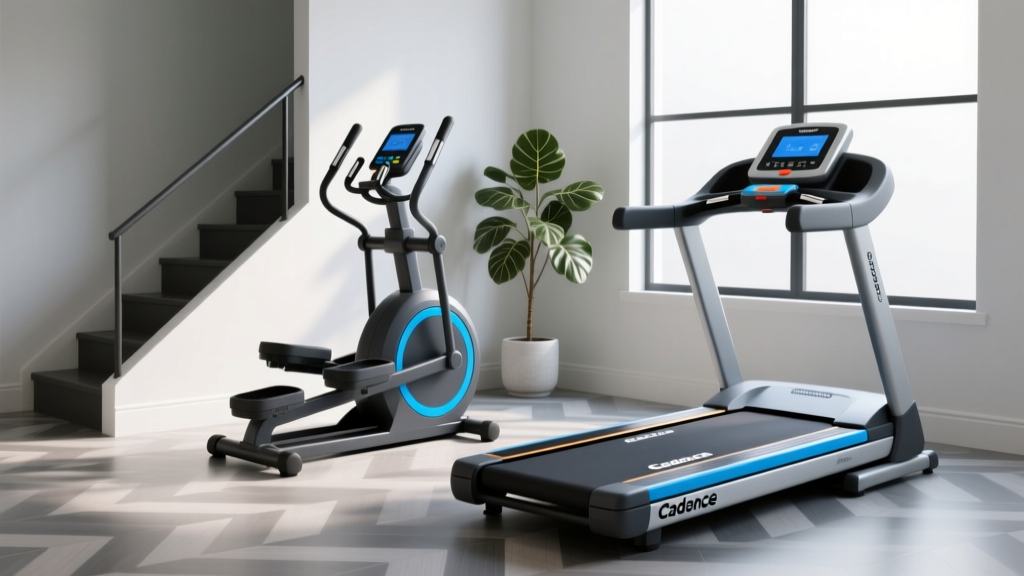
Air Bike vs Assault Bike: How to Burn 500 Calories on Treadmill in 30 Minutes
Compare Air Bike vs Assault Bike footprints for small home gyms, and learn space-saving layouts to burn 500 calories on a treadmill in 30 minutes.

The 2026 Home Gym Spatial Dilemma: Vertical vs. Horizontal Footprints
Designing a high-performance home gym in 2026 requires a ruthless approach to spatial geometry. Every square foot of floor space must justify its existence through caloric ROI and functional versatility. When mapping out your cardio zone, you are ultimately forced to choose between two distinct spatial philosophies: the compact, vertical footprint of an air bike/assault bike, or the sprawling, horizontal footprint of a treadmill. This guide breaks down the exact dimensional realities of the air bike versus assault bike comparison, providing precise layout frameworks for tight spaces. Furthermore, for those who do allocate the requisite 21-square-foot rectangle for a treadmill, we detail exactly how to maximize that spatial investment with a high-yield metabolic protocol.
Quick Space Metric Summary:- Air Bike Footprint: ~10.5 sq. ft. (Requires 24-inch lateral clearance for arm levers)
- Treadmill Footprint: ~21.0 sq. ft. (Requires 36-inch rear clearance for safety egress)
- Ceiling Height Minimum: 84 inches for bikes; 96+ inches for treadmills (accounting for deck height + user)
Air Bike vs. Assault Bike: The Dimensional Showdown
The terms 'air bike' and 'assault bike' are often used interchangeably, but from a spatial and layout perspective, the engineering differences between the top models dictate how they fit into your room. The primary spatial differentiator is the drive system (belt vs. chain) and the console height, which affects sightlines and overhead clearance in low-ceiling basements or attic gyms.
Rogue Echo vs. AssaultBike ProX vs. Schwinn AD7
To optimize your layout, you must look beyond the manufacturer's base dimensions and calculate the operational clearance. Moving parts, user ergonomics, and heat dissipation require buffer zones.
| Model (2026 Pricing) | Base Dimensions (L x W x H) | Drive System | Required Operational Zone |
|---|---|---|---|
| Rogue Echo Bike (~$895) | 52' x 29' x 93' | Belt (Quiet, low maintenance) | 6' x 5' (High console requires overhead clearance) |
| AssaultBike ProX (~$1,199) | 51' x 27' x 69' | Chain (Tactile, requires lubrication) | 6' x 4.5' (Lower profile fits under standard 8ft ceilings easily) |
| Schwinn Airdyne AD7 (~$1,099) | 50' x 28' x 68' | Belt (Single-stage, smooth) | 5.5' x 4.5' (Compact base, ideal for tight corner wedges) |
According to the Rogue Fitness official specifications, the Echo Bike's belt-drive system not only reduces acoustic feedback by up to 15 decibels compared to chain drives but also eliminates the need for lateral clearance during chain-guard maintenance. If your layout places the bike flush against a wall, the belt-driven Rogue or Schwinn models are vastly superior to the chain-driven AssaultBike, which requires periodic lateral access for chain tensioning and lubrication.
Layout Frameworks: Integrating Bikes into Tight Zones
Placing an air bike in the center of a room is a waste of premium square footage. To optimize your home gym layout in 2026, utilize these spatial integration tactics:
- The 45-Degree Corner Wedge: Instead of placing the bike parallel to a wall, angle it at 45 degrees into a corner. This creates a natural 'cockpit' feel, allows the fan to draw air from two distinct room zones (improving cooling), and reclaims the dead space directly behind the console for a small dumbbell rack or kettlebell storage.
- Sub-Floor Vibration Isolation: Air bikes generate immense downward force during standing sprints. Do not rely on thin PVC mats. Use a 4x6 foot, 3/4-inch thick vulcanized rubber horse stall mat. This protects your floor joists and prevents the bike's leveling feet from creeping across hardwood or laminate surfaces during high-RPM intervals.
- Visual Sightline Management: Because the Rogue Echo stands at a towering 93 inches, placing it directly in front of a window blocks natural light. Position the bike so the console faces the window, allowing the lower profile of the fan cage to sit below the window sill.
The Treadmill Pivot: Maximizing a 21-Square-Foot Footprint
If your spatial audit reveals that you have a dedicated 7x3 foot rectangle with adequate ceiling height (minimum 96 inches to account for a 12-inch deck incline plus a 6-foot user), a treadmill becomes a viable anchor. However, a treadmill demands a higher caloric yield to justify its massive footprint compared to a compact air bike. You cannot simply walk at 3.0 mph on a flat deck and expect optimal spatial ROI. You must leverage high-intensity incline protocols.
How to Burn 500 Calories on Treadmill in 30 Minutes
Burning 500 calories in a mere 30 minutes requires an average expenditure of 16.6 calories per minute. According to Harvard Health Publishing, vigorous stationary biking or running at a 10-minute mile pace yields roughly 13 to 16 calories per minute for a 185-pound individual. To guarantee a 500-calorie burn on a treadmill within this tight timeframe, you must combine steep inclines with interval sprinting to trigger EPOC (Excess Post-exercise Oxygen Consumption).
The Spatial-Efficient 30-Minute Incline HIIT Protocol:
- Minutes 0-5 (Calibration Warmup): Set incline to 5%. Walk at 3.5 mph. Focus on dynamic hip extension. (Estimated burn: 40 calories)
Minutes 5-25 (The 1:1 Incline/Sprint Matrix): Alternate 60-second blocks for 20 minutes total. - Sprint Phase (60s): Incline 6%, Speed 8.0 - 9.0 mph (depending on fitness level). This horizontal power output spikes heart rate to 85-90% of max.
- Active Recovery (60s): Incline 15%, Speed 2.8 mph. Do not hold the handrails. The extreme incline at a walking pace maintains a high caloric burn (approx. 14 cal/min) while clearing lactic acid.
- Minutes 25-30 (Cooldown & Flush): Drop incline to 0%, speed to 2.5 mph. Allow heart rate to descend below 110 BPM before stepping off the deck. (Estimated burn: 80 calories)
When executing high-speed sprints on a treadmill, spatial planning extends beyond the machine's physical dimensions. You must maintain a minimum 36-inch clear zone directly behind the treadmill. In the event of a stumble during an 8.5 mph sprint, this egress zone prevents you from impacting a wall, squat rack, or heavy dumbbell station. Never wedge the rear of a treadmill against a wall or glass door.
Failure Modes & Edge Cases in Spatial Planning
Even the most meticulously planned home gym layouts fail when environmental edge cases are ignored. When deciding between an air bike and a treadmill, evaluate these hidden spatial constraints:
- HVAC & Airflow Starvation: Air bikes rely on a massive front-mounted fan that displaces hundreds of cubic feet of air per minute. If you place an air bike in a tight alcove or closet gym without dedicated cross-ventilation, the ambient temperature will rise by 5-8 degrees within 15 minutes, severely degrading your performance. Treadmills, conversely, do not alter room air pressure but require overhead ceiling fan clearance.
- Acoustic Resonance in Multi-Story Homes: The AssaultBike ProX utilizes a heavy-duty chain drive that produces a distinct metallic clatter under high torque. If your gym is on a second floor above a living space, the acoustic resonance will transfer through the floor joists. In these scenarios, the belt-driven Rogue Echo or a treadmill with a specialized dampening deck (like the NordicTrack Commercial series) are mandatory spatial choices.
Expert Layout Insight: 'Never measure your space based on the machine at rest. Measure your space based on the machine in motion, plus the user's biomechanical envelope. An air bike's arm levers extend 18 inches forward and backward during full-ROM sprints. If your wall clearance is exactly the length of the bike's base, your knuckles will strike the drywall on the first interval.' — Home Gym Engineering Principles, 2026
Final Verdict: Choosing Your Primary Cardio Anchor
The decision between an air bike and a treadmill ultimately comes down to your spatial budget and your metabolic goals. If your home gym is constrained to under 150 square feet, or if you are retrofitting a low-ceiling basement, the AssaultBike ProX or Rogue Echo Bike offers an unbeatable caloric ROI per square inch. Their vertical orientation and zero-impact mechanics allow for daily high-intensity usage without destroying your joints or your floor plan.
However, if you possess the luxury of a dedicated 7x10 foot cardio zone with 9-foot ceilings, a high-incline treadmill becomes a superior tool for specific endurance adaptations. By applying the 30-minute incline HIIT protocol outlined above, you can easily burn 500 calories on a treadmill in 30 minutes, transforming a massive piece of equipment into a highly efficient metabolic engine. Map your space, respect the clearance zones, and let the geometry of your room dictate your cardio arsenal.
More gear to consider
All reviews
Cardio Machine Noise Comparison: Speed Training on Treadmill at Home
Feier Star 100 Folding Treadmill Belt Maintenance Guide

Bowflex Treadmill 10 Reviews vs Stationary Bikes: Budget Guide
Curved vs Motorized Treadmills for a Treadmill and Abs Workout

Tunturi Treadmill vs Walking Pad: A Beginner's Guide