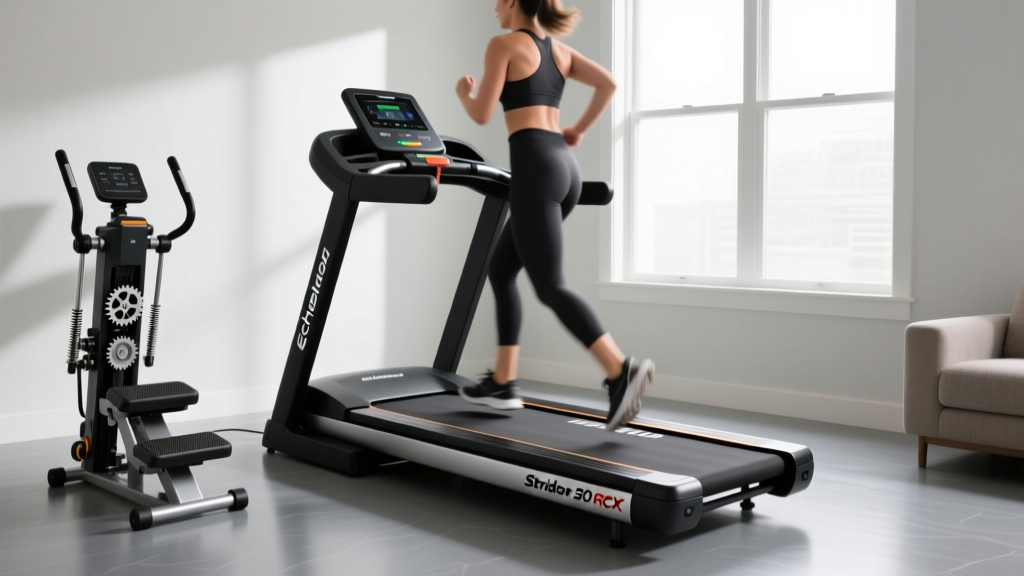
Curved vs Motorized Setup & ProForm Crosswalk Treadmill Reviews
Compare curved vs motorized treadmill setups. Read our spatial guide, assembly tips, and ProForm Crosswalk treadmill reviews for your home gym.

The Spatial Footprint: Measuring Your Floor Plan
Setting up a dedicated cardio zone requires more than just plugging in a machine and pressing start. The debate between curved manual treadmills and traditional motorized models often centers on biomechanics and joint impact, but the physical installation, spatial clearance, and assembly requirements are equally critical for home gym owners. When analyzing hundreds of ProForm Crosswalk treadmill reviews, we consistently find that users underestimate the unique spatial demands of hybrid motorized machines compared to the heavy, self-powered footprint of curved runners.
Before unboxing, you must map your floor plan. According to safety guidelines highlighted by the Consumer Reports Treadmill Buying Guide, motorized treadmills require a strict rear clearance zone to prevent severe friction burns or entrapment in the event of a fall. Curved manual treadmills, lacking a motorized belt that continues moving after a user falls, have different clearance dynamics but demand rigorous lateral space due to their wide, bowed frames.
| Specification | Curved Manual (e.g., TrueForm Runner) | Motorized Hybrid (e.g., ProForm Crosswalk 5.0) |
|---|---|---|
| Machine Footprint (L x W) | 70' x 32' | 76' x 30' |
| Rear Safety Clearance | 12' (Non-motorized belt) | 24' - 36' (Mandatory safety zone) |
| Lateral Clearance | 24' (Wide curved stance) | 18' (Extra space for moving resistance arms) |
| Ceiling Height Requirement | 8' 6' (User elevated on curve) | 8' 0' (Standard deck height) |
| Power Requirement | None (100% Human-powered) | 120V Dedicated 15-Amp Circuit |
Unboxing and Assembly: A Tale of Two Machines
The physical build of these two machine categories dictates entirely different assembly workflows. While a curved treadmill is essentially a heavy, pre-welded steel chassis, a motorized unit like the ProForm Crosswalk requires complex electronic routing and moving part attachment.
Phase 1: Curved Manual Treadmill Assembly
Curved treadmills (like the AssaultRunner Elite or TrueForm) arrive mostly pre-assembled. The primary challenge is sheer weight—often exceeding 280 lbs—and belt tensioning.
- Positioning the Chassis: Do not attempt to lift the front end alone. Use a two-person pivot technique to roll the treadmill on its rear transport wheels into position.
- Leveling the Deck: Curved belts rely on gravity and precise slat alignment. Use a 24-inch carpenter's level across the mid-section. Adjust the four corner leveling feet using a 17mm wrench until the bubble is perfectly centered. An unlevel curved treadmill will cause the slat belt to drift laterally during sprints.
- Slat Belt Tensioning: Unlike motorized belts, slat belts use a rear-tensioning system. Insert the provided 6mm hex key into the rear roller bolts. Turn both sides exactly one full clockwise rotation. Test by walking; if the belt slips underfoot, add a quarter-turn to both sides. Never overtighten, as this destroys the sealed bearings.
Phase 2: Motorized Treadmill Assembly (Crosswalk Series Focus)
Motorized treadmills require a methodical approach to protect internal wiring. Based on common ProForm Crosswalk treadmill reviews, the most frequent assembly error involves pinching the console data cable during the upright pivot.
- The Deck Pivot: With the box laid flat, remove the shipping bolts securing the deck. With one person supporting the weight, slowly lower the deck to the floor. Warning: The deck is heavily weighted toward the front motor housing.
- Upright Installation: Attach the left and right uprights using the pre-installed 17mm pivot bolts. Before fully tightening, route the blue data cable through the center channel. Ensure the cable sits inside the plastic protective sleeve to prevent the metal frame from shearing the wires when tightened.
- Attaching the Crosswalk Arms: This is unique to the Crosswalk series. The upper-body resistance arms attach to the main console mast via tension knobs and pivot pins. Apply a thin layer of white lithium grease to the pivot pins before insertion to eliminate the squeaking that plagues older models after 50+ miles of use.
Calibration, Tensioning, and Safety Protocols
Once assembled, the calibration process diverges sharply based on the machine's propulsion method. Proper calibration ensures the machine matches the biomechanical expectations outlined in standard ExRx Treadmill Testing Protocols.
Motorized Incline and Speed Calibration
For motorized units like the ProForm Crosswalk, you must enter the engineering diagnostic mode to calibrate the incline motor.
- Remove the safety key.
- Press and hold the 'Incline Up' and 'Speed Up' buttons simultaneously while reinserting the safety key.
- The machine will automatically cycle from 0% to 15% incline to set the internal potentiometer limits. Do not step on the belt during this process.
- Lubricate the motorized deck with 100% pure silicone treadmill lubricant (approx. 15ml) under the center of the belt before the first use to prevent immediate friction board wear.
Curved Treadmill Resistance and Alignment Check
Curved machines have no incline motor or electronic speed sensors to calibrate. Instead, calibration is purely mechanical. Walk at a moderate pace for 3 minutes. If the slat belt tracks to the left, tighten the right-side rear tension bolt by 1/8th of a turn. The goal is a 'dead-center' tracking that requires zero lateral correction from your stride.
Real-World Insights from ProForm Crosswalk Treadmill Reviews
Why do so many home gym owners pivot from standard motorized models to hybrid or manual setups? When synthesizing data from extensive ProForm Crosswalk treadmill reviews, a clear pattern emerges regarding the integration of upper-body ergometry into a walking routine.
'The Crosswalk arms are fantastic for low-intensity walking and active recovery, adding about 15% to my overall caloric burn. However, the assembly of the tension knobs was frustrating, and the lateral swing of the arms means I had to move my treadmill 10 inches further away from the wall than my old standard model.' — Verified Home Gym Owner, 2025 Forum Analysis
This feedback highlights a critical installation truth: hybrid motorized treadmills require a wider operational envelope. If your home gym is situated in a narrow hallway or a tight corner, the moving resistance arms of a Crosswalk model will strike drywall or adjacent equipment. In these constrained environments, a curved manual treadmill—despite its longer front-to-back footprint—often integrates better into narrow rooms because the user's arms swing naturally within the machine's existing 32-inch width.
Final Decision Framework: Which Setup Fits Your Space?
Use this checklist to finalize your installation strategy based on your specific room constraints and fitness goals.
Choose a Curved Manual Treadmill Setup If:
- Your room lacks a dedicated 15-amp electrical circuit.
- You prioritize high-intensity interval training (HIIT) and sprint mechanics over steady-state walking.
- Your room is narrow but long, allowing for the 70-inch length but restricting lateral arm swing.
- You want zero ongoing maintenance regarding electronic motor brushes or incline gear lubrication.
Choose a Motorized Hybrid (ProForm Crosswalk) Setup If:
- You have a wide, open floor plan with at least 36 inches of rear clearance and 20 inches of lateral clearance on both sides.
- Your primary use case is steady-state walking, light jogging, or physical rehabilitation requiring upper-body engagement.
- You require preset programming, heart-rate monitoring, and automatic incline adjustments that manual curved belts cannot provide.
- You are comfortable performing bi-annual deck lubrication and belt tensioning adjustments.
Ultimately, whether you are wrestling a 300-pound curved chassis into place or carefully routing data cables on a motorized Crosswalk, respecting the spatial and electrical requirements during setup is the foundation of a safe, long-lasting home cardio station.
More gear to consider
All reviews
How Fast Is 6.5 On A Treadmill? Curved vs Motorized Guide
Schwinn 810 Treadmill Review: Belt Maintenance Guide

Best Folding Treadmills for Small Spaces: Get Yours in Payments

Elliptical vs Treadmill: Home Cardio & Water Treadmill Dog Rehab
Best Equip By Workout For Gear: Matching Cardio Equipment to Your Fitness Goals