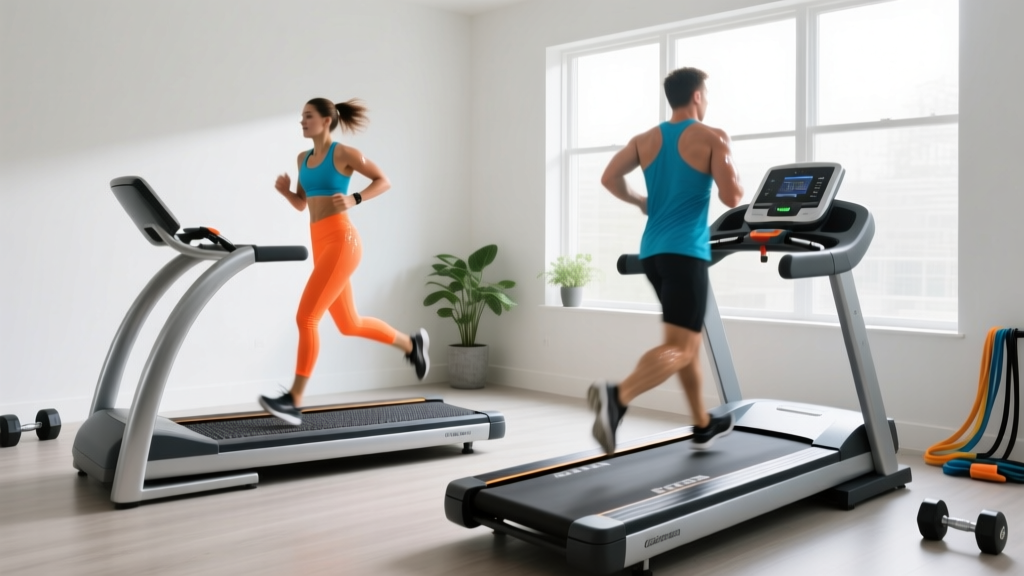
Curved vs Motorized: Beginner Guide to Fitness on Treadmill Setups
Discover the best setup for your fitness on treadmill routines. We compare curved manual vs motorized treadmills with a beginner step-by-step guide.

Introduction: Choosing Your Cardio Foundation
When mapping out your long-term fitness on treadmill journey, the first major equipment decision you will face is choosing between a traditional motorized treadmill and a modern curved manual treadmill. Both machines elevate your heart rate and build cardiovascular endurance, but they achieve this through fundamentally different biomechanical mechanisms. For beginners, this choice dictates not only your daily workout experience but also your long-term maintenance costs, space requirements, and injury prevention strategies.
This step-by-step guide will walk you through the exact specifications, real-world costs, and biomechanical realities of both machines in 2026, ensuring you select the perfect equipment for your home gym.
Beginner Tip: Do not base your decision solely on price. A cheaper motorized treadmill with a weak 2.0 HP motor will burn out within a year of regular use, whereas a premium manual treadmill requires zero electrical components and can last a decade with basic waxing.Step 1: Understand the Biomechanical Differences
Before looking at price tags, you must understand how your body interacts with the belt.
The Motorized Treadmill (The 'Pulled' Stride)
On a motorized treadmill, an electric motor turns the front roller, which pulls the belt beneath your feet. Your primary physical job is to pick your feet up and keep pace with the moving surface. Because the belt pulls your leg backward, it slightly reduces the activation of your hamstrings and glutes compared to outdoor running. Motorized decks are typically flat and feature elastomer cushioning to absorb ground reaction forces, which is highly beneficial for beginners recovering from joint issues.
The Curved Manual Treadmill (The 'Pushed' Stride)
Curved treadmills have no motor. You are the engine. The concave, curved shape relies on gravity and friction; as you strike the front slope of the curve, your body weight pulls the slat belt downward and backward. According to biomechanical analyses referenced by the Hospital for Special Surgery, this self-propelled mechanism forces a midfoot or forefoot strike and significantly increases the recruitment of your posterior chain (glutes, hamstrings, and calves). Studies show curved treadmills can increase caloric expenditure by up to 30% at the exact same perceived exertion level.
Step 2: Compare 2026 Market Leaders and Costs
To make an informed decision, you need to look at actual market data. Below is a comparison of the most reliable entry-to-mid-level models available for home use this year.
| Model | Type | 2026 Price | Drive / Motor | Footprint (L x W) | Max User Weight |
|---|---|---|---|---|---|
| Sole F80 | Motorized | $1,199 | 3.5 CHP | 82' x 33' | 375 lbs |
| NordicTrack 1750 | Motorized | $1,999 | 3.5 CHP | 80' x 38' | 300 lbs |
| AssaultRunner Elite | Curved Manual | $3,299 | Self-Powered Slat | 69' x 33' | 350 lbs |
| TrueForm Runner | Curved Manual | $3,495 | Self-Powered Slat | 71' x 34' | 400 lbs |
The Cost Reality: Motorized treadmills offer a lower barrier to entry and include digital inclines, screens, and automated pacing. However, they carry hidden long-term costs: electricity consumption, control board replacements ($200-$400), and motor brushes. Curved treadmills demand a high upfront investment but have virtually zero electronic failure points.
Step 3: Match the Machine to Your Training Zones
Your specific fitness goals should dictate your purchase. The American Heart Association emphasizes the importance of training in specific heart rate zones for optimal cardiovascular health. Here is how each machine handles different zones:
- Zone 2 (Steady-State Endurance): If your goal is long, 60-minute marathon prep runs at a steady 9:00/mile pace, a motorized treadmill is superior. The motor enforces your pace, allowing you to zone out, watch a screen, and maintain exact splits without mental fatigue.
- Zone 4 & 5 (HIIT and Sprints): If you want to do Tabata sprints or 30-second all-out intervals, a curved treadmill is the undisputed king. On a motorized machine, you have to wait 5-10 seconds for the belt to spool up to 12 MPH. On a curved machine, you hit max speed in a single stride, and you can stop instantly by simply slowing your legs and moving to the rear rails.
- Walking and Active Recovery: Beginners focusing purely on daily walking (10,000 steps) will find motorized treadmills much more comfortable. Walking on a curved manual treadmill requires an awkward leaning posture to generate enough friction to pull the heavy slat belt, which can cause lower back strain during prolonged low-speed walks.
Step 4: Evaluate Space, Power, and Maintenance Realities
Before clicking 'buy', you must audit your physical space and willingness to perform maintenance.
Electrical and Spatial Requirements
Motorized treadmills require a dedicated 15-amp or 20-amp electrical circuit. Plugging a 3.5 CHP treadmill into a shared circuit with a vacuum or space heater will trip your breaker and potentially fry the machine's lower control board. Furthermore, motorized decks are long (often over 80 inches) to accommodate the motor housing and extended belt return.
Curved treadmills require zero electricity, giving you total freedom to place them in a garage, basement, or even a covered patio. Their footprint is significantly shorter (around 69 inches) because there is no front motor hood.
The Maintenance Schedule
Crucial Maintenance Warning: The number one reason motorized treadmills fail is belt friction. You MUST apply 100% silicone treadmill lubricant under the belt every 150 miles or every 3 months. Failure to do so will cause the motor to overheat and draw excessive amperage, leading to a catastrophic motor failure that voids most warranties.Curved treadmills bypass deck lubrication but require slat belt waxing. The rubber slats glide on a series of plastic guide wheels. Every 6 months, you must apply specialized treadmill wax to the wheels to prevent the rubber slats from stretching and snapping. Additionally, curved treadmill bearings require occasional inspection for dust buildup, especially if kept in a garage.
Step 5: The Final Decision Matrix
Use this quick checklist to finalize your choice based on your beginner profile:
- Choose a Motorized Treadmill if: You are primarily a walker or a steady-state jogger, you have a budget under $2,000, you want automated incline training, and you prefer a softer, cushioned deck to protect your knees and shins.
- Choose a Curved Manual Treadmill if: You are focused on High-Intensity Interval Training (HIIT), sprint mechanics, and CrossFit-style conditioning. You have a budget over $3,000, you want to eliminate electrical fire hazards, and you have a shorter room length.
Frequently Asked Questions
Are curved treadmills bad for beginners' knees?
Not inherently, but they do alter your biomechanics. Because curved treadmills encourage a forefoot strike and lack the shock-absorbing elastomer cushions of motorized decks, the impact is absorbed by your Achilles tendon and calf muscles rather than your knee joints. If you have a history of Achilles tendinopathy or plantar fasciitis, start with a motorized treadmill. The Mayo Clinic recommends gradually transitioning to minimalist or curved running surfaces to allow connective tissues to adapt over several months.
Can I use a curved treadmill if I only want to walk?
You can, but it is not recommended for beginners. Pushing the heavy slat belt at speeds below 3.0 MPH requires you to lean heavily forward, placing unnatural stress on the lumbar spine. If walking is your primary goal, a high-quality motorized treadmill or an under-desk walking pad is a vastly superior and more ergonomic choice.
Do curved treadmills require a special floor mat?
Yes. Because curved treadmills are incredibly heavy (the AssaultRunner Elite weighs 280 lbs) and lack a wide motorized base, all that downward force is concentrated on four small rubber feet. You must use a high-density, 3/8-inch thick equipment mat to prevent permanent indentations in hardwood floors or luxury vinyl plank (LVP) flooring.
More gear to consider
All reviews
Escaping Treadmill Slavery: Stair Climber vs Treadmill 2026 Guide
Curved Manual vs C70 Treadmill: Common Mistakes & Fixes

ProForm Crosswalk 370e Treadmill vs 2026 Under Desk Office Trends

Recumbent Bike vs Treadmill Upkeep: Air vs Assault Bike Care

Yesoul T1M Plus Treadmill & Air vs Assault Bike Space Guide
