
Curved vs Motorized Treadmill: Upkeep & How to Fix Treadmill Belts
Compare curved manual vs motorized treadmills. We break down maintenance costs, durability, and exactly how to fix treadmill belt slippage on both types.

The Core Mechanical Divide: Slats vs. Continuous Loop
When outfitting a home gym in 2026, the debate between curved manual treadmills and traditional motorized treadmills extends far beyond workout biomechanics. It heavily impacts long-term maintenance, repair complexity, and overall cost of ownership. While motorized models like the Sole F80 or NordicTrack 1750 rely on a continuous PVC or urethane loop driven by a high-torque motor, curved manual treadmills like the TrueForm Runner or AssaultRunner Elite utilize a track system composed of dozens of individual vulcanized rubber slats. Understanding this mechanical divide is critical, especially when you need to know how to fix treadmill belt issues, as the troubleshooting steps for each architecture are entirely different.
According to the American Council on Exercise (ACE), curved treadmills can increase caloric expenditure by up to 30% compared to motorized counterparts due to the lack of motor assistance and the biomechanical demand of propelling the belt. However, this self-propelled design also introduces unique wear patterns on the slat bearings and track rails that motorized decks simply do not experience.
Head-to-Head Comparison Matrix (2026 Market)
Before diving into repair protocols, it is essential to understand how the leading models in both categories compare regarding belt maintenance and component lifespans.
| Feature | Motorized (e.g., Sole F80) | Curved Manual (e.g., TrueForm Runner) |
|---|---|---|
| Belt Material | Multi-ply PVC with cotton/polyester backing | Individual vulcanized rubber or TPU slats |
| Lubrication Required | Yes (100% Silicone liquid/gel) | No (Dry track and sealed bearings) |
| Tension Adjustment | Rear roller hex bolts (Left/Right) | Rear axle threaded tension rods |
| Common Failure Mode | Belt stretching, deck friction burn, fraying | Slat cracking, bearing seizure, track misalignment |
| Average Repair Cost | $150 - $300 (Full belt replacement) | $15 - $30 (Per individual slat replacement) |
| Expected Belt Lifespan | 5 to 8 years (with proper lubrication) | 10+ years (with individual slat swaps) |
Motorized Treadmills: Wear, Tear, and Tension
Motorized treadmill belts fail primarily due to friction and stretching. The continuous rubbing of the PVC belt against the wooden or MDF deck generates immense heat. If the belt is not lubricated with 100% silicone every 150 miles or 3 months, the deck will develop 'burn spots,' increasing the electrical draw on the motor and eventually causing the belt to slip or snap. Furthermore, as the belt stretches over time, it loses grip on the front and rear rollers, leading to the dreaded 'stuttering' sensation during a run.
How to Fix Treadmill Belt Slippage on Motorized Models
Learning how to fix treadmill belt slippage is a rite of passage for motorized owners. If your belt hesitates when your foot strikes it, follow this precise calibration protocol:
- Power Down and Secure: Unplug the machine entirely. Never attempt tension adjustments while the motor is live.
- Locate the Rear Roller Bolts: Find the two hex bolts at the very back of the treadmill, on the left and right side caps. These typically require a 5mm or 6mm Allen wrench.
- Measure the Gap: Check the distance between the rear roller and the side cap. It should be equal on both sides to prevent the belt from tracking off-center.
- Apply Quarter-Turn Adjustments: Turn both the left and right bolts exactly one-quarter (1/4) turn clockwise. Never overtighten, as this can strip the bolt threads or destroy the roller bearings.
- Test and Re-Calibrate: Plug the machine in, set it to 3.0 MPH, and walk on it. If slippage persists, unplug and repeat the 1/4 turn process. If the belt drifts to the left, turn the left bolt 1/4 turn clockwise to push it back to center.
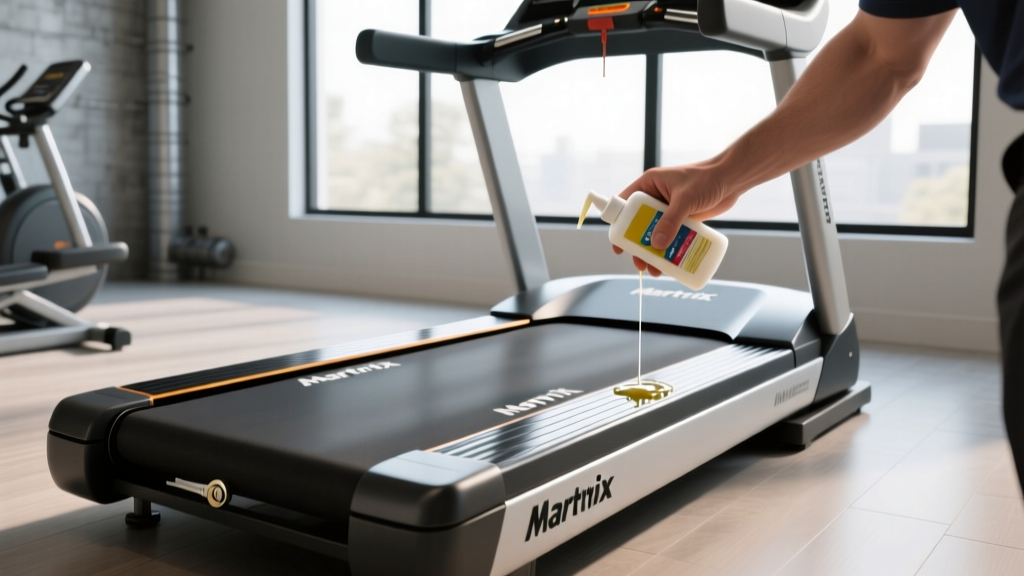
- Lubricate: Once tension is correct, lift the belt edge and apply 1 ounce of 100% pure silicone treadmill lubricant in a zig-zag pattern across the deck.
Curved Manual Treadmills: Slat Track Maintenance
Curved treadmills eliminate the motor, the deck, and the need for liquid silicone lubrication. Instead, they rely on a series of 40 to 60 individual rubber slats attached to a reinforced drive belt that rides on polyurethane wheels or bearings. Because there is no motorized friction, the primary failure points are physical impact damage (dropping heavy dumbbells on the slats) and the gradual loosening of the rear axle tension rods due to the immense repetitive force of human propulsion.
How to Fix Treadmill Belt Tension on Curved Models
When a curved treadmill belt feels 'loose' or you hear a clacking sound as the slats hit the lower track guides, the overall track tension needs adjustment. Here is how to fix treadmill belt tension on a curved manual model:
- Access the Rear Axle: Depending on the brand (e.g., TrueForm or Assault), you may need to remove a plastic shroud at the rear of the machine using a Phillips or Torx screwdriver to expose the tensioning rods.
- Identify the Tension Nuts: You will see a threaded rod on both the left and right sides connecting the rear axle to the frame. These are secured with locking nuts (usually 13mm or 15mm).
- Loosen the Locking Nuts: Use a wrench to loosen the locking nut so you can turn the inner tensioning nut.
- Adjust Evenly: Turn the inner tensioning nuts clockwise by exactly one full rotation on both sides simultaneously. Uneven tension will cause the entire slat track to bind or derail from the guide wheels.
- Check the Deflection: Press down on the top of the curved track. There should be roughly 1/2 inch to 3/4 inch of vertical deflection. If it is drum-tight, you risk snapping the internal Kevlar drive belt.
- Secure and Test: Tighten the locking nuts back against the frame, replace the shroud, and test the machine with a light jog to ensure the slats track smoothly without lateral wobble.
One of the greatest financial advantages of curved treadmills is modular repair. If a single rubber slat cracks or tears, you do not need to buy a $250 replacement belt. You simply unbolt the damaged slat (usually 4 hex screws), order a single replacement slat from the manufacturer for about $20, and bolt it into place in under five minutes.
Troubleshooting Edge Cases and Failure Modes
While standard tensioning resolves 90% of belt issues, home gym owners must be aware of edge cases that require more invasive repairs.
- Motorized Belt Fraying: If the edges of your motorized belt are fraying and leaving black dust on your floor, the belt is misaligned and rubbing against the side motor housing or foot rails. Tensioning will not fix this; you must re-center the belt and potentially trim the frayed edges with heavy-duty shears to prevent it from catching under the motor hood.
- Curved Track Bearing Seizure: If your curved treadmill squeaks rhythmically and the belt feels 'sticky' at a specific point in the rotation, a slat bearing or guide wheel has seized. You must rotate the belt by hand to find the stiff wheel, pop it out of its housing, and replace it with a standard 608zz or 6200zz skate bearing (available at any hardware store for under $3).
- Motorized Deck Grooving: If you have fixed the tension and lubricated the belt, but you still feel a 'bumpy' or stuttering sensation, run your hand under the belt (while unplugged). If you feel deep grooves carved into the wooden deck, the deck is ruined. A new belt will be destroyed within weeks on a grooved deck. You must flip the deck (if reversible) or order a replacement MDF deck board.
Long-Term Cost of Ownership: Which Wins?
When evaluating the total cost of ownership over a 10-year period, the maintenance profiles of these two machines diverge sharply. Consumer Reports frequently notes that motorized treadmills are among the most commonly repaired home fitness appliances, largely due to motor burnout and deck friction.
5-Year Maintenance Cost Estimate
Motorized Treadmill (e.g., Sole F80 - $1,199 MSRP):
Quarterly Silicone Lubricant: $60
1x Replacement Belt & Deck Kit (Year 4): $220
Professional Calibration/Tune-up: $150
Total 5-Year Upkeep: ~$430
Curved Manual Treadmill (e.g., TrueForm Runner - $3,499 MSRP):
Lubrication: $0
Replacement Slats (Est. 3 slats over 5 years): $60
Bearing Replacements: $25
Total 5-Year Upkeep: ~$85
The Final Verdict for Your Home Gym
If your priority is minimizing mechanical upkeep and you possess basic DIY skills, the curved manual treadmill is the undisputed champion of longevity. The modular slat design means you will never face the daunting task of threading a massive, heavy continuous belt over a deck and motor housing. You simply swap out individual components as they wear.
However, if you require incline capabilities, integrated interactive programming (like iFIT or JRNY), and a lower upfront entry price, a high-quality motorized treadmill remains the standard. Just commit to a strict 90-day lubrication schedule and familiarize yourself with the rear roller tension bolts. Knowing exactly how to fix treadmill belt slippage and tracking issues will save you hundreds of dollars in technician call-out fees and keep your 2026 fitness goals firmly on track.
More gear to consider
All reviews
Curved vs Motorized Treadmill: Beyond Treadmill Pronunciation

Elliptical vs Treadmill: Home Cardio & Water Treadmill Dog Rehab
Cardio Machine Noise Comparison: Treadmill Pace Converter Impacts
WalkingPad R2 Treadmill Setup & Cardio Noise Comparison
Matrix Treadmill How to Use and Maintain: Belt Lubrication Guide
