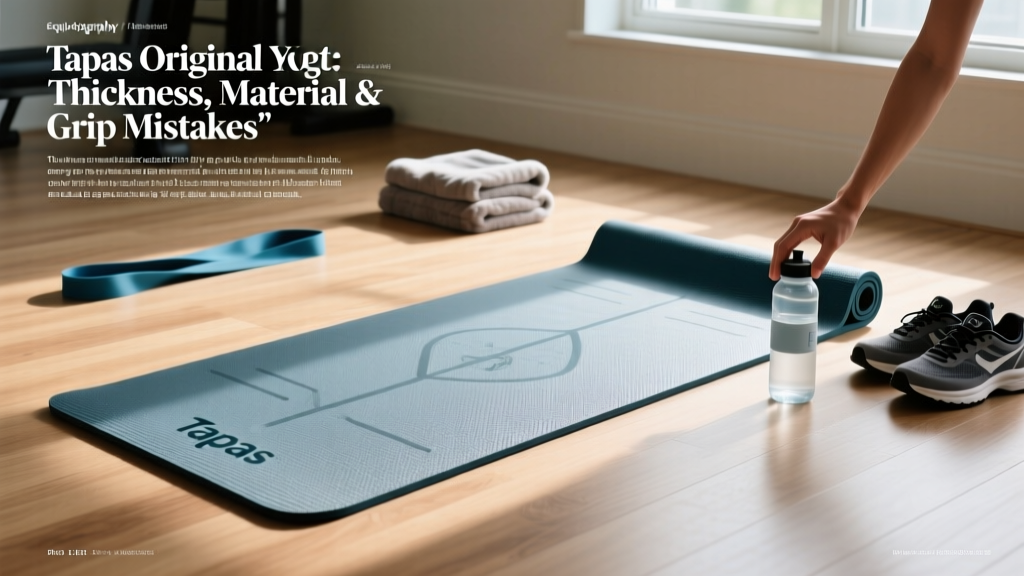
Tapas Original Yoga Mat: Thickness, Material & Grip Mistakes
Troubleshoot common Tapas Original yoga mat mistakes. Compare its 3mm PVC thickness, dry grip, and material limits against top market standards.

The Tapas Original yoga mat by Hugger Mugger has maintained a cult following for over two decades. Priced accessibly at around $34.95 in 2026, it is widely considered the gold standard for budget-friendly, no-nonsense studio mats. However, its specific construction—a 1/8-inch (3mm) closed-cell PVC build—creates a unique set of physical limitations. Many practitioners purchase the Tapas Original based on its legendary 'sticky' reputation, only to encounter severe traction failure, joint discomfort, or material degradation because they misunderstand its core engineering.
This troubleshooting guide dissects the most common mistakes users make regarding the Tapas Original yoga mat's thickness, material composition, and grip mechanics. By comparing these metrics against modern market standards, you can determine if this mat aligns with your biomechanical needs or if it is time to pivot to a different material profile.
The 3mm Thickness Trap: Joint Support Mistakes
The most frequent complaint from new Tapas Original users is knee and wrist pain during weight-bearing poses. The mat features a uniform 1/8-inch (3mm) thickness. While this provides excellent stability for standing balances like Warrior III or Half Moon, it is fundamentally inadequate for high-compression postures.
Biomechanical Insight: According to the American Council on Exercise (ACE), kneeling poses and wrist-heavy inversions can generate localized joint pressure exceeding 3.5 times your body weight. A 3mm closed-cell PVC mat will completely 'bottom out' (compress to the hard floor) under as little as 120 lbs of focused load, offering zero residual shock absorption.
Troubleshooting Joint Pain on the Tapas Original
If you are experiencing patellar (knee) or carpal (wrist) pain, do not assume your alignment is the sole culprit. The mat's compression threshold is likely the primary failure point.
- The Layering Fix: For restorative sequences or poses like Camel (Ustrasana) and Cat-Cow, fold a high-density woven yoga blanket and place it beneath the Tapas mat. This preserves the PVC's dry grip on the floor while adding 5mm-8mm of compressible joint support.
- The Threshold Rule: If you weigh over 160 lbs, the 3mm Tapas Original will compress fully during low lunge (Anjaneyasana). You must use a localized foam wedge or folded towel under the back knee to prevent bruising.
Material Misconceptions: Closed-Cell PVC vs. Sweat
The Tapas Original is constructed from latex-free, closed-cell Polyvinyl Chloride (PVC). 'Closed-cell' means the material is non-porous; it does not absorb moisture. This is a massive advantage for hygiene and easy cleaning, but it creates a catastrophic failure mode in high-heat environments.
The Hot Yoga Traction Failure
A common and dangerous mistake is using the Tapas Original for Bikram or heated Vinyasa flow without a microfiber towel. Because the PVC cannot absorb sweat, moisture pools on the surface. The mat's famous 'tackiness' is instantly neutralized by a microscopic layer of water, turning the surface into an ice rink during Downward-Facing Dog.
The Fix: If you practice in rooms heated above 80°F (26°C), you must pair the Tapas Original with a silicone-dot microfiber yoga towel (such as the Yogitoes or Shandali). Alternatively, if you sweat heavily and refuse to use a towel, you need to abandon closed-cell PVC entirely and transition to an open-cell Polyurethane (PU) or natural rubber mat, which absorbs moisture to increase friction.
Grip & Material Comparison Matrix
To understand where the Tapas Original fits in the 2026 gear landscape, we must compare its material and grip profile against premium market alternatives. Grip is not a single metric; it is divided into dry tack (initial stickiness) and wet traction (friction under sweat).
| Mat Model | Material | Thickness | Dry Grip | Wet Grip | Avg. Price (2026) |
|---|---|---|---|---|---|
| Tapas Original | Closed-Cell PVC | 3.0mm | 9/10 | 2/10 | $35 |
| Manduka PRO | Dense PVC | 6.0mm | 6/10 | 5/10 | $120 |
| Jade Harmony | Natural Rubber | 4.7mm | 8/10 | 8/10 | $85 |
| Liforme Original | PU / Natural Rubber | 4.2mm | 10/10 | 10/10 | $150 |
As highlighted in comprehensive gear tests by Yoga Journal, closed-cell PVC mats like the Tapas Original dominate the 'dry grip' category due to their manufactured surface tackiness. However, they consistently rank at the bottom for 'wet grip.' If your practice involves dynamic transitions where your hands and feet perspire, the Tapas Original will fail you unless mitigated with a towel.
Troubleshooting the 'Sticky' Surface: Cleaning Errors
Because the Tapas Original relies on surface tackiness for its grip, improper cleaning is the fastest way to ruin the mat. Many users mistakenly apply essential oil-based cleaners or harsh household degreasers to their PVC mats.
The Plasticizer Migration Problem
PVC is inherently rigid. To make the Tapas mat flexible and sticky, manufacturers add chemical plasticizers. Essential oils (like tea tree, lavender, or eucalyptus) and alcohol-based sprays act as solvents. They break down these plasticizers, causing them to leach out of the mat. The result? The mat dries out, loses its stickiness, and begins to flake or crack within months.
The Correct Troubleshooting Cleaning Protocol
To maintain the molecular integrity of the PVC surface, use only pH-neutral, oil-free solutions.
- The DIY Formula: Mix 3 parts distilled water with 1 part white vinegar and exactly one drop of oil-free dish soap (like Dawn) in a spray bottle.
- Application: Lightly mist the mat after practice. Do not soak it.
- Removal: Wipe immediately with a damp microfiber cloth, then hang to air dry away from direct UV sunlight (UV rays also accelerate PVC degradation).
Edge Cases: When to Retire Your Tapas Mat
Even with perfect care, PVC mats have a finite lifespan. Watch for these specific failure modes that indicate the mat is no longer safe for practice:
- Surface Glazing: If the mat feels smooth and glossy rather than matte and tacky, the plasticizers have fully migrated to the surface and oxidized. No amount of scrubbing will restore the original grip.
- Edge Delamination: If the edges begin to curl permanently or show micro-tears, the structural integrity of the foam-PVC blend has failed, creating a tripping hazard during transitions.
Quick Troubleshooting FAQ
Q: Can I leave the Tapas Original in my car?
A: No. PVC becomes highly malleable at temperatures above 110°F (43°C). Leaving it in a hot car will cause the mat to warp, stretch out of its rectangular shape, and permanently lose its tension.
Q: Why does my new Tapas mat smell like chemicals?
A: This is 'off-gassing,' common in newly manufactured PVC products. Unroll the mat in a well-ventilated, shaded outdoor area for 48 to 72 hours before your first practice to allow the volatile organic compounds (VOCs) to dissipate safely.
Q: Is the Tapas Original suitable for tall practitioners?
A: The standard Tapas Original measures 68 inches long. If you are over 5'10", you will likely step off the mat during wide-legged stances. You must specifically seek out the 'Tapas Extra Long' (72-inch) or 'Tapas Mega' (74-inch) variations to accommodate your wingspan and stride.
More gear to consider
All reviews
Jade Yoga Travel Yoga Mat vs Medicine Balls: Weight Selection Guide

Beyond Nike SKIMS Yoga Mat Hype: 2026 Exercise Ball Size Guide
Home Gym Layout: Stability Ball vs BOSU & 3mm vs 5mm Yoga Mat
Loop Band vs Tube Band: 2026 Budget Breakdown & R Yolo Yoga Mats
Exercise Ball Size Guide & Gaiam Yoga Mat Wash Review
