Best Hangable Yoga Mats and Block Strap Guide 2026
Discover the best hangable yoga mats for 2026 and master your practice with our expert yoga block and strap buying guide. Top picks, sizing, and materials.

The Hangable Yoga Mat Revolution: Reclaiming Your Studio Space
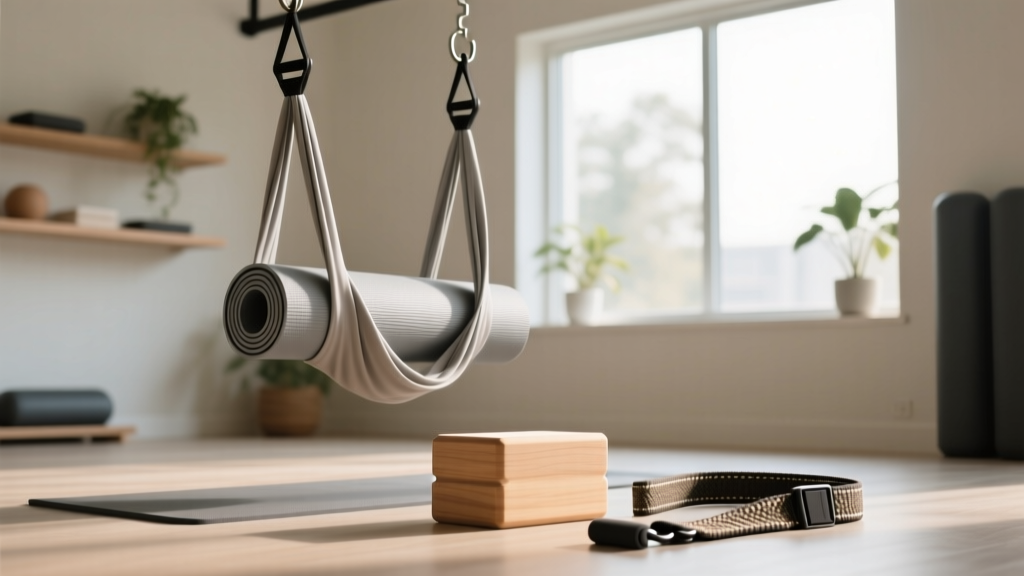
As home fitness spaces evolve in 2026, spatial efficiency has become just as important as equipment quality. For dedicated practitioners, hangable yoga mats and vertical storage ecosystems have emerged as the gold standard. Rather than stuffing rolled mats into cramped closets or leaving them unrolled to trip over, modern yogis are turning to architectural wall hooks and specialized racks. Mats designed with reinforced, heavy-duty canvas carry loops—such as the Manduka PROlite ($88) or the JadeYoga Harmony ($99)—can be suspended directly from wall-mounted bamboo hangers ($25-$40) or multi-tier steel racks like the Yamazaki Tower Rack ($65). This not only allows the mat's natural rubber or PVC materials to off-gas and dry completely after hot yoga sessions, but it also transforms your gear into a functional, minimalist display.
However, optimizing your vertical storage is only half the battle. A truly optimized home studio requires the right tactile accessories to support your physical practice once the mat is unrolled. This brings us to the most critical, yet frequently misunderstood, components of your prop arsenal. Welcome to our definitive yoga block and strap buying guide.
The Expert Yoga Block Buying Guide: Material Science and Failure Modes
Yoga blocks are not merely placeholders for inflexible hamstrings; they are essential tools for maintaining spinal alignment and distributing weight. According to alignment principles outlined by Yoga Journal, props bridge the gap between the floor and your body, preventing compensatory movements that lead to joint strain. When purchasing blocks, the material you choose dictates the prop's compressive yield, grip, and lifespan.
Cork vs. EVA Foam vs. Bamboo
The market is dominated by three primary materials, each with distinct mechanical properties and specific failure modes that buyers must understand before investing.
| Material | Avg. Price Range | Weight (per block) | Compressive Yield | Primary Failure Mode |
|---|---|---|---|---|
| Recycled Cork | $22 - $28 | 2.0 - 2.5 lbs | High (Minimal give) | Edge spalling on hard floors |
| High-Density EVA Foam | $10 - $16 | 0.3 - 0.5 lbs | Low (Compresses) | Memory compression (height loss) |
| Bamboo / Wood | $35 - $45 | 2.8 - 3.2 lbs | Zero (Rigid) | Surface slipping in high sweat |
Deep Dive: Cork Blocks. The Manduka Recycled Cork Yoga Block ($24) remains the industry benchmark. Cork provides a natural, tacky grip that actually improves with slight moisture (sweat). However, cork is brittle. If dropped repeatedly on concrete or tile, the edges will experience 'spalling' (chipping). Expert Tip: Always place cork blocks on your mat or carpeted surfaces during transitions.
Deep Dive: EVA Foam Blocks. Foam blocks, like the Gaiam Essentials 2-Pack ($12), are ideal for travel and restorative poses where you need the block to contour to your spine. However, low-density foam suffers from 'memory compression.' After 14 to 18 months of daily, weight-bearing use (such as in Half Moon pose), the foam can permanently lose up to 15% of its original height, compromising your alignment. Always look for high-density EVA foam (rated above 60 kg/m³) if you plan to bear weight on it.
Sizing Matters: Standard vs. Narrow Profiles
The standard block dimension is 4" x 6" x 9". However, practitioners with smaller hand spans (typically under 7 inches from wrist to middle finger tip) often struggle to grip the 4-inch width securely during arm balances. If this applies to you, seek out 3" x 6" x 9" narrow-profile blocks, such as the Hugger Mugger 3-inch Cork Block ($20), which drastically reduces grip fatigue and wrist strain.
Yoga Strap Buying Guide: Buckle Mechanics and Tensile Strength
While blocks provide structural support, straps act as arm extenders. The American Council on Exercise (ACE) notes that tension tools like straps increase proprioceptive feedback, allowing the nervous system to safely release muscle guarding during deep stretches. When buying a strap, the buckle mechanism and fabric weave are the only two metrics that matter.
D-Ring vs. Cinch Buckles
- Metal D-Ring (The Gold Standard): Utilizing two welded steel or aluminum rings, D-rings create a high-friction lock when the strap is folded back through them. They are virtually indestructible under human-generated tensile force. The Hugger Mugger 10ft Cotton Strap ($18) features welded steel D-rings rated for over 300 lbs of tension.
- Polycarbonate Cinch Buckles: These feature a quick-release lever and a single slot. While they allow for rapid, one-handed adjustments, they are prone to micro-slipping when subjected to high, sustained tension (such as in intense hamstring pulls). Furthermore, plastic degrades under UV light over time.
Fabric Weave and Width Specifications
Always choose 100% cotton over nylon. Nylon straps, while durable, cause severe friction burns if they slip through your hands or wrap around your foot during dynamic movements. Cotton provides a forgiving, skin-friendly grip. Regarding width, 1.5 inches is the optimal standard. Straps that are 1 inch wide will dig into your arches and cut off circulation during supine leg stretches, while 2-inch straps are too bulky to thread smoothly through standard D-rings.
Length Sizing Framework
- 6-Foot Straps: Best for practitioners under 5'4" or for targeted upper-body shoulder openers.
- 8-Foot Straps: The universal standard. Ideal for practitioners between 5'4" and 6'0" performing seated forward folds and reclining hand-to-big-toe poses.
- 10-Foot Straps: Mandatory for practitioners over 6'0", or for advanced binding poses (like Supta Baddha Konasana) where the strap must wrap around the lower back and both feet simultaneously.
Step-by-Step: Integrating Hangable Gear, Blocks, and Straps
As highlighted by the Mayo Clinic, proper use of yoga accessories reduces joint strain and makes the practice accessible across all age groups. Here is how to integrate your newly purchased gear into a cohesive wall-assisted routine:
Wall-Assisted Shoulder Flossing (Using the Mat Anchor)
Because your hangable yoga mat setup likely involves a sturdy wall rack or architectural hook, you can use this anchor point for deep tissue release.
- Loop your 8-foot cotton D-ring strap securely over the wall hook or mat rack arm.
- Stand facing away from the wall, holding one end of the strap in each hand.
- Walk forward slowly, allowing the strap to pull your arms into extension behind your torso.
- Place a 4-inch cork block horizontally between your shoulder blades to maintain thoracic extension and prevent rib-flaring.
- Hold for 90 seconds, focusing on diaphragmatic breathing.
Supine Hamstring Isolation (Using Blocks and Straps)
- Lie flat on your mat. Place a foam block flat under your sacrum to tilt the pelvis and protect the lumbar spine.
- Loop your strap around the arch of your right foot.
- Extend the leg upward. Grip the strap close to the foot to keep your elbows straight and shoulders grounded.
- If your leg cannot reach 90 degrees without your knee bending, use the strap to pull the leg only to its active edge, then engage the quadriceps to push the foot away into the strap's resistance.
Maintenance and Storage Best Practices
To maximize the lifespan of your investment, proper maintenance is non-negotiable.
- Strap Care: Wash cotton straps in a mesh laundry bag on a cold, gentle cycle. Air dry only. High heat in a dryer will shrink the cotton by up to 8%, effectively turning your 8-foot strap into a 7-foot strap and altering your biomechanical leverage.
- Block Sanitization: Never submerge cork blocks in water; they will absorb moisture and cultivate mold internally. Instead, use a lightly damp microfiber cloth with a 50/50 mix of water and witch hazel to wipe down the surfaces after heavy sweat sessions.
- Mat Hanger Integrity: If using drywall anchors for your hangable mat rack, check the mounting screws every 6 months. The constant shifting of weight as you remove and replace heavy rubber mats can slowly widen the drywall hole, leading to sudden hardware failure.
Frequently Asked Questions
Can I use a regular belt instead of a yoga strap?
While a leather belt works in a pinch for gentle stretches, it lacks the tensile flexibility of woven cotton and features a metal buckle that can scratch your hardwood floors or damage your mat. Furthermore, belts are typically only 1 to 1.25 inches wide, which will cause painful pressure points on the arches of your feet during reclining poses.
Do I need two blocks or just one?
Always purchase blocks in pairs. Bilateral symmetry is a core tenet of yoga alignment. Using a block under only one hand in poses like Triangle (Trikonasana) or Half Moon (Ardha Chandrasana) creates an artificial pelvic tilt, which can exacerbate sacroiliac (SI) joint dysfunction over time.
Are hangable yoga mats safe on all wall types?
Hangable setups require secure mounting. While heavy-duty adhesive hooks might hold a 3 lb travel mat, standard 5 lb to 8 lb PVC or natural rubber mats require drilled anchors into drywall studs or masonry. Always verify the weight rating of your wall hardware exceeds the combined weight of your mat and any wet towels draped over it.
More gear to consider
All reviews
Loop vs Tube: Budgeting Pregnancy Safe Yoga Bolsters Mats Straps

Which Medicine Ball Weight? Guide & Mat for Yoga 7 Chakras Review

Compact Pilates Layouts: Space-Saving Gear & Bala Yoga Mat Towel

Beyond the Alo Yoga Yoga Mat: Battle Rope Length & Thickness

Pull-Up Assist Band Sizing & Calia 4mm Power Grip Yoga Mat Guide
