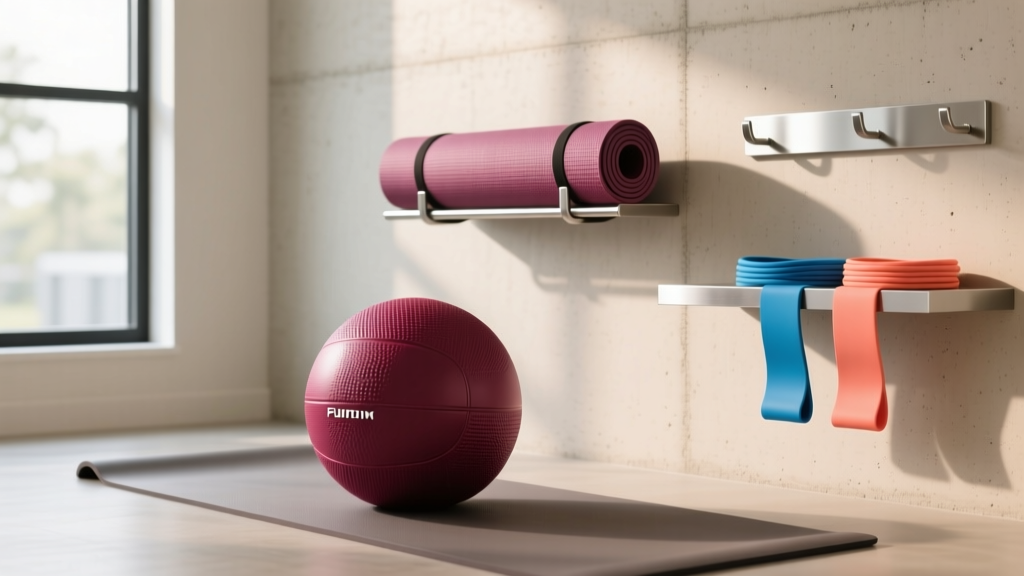
Exercise Ball Size Guide for Your DIY Yoga Mat Space
Optimize your home gym layout. Learn how to choose the right exercise ball size, match it to your DIY yoga mat space, and store it safely.

The Spatial Challenge: Merging Custom Flooring with Spherical Gear
In 2026, the home fitness paradigm has shifted heavily toward hyper-personalized, space-efficient layouts. Enthusiasts are increasingly moving away from mass-produced, single-piece mats, opting instead to build a custom diy yoga mat zone using interlocking cork tiles, natural rubber rolls, or high-density EVA foam. These custom layouts allow for perfect corner-fitting and tailored thickness. However, integrating large, spherical equipment like stability balls into these carefully planned rectangular zones creates unique spatial and storage conflicts. An exercise ball is not just a piece of gear; it is a spatial anchor that dictates traffic flow, operational clearance, and flooring preservation in your home gym.
Whether you are outfitting a 10x10 foot spare bedroom or a dedicated garage gym, understanding the intersection of your ball's diameter, your required movement clearance, and your custom mat's material limits is critical. This guide provides a comprehensive exercise ball size guide and buying tips specifically viewed through the lens of space optimization and layout design.
The Definitive Exercise Ball Size Guide
Selecting the correct stability ball diameter is strictly a function of user height and biomechanics. According to the American Council on Exercise (ACE), the golden rule of sizing is achieving a 90-degree hip-to-knee angle when seated on the ball with feet flat on the floor. However, from a layout design perspective, you must also account for the physical footprint the ball occupies when not in use, and the clearance required when it is in motion.
| User Height | Recommended Ball Diameter | Static Footprint (Approx.) | Min. Room Clearance Required |
|---|---|---|---|
| Under 5'0" | 45 cm (18 in) | 3 sq. ft. | 5 x 5 ft. |
| 5'1" - 5'8" | 55 cm (22 in) | 4.5 sq. ft. | 6 x 6 ft. |
| 5'9" - 6'2" | 65 cm (26 in) | 6 sq. ft. | 7 x 7 ft. |
| 6'3" - 6'7" | 75 cm (30 in) | 8 sq. ft. | 8 x 8 ft. |
| Over 6'8" | 85 cm (34 in) | 10 sq. ft. | 9 x 9 ft. |
Calculating the Operational Radius
The 'Min. Room Clearance' metric above is vital for space optimization. If your diy yoga mat is built into an alcove or a tight corner, a 65cm ball requires a 7x7 foot operational radius to safely perform dynamic movements like stability ball rollouts, pikes, or Russian twists without striking walls or furniture. If your custom mat zone is only 6x4 feet, you must either downsize your ball (which compromises the 90-degree biomechanical rule) or redesign your layout to allow the ball to roll off the mat onto adjacent hard flooring during dynamic exercises.
Buying Tips: Material Science and Anti-Burst Tech
When buying an exercise ball, the material composition directly impacts both safety and how the ball interacts with your home gym environment. The National Strength and Conditioning Association (NSCA) emphasizes that core stabilization tools must meet strict load-bearing thresholds, especially when used for weighted exercises or plyometrics.
⚠️ Layout Warning: The Danger of Cheap PVCUltra-cheap, thin PVC balls (often found in bulk discount bins) lack anti-burst properties. If punctured by a stray dumbbell or a sharp edge near your mat zone, they pop explosively. This not only poses a severe injury risk but can send the user crashing onto the edges of your custom flooring, potentially cracking interlocking tiles or tearing rubber mat seams.
Key Specifications to Demand in 2026
- Anti-Burst (Slow Deflate) Technology: Look for multi-layered PVC or TPE blends rated for slow deflation. If punctured, the ball should slowly leak air, allowing you to safely dismount.
- Static vs. Dynamic Weight Ratings: Premium models like the TheraBand Stability Ball or URBNFit Elite boast static weight limits of 2,000 to 2,200 lbs, and dynamic (moving) limits of 500+ lbs. Never buy a ball with a dynamic limit under 300 lbs.
- Anti-Slip Texture: For layout optimization, you want a ball with a subtle matte or ribbed finish. High-gloss balls slide unpredictably on hardwood floors adjacent to your mat zone, increasing the risk of colliding with walls or mirrors.
- Base Rings vs. No Base: Some models come with removable stabilizing base rings. While these prevent the ball from rolling away, they increase the static footprint by up to 30%, which can ruin the clean lines of a minimalist room layout.
Space Optimization: Protecting Your DIY Mat Layout
A frequently overlooked aspect of home gym design is material fatigue. Leaving a fully inflated 65cm exercise ball resting in one spot on a diy yoga mat made of EVA foam or soft cork can cause permanent compression divots. Over weeks and months, the concentrated weight and spherical pressure will warp the cellular structure of foam tiles and leave permanent depressions in natural cork.
Vertical Storage and Hammock Systems
To maintain the integrity of your custom flooring and keep your walking paths clear, vertical storage is non-negotiable for spherical gear. Consider these layout-friendly storage solutions:
- Wall-Mounted Ball Hammocks: Utilizing heavy-duty nylon mesh anchored into wall studs, these hammocks cradle the ball in unused vertical corners. They cost between $15 and $30 and completely eliminate the ball's floor footprint.
- Ceiling Hoists: For garage gyms with exposed joists, a simple pulley hoist system allows you to lift the ball to the ceiling when not in use, maximizing your usable mat space below.
- Tension Pole Bins: Floor-to-ceiling tension poles with wire mesh baskets can store the ball in room corners without requiring you to drill into drywall or damage baseboards.
Air Pressure, Temperature, and Spatial Shrinkage
An often-missed variable in spatial planning is thermal expansion. PVC exercise balls expand in warm rooms and contract in cold environments. If you inflate your ball to its maximum 65cm diameter in a 75°F living room, but your garage gym drops to 55°F in the winter, the ball can shrink by up to 2cm. This alters your biomechanical 90-degree angle and changes the operational clearance. Always inflate your ball in the actual room where it will be used, and allow the PVC to stretch and acclimate over a 24-hour period before topping off the final air pressure.
Frequently Asked Questions
Can I use an exercise ball on a textured DIY cork mat?
Yes, but with caution. Cork is highly durable and provides excellent grip, which prevents the ball from slipping during planks. However, the abrasive nature of raw cork can slowly wear down the anti-burst coating on cheaper PVC balls. If your diy yoga mat features exposed cork, opt for a ball with a thick, matte TPE exterior rather than thin PVC.
How do I measure my room for a ball if my mat is wall-to-wall?
If your custom mat covers the entire room, measure the distance from the center of the room to the nearest wall. You need at least 3.5 feet of clearance from the center point in all directions to safely perform prone rollouts with a 65cm ball without your feet or the ball striking the drywall.
Are peanut-shaped balls better for small spaces?
Peanut balls (or stability peanuts) are exceptional for space optimization. Because their elongated shape prevents them from rolling in all directions, they require significantly less lateral clearance than spherical balls. They are highly recommended for narrow galley-style home gyms or tight apartment layouts where a traditional round ball would constantly roll into furniture.
For more insights on creating the ultimate home workout environment, refer to the Mayo Clinic's fitness guidelines on safe home exercise practices and equipment maintenance. By carefully matching your exercise ball size to your physical dimensions and respecting the spatial realities of your custom flooring, you can build a safe, efficient, and highly optimized workout sanctuary.
More gear to consider
All reviews
Medicine Ball Weight Guide & Setup: Yoga Mat Clas Ohlson Test
Battle Rope Length & Thickness Guide + Yoga Mat Rack Storage

Pilates Accessories Budget: Sanitizing Yoga Mats & Gear Value

Loop Band vs Tube Band Comparison & Cloud Yoga Mat Trends 2026

How to Carry Yoga Mat and Jump Rope Gear: Troubleshooting