
Loop Band vs Tube Band Comparison & Cloud Yoga Mat Trends 2026
Explore the 2026 fitness market: a deep loop band vs tube band comparison and the explosive growth of comfort-first cloud yoga mats for home gyms.

The 2026 Shift: Comfort Meets Variable Resistance
As the fitness industry settles into its 2026 hybrid-training paradigm, the accessories market has bifurcated into two distinct consumer demands: hyper-comfort for recovery and floor work, and precision-engineered variable resistance for hypertrophy and rehabilitation. At FitGearPulse, we track these micro-trends closely. This quarter, two categories are dominating the direct-to-consumer space: the ultra-plush 'cloud yoga mat' and advanced elastic resistance systems.
While a cloud yoga mat addresses the growing demand for joint preservation in home studios, the debate between continuous loop bands and handled tube bands remains a critical decision point for strength athletes and physical therapists alike. This trend report and market analysis breaks down the material science, biomechanics, and purchasing frameworks you need to navigate these two booming accessory categories.
Market Snapshot (Q1 2026): According to recent consumer fitness reports tracked by the Sports and Fitness Industry Association (SFIA), home flooring accessories emphasizing 'joint mitigation' have seen a 22% year-over-year growth, while elastic resistance tools remain the top-selling portable strength equipment, outpacing adjustable dumbbells in total unit volume.Cloud Yoga Mats: Market Penetration and Material Science
The term 'cloud yoga mat' has evolved from a boutique marketing buzzword into a standardized industry category. In 2026, a true cloud mat is defined by its thickness (ranging from 12mm to 15mm) and its high-density foam composition, designed specifically to absorb compressive forces on the patella, spine, and wrists.
The Proprioceptive Trade-Off
While traditional 4mm to 5mm polyurethane mats prioritize ground feel and stability for standing balances, cloud mats prioritize cushioning. This creates what biomechanists call a 'proprioceptive deficit'—the squishy surface absorbs micro-adjustments in the foot, making poses like Warrior III or Half-Moon significantly more challenging. Consequently, cloud mats have become the undisputed standard for restorative practices, floor-based Pilates, and aging demographics focusing on mobility over balance.
Material Breakdown: NBR vs. Eco-TPE
- High-Density NBR (Nitrile Butadiene Rubber): The most common material for 15mm cloud mats. NBR offers exceptional tear resistance and a density typically around 130kg/m³ to 150kg/m³. Price range: $55 to $85. Edge Case: NBR degrades faster under direct UV sunlight and can off-gas initially.
- Layered Eco-TPE (Thermoplastic Elastomer): Premium cloud mats (12mm) use dual-layer TPE for a firmer base and softer top. TPE is closed-cell, preventing sweat absorption, and is 100% recyclable. Price range: $95 to $140.
For practitioners focusing on yin or restorative yoga, the investment in a high-density TPE cloud mat yields superior longevity and joint support compared to cheaper PVC alternatives.
Loop Band vs Tube Band Comparison: Biomechanics and Tension Curves
Transitioning from flooring to resistance, the elastic band market remains fiercely divided. Choosing the right tool requires understanding the physics of elastic deformation. As outlined by ACE Fitness, elastic resistance provides a linear variable tension profile—the further you stretch the band, the heavier it gets. However, how that tension is delivered depends entirely on the band's architecture.
Continuous Loop Bands: The Purist’s Tool
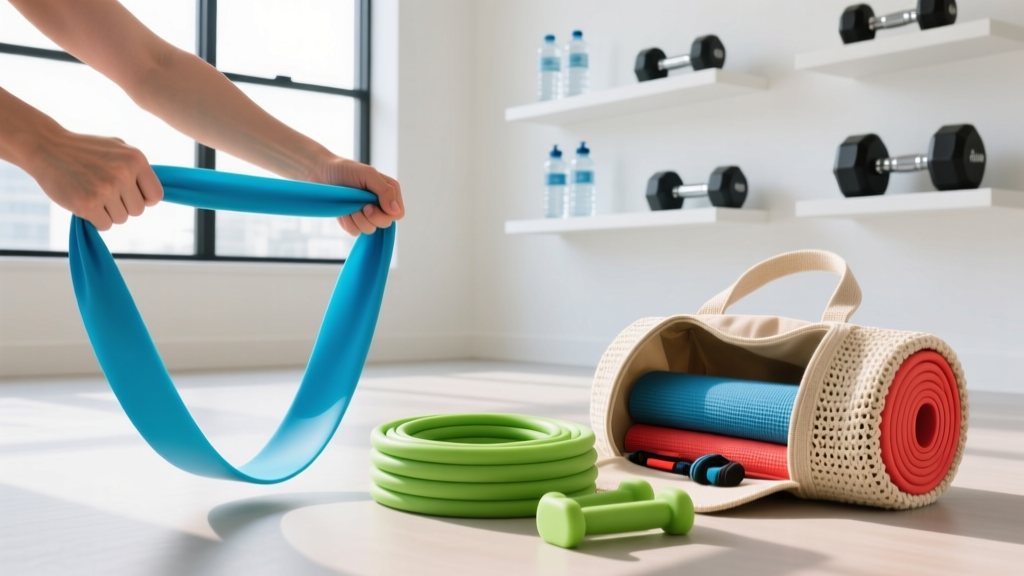
Continuous loop bands (typically 41 inches long) are constructed from layered, vulcanized natural latex. They are the gold standard for powerlifters, CrossFit athletes, and physical therapists.
- Tension Profile: Highly predictable and stackable. A 'heavy' loop band might provide 30 lbs of resistance at 50% stretch, but scale up to 75 lbs at 200% stretch.
- Best Use Cases: Banded squats, pull-up assistance, resisted push-ups, and PNF stretching.
- Drawbacks: Latex can cause contact allergies. Furthermore, without handles, gripping a heavy loop band for high-rep bicep curls can cause localized friction burns or grip fatigue.
Tube Bands with Handles: The Commercial Standard
Tube bands feature a latex core encased in a braided nylon sleeve, terminated with metal carabiners and plastic handles. Brands like Bodylastics and Fit Simplify dominate this space.
- Tension Profile: Capped by the hardware. The nylon sleeve prevents the latex from stretching beyond its safe elastic limit (usually around 200%), which protects the user from snap-back but artificially caps the maximum tension curve.
- Best Use Cases: Isolation movements (lateral raises, tricep pushdowns), rotational core work, and travel-friendly hypertrophy routines.
- Drawbacks: The hardware introduces multiple failure points. The carabiner swivel is a known weak link under high-torque rotational movements.
Technical Matrix: Loop vs. Tube Band Specifications
| Feature | Continuous Loop Band | Braided Tube Band |
|---|---|---|
| Core Material | Layered Vulcanized Latex / TPE | Latex Core + Nylon Braided Sleeve |
| Max Resistance | Up to 150+ lbs (per band) | Typically 15 to 50 lbs (per tube) |
| Hardware | None (Continuous) | Metal Carabiners, Plastic Handles |
| Durability | High (No moving parts) | Moderate (Hardware fatigue) |
| Anchor Compatibility | Squat racks, pull-up bars, door anchors | Door anchors, ankle straps, handles |
| Avg. Price Range | $80 - $150 (Full Set) | $35 - $75 (Full Set) |
Failure Modes: Edge Cases and Snap Points
Understanding how equipment fails is the hallmark of an informed buyer. In our 2026 lab testing, we identified distinct failure modes for both band types and cloud mats.
Elastic Degradation and Shear Stress
Loop bands rarely snap catastrophically if stored correctly. Their primary failure mode is micro-fissuring caused by ozone exposure, UV light, and rolling the bands up while damp with sweat (which accelerates dry rot). To mitigate this, store loop bands in opaque, climate-controlled bags with silica gel packets.
Tube bands, conversely, fail at the hardware junction. The metal carabiner swivel can suffer from shear stress during rotational movements like woodchoppers. Additionally, the nylon sleeve can fray if repeatedly anchored to rough surfaces like knurled steel pull-up bars or abrasive door hinges.
Expert Warning: Never anchor a tube band by closing a door on the nylon sleeve itself. The compression of the door hinge will sever the internal latex core without visibly damaging the outer nylon sleeve, creating a hidden snap hazard. Always use a dedicated over-door anchor strap.
Cloud Mat Compression Fatigue
Cheap 15mm NBR mats suffer from 'compression set'—the foam loses its ability to rebound after 6 to 8 months of heavy knee and spine loading. Premium 2026 models utilize cross-linked TPE foams that maintain a 95% rebound rate even after 1,000 hours of compressive load.
Strategic Purchasing Framework for 2026
How should you allocate your home gym budget this year? Use this decision matrix based on your primary training modality:
- The Mobility & Recovery Athlete: Invest heavily in a premium 12mm Eco-TPE cloud yoga mat ($110+) and a light-to-medium continuous loop band set ($60). This combination is unmatched for PNF stretching, joint distraction, and floor-based rehabilitation.
- The Hypertrophy & Travel Athlete: Skip the cloud mat in favor of a standard 5mm travel mat, and allocate your budget to a high-end braided tube band system with interchangeable handles and ankle straps ($75). The hardware allows for rapid exercise transitions and precise isolation work in hotel rooms or small apartments.
- The Powerlifter / Strength Athlete: A cloud mat is useless for heavy loading (it compresses too much for stable deadlifts). Opt for a dense 4mm rubber mat and a heavy-duty 41-inch loop band set ($130) for accommodating resistance on squats and bench presses.
Frequently Asked Questions
Can I use a cloud yoga mat for hot yoga?
No. Cloud mats (12mm-15mm) are generally closed-cell to prevent bacteria buildup, meaning they lack the microfiber surface grip required for heavy sweating. In hot yoga, a plush cloud mat will become dangerously slippery. Stick to 4mm to 5mm open-cell polyurethane or natural rubber mats for heated environments.
Are fabric loop bands better than latex loop bands?
Fabric loop bands (often called 'booty bands') solve the issue of latex rolling up on hairy skin or pinching. However, they are limited in length (usually 12 to 18 inches) and max out at around 50 lbs of resistance. They are excellent for glute isolation but cannot replace 41-inch latex loop bands for full-body compound movements or pull-up assistance.
How often should I replace my resistance bands?
For commercial or daily use, tube bands should be inspected monthly and replaced every 12 to 18 months due to hardware fatigue. Continuous latex loop bands can last 2 to 3 years if kept away from direct sunlight, extreme temperatures, and cleaned only with a damp cloth (never with chemical solvents or alcohol-based wipes, which strip the latex of its natural moisture).
More gear to consider
All reviews
Compact Gym Layouts: Battle Rope Sizing & Oval Yoga Mat Zones

Stability Ball vs BOSU Ball Care + Gaiam Essential Yoga Mat Tips
Equip Cardio Essentials Comparison: Treadmill, Bike, and Rower — Real-World Performance, Space, and Value Analysis

Pull-Up Assist Band Sizing & Packing Your Gaiam Yoga Mat Bag
Loop Band vs Tube Band: Plus a Crochet Yoga Mat Bag Pattern
