Medicine Ball Weight Selection & Yoga Mat Hanger Storage Guide
Master medicine ball weight selection with our troubleshooting guide. Avoid sizing mistakes and optimize home gym space with smart yoga mat hanger storage.

The Biomechanics of Ballistic Loading: Why Weight Selection is Critical
Medicine ball training remains a cornerstone of rotational power, core stiffness, and explosive triple extension in 2026. However, walk into any commercial facility or home gym, and you will frequently see athletes struggling with loads that either destroy their kinetic chain or fail to elicit a neuromuscular adaptation. The primary failure mode in ballistic training is prioritizing mass over velocity. According to the National Strength and Conditioning Association (NSCA), peak power output during rotational throws is achieved when the implement allows for maximum angular velocity without compromising spinal neutrality.
Choosing the correct medicine ball weight is not about ego; it is about matching the implement to the specific energy system and movement pattern you are targeting. Equally important is how you store this equipment. While a wall-mounted yoga mat hanger is perfect for organizing your PVC mats, resistance bands, and Pilates rings, attempting to store heavy, dense rubber slam balls on lightweight organizers is a recipe for drywall destruction and equipment degradation. This troubleshooting guide will help you diagnose your current medicine ball arsenal and optimize your home gym storage safely.
⚠️ Safety Warning: Never store medicine balls on standard wire racks or hang them from hooks designed for lightweight accessories. A standard yoga mat hanger is typically rated for 15–20 lbs of distributed, static weight (like rolled TPE mats). Dropping or hanging a 30-lb dynamic slam ball on these fixtures will cause catastrophic anchor failure.5 Common Medicine Ball Weight Selection Mistakes
Troubleshooting your training starts with identifying where your load selection is failing your biomechanics. Here are the most common errors we see in the field:
1. Going Too Heavy for Rotational Power
The Mistake: Using a 20-lb wall ball for Russian twists or rotational throws against a wall. The Failure Mode: When the load exceeds roughly 10% of your body weight during high-velocity transverse plane movements, your body compensates by initiating the movement from the lumbar spine rather than the hips and thoracic spine. This leads to severe lumbar shear force and a drastic drop in rotational velocity. The Fix: Drop to a 4-lb to 8-lb soft-shell medicine ball (e.g., Dynamax Soft Shell 14", $115–$145) to prioritize speed and hip separation.
2. Using "Dead" Slam Balls for Rebound Work
The Mistake: Buying a sand-filled, no-bounce slam ball and attempting to use it for continuous chest-pass rebounds. The Failure Mode: Slam balls are engineered with Kevlar-reinforced, sand-filled interiors to absorb kinetic energy upon impact. Using them for rebound work forces your muscles to generate 100% of the concentric force from a dead stop on every rep, altering the stretch-shortening cycle (SSC) and increasing shoulder impingement risk. The Fix: Use a rubber, air-filled medicine ball (e.g., Rogue Echo Medicine Ball, $75–$115) that offers a predictable, lively bounce for plyometric rebound drills.
3. Ignoring the Diameter-to-Weight Ratio
The Mistake: Selecting a ball based solely on the printed weight, ignoring the physical dimensions. The Failure Mode: A compact, high-density 15-lb slam ball might only be 9 inches in diameter. During overhead slams, this small surface area creates intense grip fatigue and alters the wrist angle at the point of release, reducing power transfer. The Fix: For overhead slams and wall balls, stick to standard 14-inch diameter balls regardless of the weight, ensuring your hands can properly cradle the implement.
4. Ego-Lifting on Overhead Slams
The Mistake: Selecting a 50-lb slam ball to maximize "muscle burn." The Failure Mode: The athlete loses triple extension (ankles, knees, hips). Instead of an explosive, full-body whip, the movement devolves into a slow, grinding triceps and lat pulldown. You lose the plyometric benefit entirely. The Fix: Film your set in slow motion. If your hips do not fully extend before the downward acceleration phase, the ball is too heavy. Drop the weight by 30%.
5. Poor Storage Leading to Equipment Degradation
The Mistake: Stacking heavy slam balls on top of soft-shell wall balls, or hanging loop bands and heavy gear on a flimsy yoga mat hanger. The Failure Mode: Soft-shell balls will warp and lose their spherical symmetry if stored under heavy point-loads. Furthermore, overloading a yoga mat hanger with heavy resistance bands and kettlebells will rip the drywall anchors out. The Fix: Invest in a dedicated steel vertical medicine ball rack (e.g., Rogue Medicine Ball Rack, ~$125). Reserve your heavy-duty yoga mat hanger strictly for its intended purpose: keeping your yoga mats, foam rollers, and lightweight resistance bands uncreased and untangled.
The 2026 Medicine Ball Weight Matrix
Use this diagnostic table to select the correct implement based on your specific training goal and experience level. Prices reflect current 2026 market averages for premium commercial-grade gear.
| Exercise Type | Beginner Weight | Advanced Weight | Required Ball Type | Top Model Example & Price |
|---|---|---|---|---|
| Overhead Power Slams | 10 - 15 lbs | 20 - 30 lbs | Dead-Bounce Slam Ball (Sand/Rubber) | TRX HexGrip Slam ($49 - $89) |
| Rotational Throws | 4 - 6 lbs | 8 - 12 lbs | Soft-Shell Wall Ball (14" Diameter) | Dynamax Soft Shell ($115 - $145) |
| Chest Pass Rebounds | 6 - 8 lbs | 10 - 15 lbs | High-Bounce Rubber Ball | Rogue Echo Med Ball ($75 - $115) |
| Core / V-Ups | 8 - 10 lbs | 15 - 20 lbs | Textured Grip Rubber / Slam Ball | REP Fitness Sand Med Ball ($45 - $75) |
Troubleshooting Your Current Arsenal: A Diagnostic Flow
Not sure if the ball currently sitting in your gym is the right weight? Run it through this quick diagnostic checklist recommended by strength and conditioning professionals.
- The Velocity Test: Perform 5 consecutive rotational throws against a wall. If the 5th throw travels less than 80% of the distance of your 1st throw, your central nervous system is fatiguing too quickly. Diagnosis: The ball is too heavy for power work.
- The Posture Test: Record a video of your overhead slams from a lateral angle. Draw an imaginary line from your hips to your shoulders at the apex of the throw. If your spine is excessively arched or your ribs are flared to compensate for the load, your core cannot stabilize the weight. Diagnosis: Drop down one weight tier.
- The Grip Test: If you find yourself constantly readjusting your grip mid-throw, or if your forearms burn out before your lats and core, the ball's surface texture or diameter is incorrect for your hand size. Diagnosis: Switch to a ball with a wider diameter or a textured HexGrip surface.
Optimizing Home Gym Storage: The Yoga Mat Hanger & Beyond
Proper equipment storage is a critical, yet often overlooked, component of gym safety and equipment longevity. As the American Council on Exercise (ACE) notes, maintaining a clear, organized training space reduces trip hazards and mental friction before a workout.
Organizing the "Bands, Balls & Accessories" Category
- Medicine & Slam Balls: Store on the floor in a vertical, tiered steel rack. Never stack soft-shell balls under heavy rubber balls, as the foam interior will permanently compress and warp.
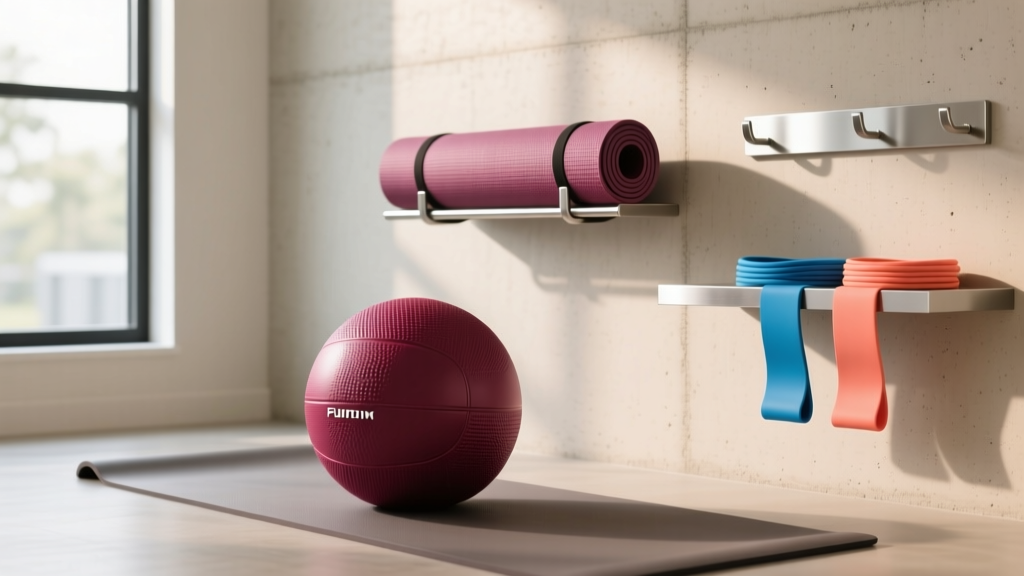
- Yoga Mats & Pilates Gear: This is where a high-quality, stud-mounted yoga mat hanger shines. By hanging your mats vertically, you prevent the permanent creases and edge-curling that occur when mats are rolled tightly for long periods. Use the secondary hooks on the hanger for lightweight loop bands and jump ropes.
- Resistance Bands: Do not leave heavy tube bands stretched or hanging in direct sunlight, as UV exposure degrades the latex. Store them in a breathable canvas bin or draped over the wide, padded hooks of your yoga mat hanger to prevent micro-tears at the carabiner attachment points.
"The right implement should feel like an extension of your body, not an anchor dragging down your kinetic chain. If you are training for speed, respect the physics of the force-velocity curve. If you are training for tissue conditioning, respect the structural limits of your storage equipment."
Final Verdict
Mastering medicine ball weight selection requires abandoning the "heavier is better" mentality in favor of biomechanical precision. By matching the ball's mass, diameter, and bounce profile to your specific training goal, you will unlock new tiers of rotational power and explosive output. Pair this intelligent load selection with a meticulously organized home gym—utilizing heavy-duty steel racks for your ballistic tools and a dedicated yoga mat hanger for your recovery and mobility accessories—and you will create a training environment that is as safe and efficient as it is effective.
More gear to consider
All reviews
Yoga Mats Shark Tank Investors Would Fund: 2026 Guide
Loop vs Tube Band Longevity: How Thick Is a Standard Yoga Mat?

Medicine Ball Weight Selection Guide & Bala Yoga Mat Scrunchie

Stability Ball vs BOSU Ball: 2026 Trends & Lululemon Yoga Mat Carrier

Exercise Ball Size Guide & Budget: Pendleton Stylish Yoga Mat Value