
Medicine Ball Weight Guide & Setup: Yoga Mat Clas Ohlson Test
Master medicine ball weight selection and home gym setup. We test the Clas Ohlson yoga mat for impact protection and guide your functional training zone.

The Ultimate Medicine Ball Weight Selection Guide & Home Gym Setup
Building a functional training zone in your garage or spare room requires more than just buying a heavy sphere and throwing it at the floor. A proper setup demands a precise understanding of biomechanical loading, spatial awareness, and impact mitigation. In this complete setup and installation walkthrough, we will break down the exact parameters for choosing the right medicine ball weight for your specific physiological goals, and then transition into the physical installation of your training space—including a critical stress test of budget flooring options like the popular yoga mat Clas Ohlson retails for under $20.
2026 Setup Alert: As of 2026, supply chain stabilizations have made premium 3/4-inch vulcanized rubber mats more affordable than ever. Do not compromise your subfloor or your joints by skipping the proper impact layer.Phase 1: The Biomechanics of Medicine Ball Weight Selection
Selecting the correct weight is not about ego; it is about the velocity-force curve. According to the National Strength and Conditioning Association (NSCA), the primary goal of medicine ball training is to develop explosive power (rate of force development). If the ball is too heavy, the movement becomes a slow, grinding strength exercise rather than a plyometric power movement. If it is too light, you fail to recruit high-threshold motor units.
Categorizing the Equipment
Before selecting a weight, you must match the ball type to the intended surface and movement pattern:
- Slam Balls (No-Bounce): Constructed with a thick, sand- or gel-filled vulcanized rubber shell. Designed for high-velocity downward force. (e.g., Rogue Echo Slam Ball, priced around $45-$115 depending on weight).
- Wall Balls (Soft-Shell Bounce): Feature a padded PVC or leather exterior with a minimal bounce. Used for squat-to-throw mechanics against reinforced walls. (e.g., Dynamax Pro Wall Ball, typically $110-$160).
- Traditional Medicine Balls (Bounce): Rubber shells with a predictable rebound. Used for chest passes, rotational throws, and reactive catching drills.
Weight Selection Matrix
The American Council on Exercise (ACE) recommends selecting a weight that allows for maximum speed without compromising the structural integrity of the movement pattern. Below is the definitive weight selection matrix for 2026 functional training protocols:
| Training Goal | Recommended Weight | Ideal Ball Type | Rep Range & Tempo |
|---|---|---|---|
| Max Power (Slams) | 10% - 15% of Bodyweight | Dead-Bounce Slam Ball | 3-5 sets of 4-6 reps (Max Velocity) |
| Core Rotational Power | 4% - 8% of Bodyweight | Bounce Med Ball / Wall Ball | 3 sets of 8-10 reps per side |
| Muscular Endurance / MetCon | 15% - 20% of Bodyweight | Soft-Shell Wall Ball | AMRAP or 15+ rep conditioning sets |
| Rehab / Rotator Cuff Prep | 2 lbs - 6 lbs (Fixed) | Small PVC / Gel Grip Ball | 2 sets of 15-20 slow eccentrics |
Expert Insight: Never use a traditional bouncy rubber medicine ball for overhead slams. The kinetic energy transfer upon impact with concrete or hardwood can cause the ball to rebound directly into your face or shatter nearby drywall. Always verify the Shore A hardness rating of your equipment before high-velocity use.
Phase 2: Flooring Setup & The Clas Ohlson Mat Reality Check
Once you have selected your 20lb or 30lb slam ball, you must address the impact zone. Many European and budget-conscious home gym builders start by searching for a yoga mat Clas Ohlson stocks in its wellness and home goods aisles, hoping it will suffice for functional training. Let us break down the material science of why this is a critical failure point.
The Budget Mat Stress Test
The standard yoga mat Clas Ohlson typically retails is constructed from TPE (Thermoplastic Elastomer) or basic PVC, measuring roughly 6mm thick with a density of about 1.2 kg/m³. While excellent for static stretching and yoga asanas, TPE lacks the compressive strength to handle dynamic point-loads. When a 20lb slam ball is dropped from a 7-foot apex, it generates hundreds of pounds of instantaneous force upon impact.
- Failure Mode 1 (Compression Set): The TPE foam will permanently compress within 3 to 5 heavy slam sessions, leaving a cratered impact zone that offers zero acoustic or structural dampening.
- Failure Mode 2 (Tear Propagation): The aggressive knurling or grip texture on a Rogue or Titan slam ball will act like sandpaper against the soft TPE, tearing the mat within weeks.
- Failure Mode 3 (Subfloor Damage): Because the 6mm mat absorbs almost no kinetic energy, the remaining force transfers directly into your concrete slab or wooden joists, risking micro-fractures in concrete or nail-pops in hardwood.
The 2026 Standard: Vulcanized Rubber
To properly install a medicine ball training zone, you must use 3/4-inch (19mm) vulcanized rubber horse stall mats. These mats feature a Shore A hardness rating of 60+, meaning they deflect the kinetic energy laterally rather than compressing vertically. As of 2026, a standard 4x6 foot rubber mat costs between $55 and $85 at agricultural supply stores—a mandatory investment for any serious setup.
Phase 3: Step-by-Step Installation Walkthrough
Follow this precise installation protocol to build a safe, durable, and acoustically treated medicine ball zone.
- Define the Strike Zone: Measure an 8x8 foot minimum clearance area. Ensure there are no overhead obstructions (light fixtures, ceiling fans, or exposed HVAC ducts) within a 9-foot vertical radius. According to ExRx.net exercise mechanics, full overhead extension requires at least 1.5 times your height in vertical clearance.
- Subfloor Preparation: Sweep and vacuum the concrete or wood subfloor. Any trapped gravel or debris will act as a fulcrum under the heavy rubber mats, causing them to crack or shift during use.
- Acoustic Dampening Layer (Optional but Recommended): If you are building on a second floor or have shared walls, lay down a 5mm cork underlayment beneath the rubber mats. This decouples the floor and reduces low-frequency impact noise by up to 40%.
- Mat Placement & Seam Sealing: Lay your 3/4-inch vulcanized rubber mats flat. They will naturally expand and contract with temperature changes. To prevent the mats from separating when a heavy ball strikes the seam, use 3-inch wide, heavy-duty HVAC aluminum foil tape (not standard duct tape) on the underside of the seams.
- Wall Protection: If you are incorporating wall balls or rotational throws, install 3/4-inch plywood backing on the drywall, covered by a layer of high-density EVA foam puzzle tiles. Never throw a 20lb medicine ball directly into standard 1/2-inch drywall; it will punch through to the studs.
Phase 4: Maintenance & Safety Protocols
Equipment degradation is a silent hazard in home gyms. Inspect your slam balls monthly for "weeping"—a phenomenon where the internal sand or gel matrix begins to leak through micro-fissures in the rubber shell. If you notice black dust accumulating on your new rubber mats after every workout, the ball's outer shell is delaminating and must be retired immediately to prevent a catastrophic mid-air rupture.
Furthermore, clean your vulcanized rubber flooring with a pH-neutral cleaner. Avoid bleach or ammonia-based products, as these will dry out the rubber compounds, leading to premature brittleness and edge-crumbling.
Frequently Asked Questions (FAQ)
Can I use a wall ball for floor slams?
No. Wall balls are filled with cotton batting or polypropylene fiber designed to absorb impact against a wall. Slamming them into the floor will destroy their internal structure, causing them to become lopsided and lose their spherical integrity within a dozen reps.
Is the yoga mat Clas Ohlson sells useful for anything in this setup?
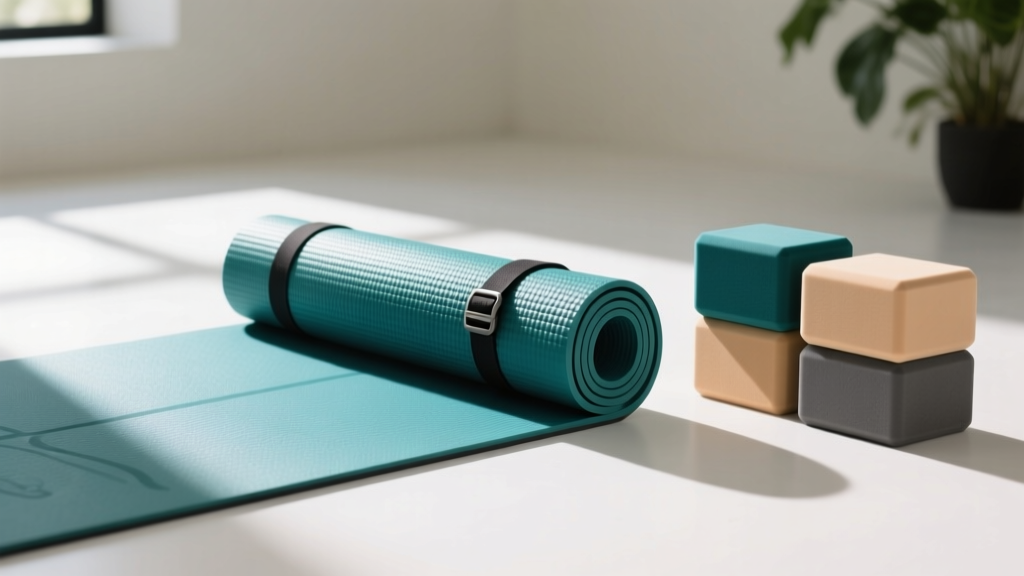
Yes, but strictly for the cool-down zone. Keep the budget TPE mat rolled up and deploy it outside the 8x8 rubber strike zone for post-workout mobility work, stretching, or core floor exercises where impact dampening is not required.
How do I know if my ceiling is high enough for overhead slams?
Stand barefoot, reach your arms fully overhead, and add the diameter of your medicine ball (usually 14 to 18 inches). You need a minimum of 12 inches of clearance above that highest point to safely accelerate the ball without clipping the ceiling drywall.
More gear to consider
All reviews
Resistance Band Set Levels vs Red Light Yoga Mat: 2026 Guide

2026 Pilates Equipment Accessories Guide & Yoga Mat Spray Trends

Yoga Block & Strap Guide: Space Layouts & Yoga Mat Sling Bag Storage

2026 Gear Trends: Gym Bag Yoga Mat Holder & Exercise Ball Size Guide
Nautilus Yoga Mat With Strap vs Custom Block Kits: 2026 Value Guide
